

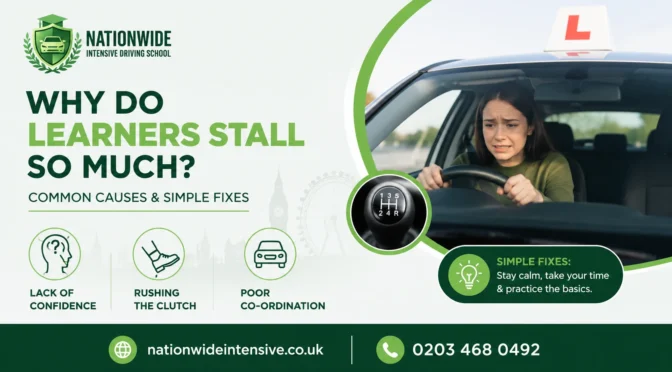
If you keep stalling during your driving lessons, don’t worry,it’s one of the most common challenges for learner drivers, especially when learning in a manual car. In my experience as a driving instructor, stalling usually happens because of clutch control, rushing to move off, or feeling nervous rather than a lack of driving ability. The good news is that once you understand why it’s happening, it’s usually one of the easiest driving habits to fix.
If you’ve ever stalled the car at a busy junction or when the traffic lights turned green, you’re definitely not the only one.
I’ve taught hundreds of learner drivers over the years, and almost every one of them has apologised after stalling.
Some even say,
“I don’t think I’ll ever get the hang of this.”
The funny thing is, a few weeks later, those same learners are moving off smoothly without even thinking about it.
Stalling isn’t a sign that you’re a bad driver. It’s simply part of learning how to control a manual car. Like every driving skill, it becomes easier with practice, confidence and the right guidance.
Let’s look at why learners stall so often and, more importantly, how you can stop it from happening.
Why Does a Car Stall?
A car stalls when the engine doesn’t receive enough power to keep running.
For learner drivers, this usually happens because the clutch is released too quickly before the engine has enough power to move the vehicle.
Although it can feel embarrassing, it’s completely normal and something every experienced driver has dealt with at some point.
The important thing is understanding why it happens so you can avoid repeating the same mistake.
1. Releasing the Clutch Too Quickly
This is by far the most common reason learners stall.
Many new drivers lift the clutch too fast because they’re eager to move away, especially when other vehicles are waiting behind them.
Instead, focus on finding the biting point.
Once you feel the car gently wanting to move forward, pause briefly before releasing the clutch fully.
In my experience, slowing this one movement down often solves most stalling problems within a couple of lessons.
2. You’re Feeling Rushed by Other Drivers
Pressure from traffic can make even confident learners panic.
You stop at a junction.
The lights change.
A car behind you starts creeping forward.
Suddenly you’re trying to move off too quickly,and the engine stalls.
Remember this:
Other drivers would rather wait a few extra seconds than see you make an unsafe decision.
Take your time, follow your Mirror-Signal-Manoeuvre (MSM) routine and move away safely instead of rushing because of pressure from other road users.
3. You’re Not Using Enough Accelerator
Another common mistake is trying to move off without giving the engine enough power.
Every car is slightly different.
Some require a little more acceleration than others before releasing the clutch.
During Driving Lessons The Wrythe, your instructor will help you understand how your training vehicle responds so moving off becomes much smoother and more consistent.
With practice, you’ll begin to recognise the sound and feel of the engine without consciously thinking about it.
4. You’re Looking at the Pedals Instead of the Road
Many learners instinctively glance down at their feet while finding the biting point.
This creates two problems:
- You lose awareness of what’s happening around you.
- It increases your anxiety because you’re trying to do too many things at once.
Trust your feet.
Clutch control develops through muscle memory, not by watching the pedals.
The more you practise, the more natural it becomes.
5. Test Nerves and Driving Anxiety
Something I often notice is that learners stall more during mock driving tests than during normal lessons.
Why?
Because nerves affect timing and coordination.
You start overthinking every movement:
“Is the clutch high enough?”
“Am I giving enough gas?”
“What if I stall again?”
Ironically, worrying about stalling often makes it more likely to happen.
Confidence grows through repetition, and that’s why regular driving practice is so important.
6. You’re Learning in a Manual Car
Here’s something worth remembering.
If you’re taking manual driving lessons, learning clutch control is simply part of the process.
Unlike automatic cars, manual vehicles require you to coordinate:
- Clutch
- Accelerator
- Brake
- Gear changes
That’s a lot to manage when you’re still learning road awareness, observations and hazard perception.
Be patient with yourself,it gets easier.
7. You’re Not Practising Moving Off Enough
Many learners spend lots of time practising roundabouts and parking but don’t spend enough time mastering simple moving-off exercises.
One exercise I often recommend is practising:
- Moving off and stopping
- Hill starts
- Pulling over safely
- Moving away from the kerb
Repeating these basic skills builds confidence much faster than only practising long drives.
Could an Intensive Driving Course Help?
If you’re struggling with clutch control after weeks of lessons, it may not be because you’re incapable, it could simply be because there’s too much time between sessions.
An Intensive Driving Course The Wrythe gives you the chance to practise every day instead of once a week.
Many learners find this helps build muscle memory much faster because yesterday’s lesson is still fresh in their mind.
For learners who want to improve quickly before their practical driving test, this approach can make a noticeable difference.
How to Stop Stalling More Often
If stalling is affecting your confidence, try these simple tips:
- Slow down when releasing the clutch.
- Learn to recognise the biting point.
- Use gentle acceleration before moving off.
- Don’t rush because of traffic behind you.
- Practise hill starts regularly.
- Stay calm if the car stalls,it happens to everyone.
- Remember that smooth driving comes with repetition, not perfection.
Most learners are surprised by how quickly this habit improves once they stop worrying about it.
Frequently Asked Questions
Is it normal to stall during driving lessons?
Yes. Stalling is one of the most common issues learner drivers experience, especially during manual driving lessons. It becomes much less frequent as your clutch control improves.
How long does it take to stop stalling?
Every learner is different, but many drivers become much more confident after consistent practice over several lessons. Regular driving and repetition are key.
Do people fail their driving test because of stalling?
Not necessarily. A single stall doesn’t automatically mean you’ll fail your practical driving test. What matters is how safely and calmly you deal with the situation afterwards.
Are automatic driving lessons easier?
Many learners find automatic cars easier because there is no clutch pedal or manual gear changes. This allows you to focus more on road awareness and observations.
Can an intensive driving course improve clutch control?
Yes. Many learners improve more quickly during intensive courses because they practise clutch control every day, helping build confidence and muscle memory faster.
Final Thoughts
If you keep stalling during your driving lessons, don’t let it knock your confidence.
From my experience teaching learner drivers, stalling is simply one of those milestones that almost everyone goes through. Once you understand how the clutch, accelerator and biting point work together, smooth moving-offs become second nature.
If you’re looking for professional Driving Lessons The Wrythe, Nationwide Intensive LTD. is working with experienced instructors can help you build confidence and improve your clutch control step by step. And if you’d like to make faster progress, an Intensive Driving Course The Wrythe can give you the consistent practice needed to develop strong driving habits in a shorter period.
Whether you’re considering regular lessons, an intensive course, or deciding between automatic driving lessons and manual driving lessons, remember that every confident driver once stalled exactly where you are now. The difference is they kept practising,and you will too.
