
All posts by admin

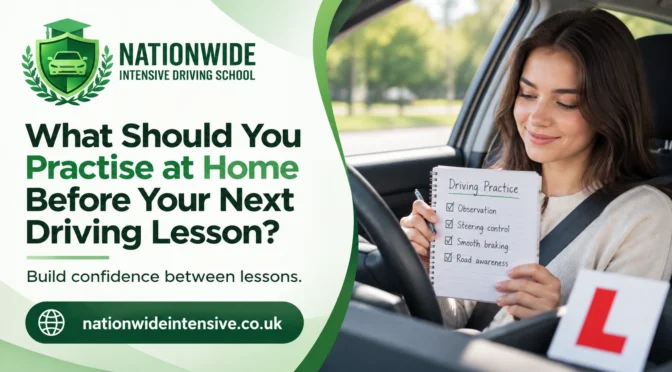
What Should You Practise at Home Before Your Next Driving Lesson?

Before your next driving lesson, practise the things that don’t require you to be behind the wheel. Review road signs, mentally rehearse routines such as moving off and junctions, study common hazards, revisit your instructor’s feedback and plan what you want to improve next time. A little preparation at home can make your actual lesson more focused and productive.

You don’t have to be sitting in the driver’s seat to practise driving.

In fact, some of the best preparation happens when the car is parked and you’ve got a cup of tea in your hand.

When learners come back to a lesson after several days, they sometimes say:

“I’ve forgotten everything we did last time.”

Usually, they haven’t.

They just haven’t thought about it since.

As a driving instructor, one of the simplest things I’d recommend is spending 10–20 minutes between lessons thinking about what you’ve already learned.

It doesn’t need to feel like homework.

You simply want to keep the information fresh in your mind.

1. Go Over Your Last Instructor Feedback

Start here.

Think about the last lesson and ask:

What did I do well?

What did I struggle with?

What did my instructor tell me to improve?

Maybe you were told to:

  • Check mirrors earlier.
  • Approach junctions more slowly.
  • Improve clutch control.
  • Look further ahead.
  • Position better at roundabouts.
  • Keep a safer following distance.
  • Make decisions earlier.

Pick one or two points.

Trying to remember every piece of feedback at once can make your next lesson feel overwhelming.

If you’re taking Driving Lessons Pollards Hill, keeping a simple note of your main improvement points can help you and your instructor focus your next session.

2. Revise UK Road Signs

Road signs are something you can easily practise at home.

Look through common UK signs and make sure you understand what they mean.

Pay particular attention to signs relating to:

  • Speed limits
  • Give Way
  • Stop
  • No Entry
  • One-way roads
  • Roundabouts
  • Pedestrian crossings
  • Parking restrictions
  • Bus lanes
  • Warning hazards

Don’t just memorise the picture.

Ask yourself:

“If I saw this sign while driving, what would I need to do differently?”

That’s a much more useful way to learn.

3. Practise Hazard Awareness

You can also improve your hazard perception without driving.

Watch a road scene and identify potential hazards.

For example:

A parked van: Could someone step out?

A cyclist: Could they move around an obstruction?

A pedestrian near the kerb: Might they cross?

A junction ahead: Could another vehicle emerge?

You’re training yourself to think ahead rather than simply react when something happens.

This type of hazard awareness is extremely useful when you’re learning to drive.

4. Mentally Rehearse Your Driving Routine

This might sound strange at first, but mental rehearsal can be useful.

Imagine yourself sitting in the driver’s seat.

Picture:

Starting the engine → checking your surroundings → moving off → checking mirrors → approaching a junction → adjusting speed → observing → making a safe decision.

You don’t need to sit there for an hour doing this.

A few minutes is enough.

The purpose isn’t to memorise a rigid script.

It’s to become familiar with the sequence of actions so you’re less likely to feel overwhelmed during the actual lesson.

5. Study the Roads Around You

If you regularly have Driving Lessons Pollards Hill, pay attention to the roads you travel on as a passenger.

Look at:

  • Lane markings
  • Junction layouts
  • Traffic lights
  • Pedestrian crossings
  • Bus stops
  • Roundabouts
  • Speed-limit signs
  • Road markings
  • Parking restrictions

Ask yourself:

“If I were driving here, what would I need to watch for?”

This turns an ordinary journey into a useful observation exercise.

Of course, don’t distract the driver you’re travelling with. Your attention should remain on being a passenger.

6. Use Maps to Plan Routes

Before your next lesson, you can look at the general area where you’ll be driving.

You don’t need to memorise the route.

Instead, identify the types of roads you might encounter.

For example:

  • Residential streets
  • Busy main roads
  • Multi-lane roads
  • Roundabouts
  • Narrow roads
  • Junctions
  • Areas with parked vehicles

This can reduce the surprise factor when you encounter them during a lesson.

Remember, though: your instructor may deliberately choose a different route based on your ability and the skills you’re practising.

7. Practise Explaining What You Would Do

Here’s a simple exercise.

Imagine you’re approaching a junction.

Talk yourself through the situation:

“I’d check my mirrors.”

“I’d reduce my speed.”

“I’d look for signs and road markings.”

“I’d check for traffic and pedestrians.”

“I’d decide whether it’s safe to proceed.”

You’re practising decision-making, not pretending you’re actually driving.

This can be particularly useful if you tend to freeze when your instructor asks:

“What are you thinking?”

8. Review Your Weakest Skill

Don’t spend all your preparation time practising things you’re already good at.

If you consistently struggle with roundabouts, revise roundabout rules.

If junctions cause problems, think about approach speed and observation.

If you struggle with parking, mentally review the reference points your instructor has taught you.

The aim is simple:

Turn your weakest area into your next practice target.

9. Don’t Try to Teach Yourself Everything

This is important.

The internet is full of driving advice, but not every technique you find online will be appropriate for your particular situation.

Your instructor can see how you actually drive and explain what needs changing.

So use online resources and revision materials to support your lessons—not to replace professional instruction.

If you’re unsure about something you’ve read, ask your instructor at the next lesson.

10. Can You Practise Actual Driving at Home?

Only if you have access to a suitable vehicle, an appropriately qualified and experienced supervising driver, and the correct insurance and legal requirements are met.

Never practise on private or public roads simply because you think an area is quiet.

If you are practising legally with a supervisor, follow their instructions and your instructor’s guidance.

Otherwise, there is plenty you can do without moving the car at all.

What About Learners Taking an Intensive Course?

The same preparation can be particularly useful during an Intensive Driving Course Pollards Hill.

With lessons closer together, you have less time between sessions.

That means reviewing what you learned immediately after each lesson can help keep important information fresh.

For example:

Lesson 1: Junctions

At home: Review junction observations and signs

Lesson 2: Roundabouts

At home: Revisit positioning and priorities

Lesson 3: Independent driving

At home: Think about planning and following directions

This creates a continuous learning cycle rather than treating every lesson as a separate event.

What About Manual and Automatic Learners?

Your at-home preparation can be useful regardless of the car you’re learning in.

With manual driving lessons, you may want to mentally review clutch control, gear selection and moving-off routines.

With automatic driving lessons, you can focus more heavily on observation, speed control, road positioning, junctions and hazard awareness.

The exact areas you need to practise will depend on your current ability.

A Simple 15-Minute At-Home Routine

If you don’t know where to start, try this before your next lesson:

5 minutes: Review your instructor’s last feedback.

5 minutes: Revise road signs or hazard awareness.

5 minutes: Mentally rehearse the skill you’re currently learning.

That’s it.

You don’t need to turn learning to drive into a second full-time job.

Consistency matters more than spending hours studying.

Frequently Asked Questions

Can I practise driving skills without a car?

Yes. You can revise road signs, study hazards, mentally rehearse driving routines and review your instructor’s feedback without physically driving.

How long should I practise at home?

Even 10–20 minutes can be useful. Short, regular preparation is generally more practical than trying to study for hours.

Should I practise driving with a family member?

You can only do so legally if you meet the relevant UK learner-driver requirements, including appropriate supervision and insurance. If you’re unsure, check the current rules before driving.

What should I revise before my next lesson?

Focus on what your instructor identified as your weakest area. This could be junctions, roundabouts, clutch control, mirror checks, road positioning or hazard awareness.

Can home practice help with an intensive driving course?

Yes. Reviewing each lesson while it’s still fresh can help you maintain continuity during concentrated training.

Should I memorise every driving routine?

No. You want to understand what you’re doing and why, rather than blindly memorising a sequence that may not apply to every road situation.
Can Too Many Driving Lessons in One Day Affect Your Progress?

Yes, having too many driving lessons in one day can sometimes affect your progress, especially if you’re becoming mentally tired or struggling to concentrate. Intensive driving can be very effective when the sessions are planned properly, with breaks and enough time to absorb what you’ve learned. More hours behind the wheel don’t automatically mean faster progress.

Ever finished a driving lesson and thought:

“I genuinely can’t remember what I was doing for the last 20 minutes.”

It happens.

Driving requires a surprising amount of concentration when you’re learning. You’re watching the road, checking mirrors, managing the car, reading signs, anticipating other road users and listening to your instructor, all at the same time.

So it’s understandable to wonder whether doing several hours of lessons in one day is actually helping.

As an experienced driving instructor, I’d say the answer is:

It depends on how those hours are structured.

An intensive schedule can be excellent for some learners. But squeezing too much driving into one day without proper breaks can leave you mentally exhausted and make the later part of the session less productive.

Why Can Long Driving Sessions Become Difficult?

When you’re learning, driving isn’t automatic yet.

A qualified driver might approach a junction almost without thinking about every individual step.

A learner is different.

You’re consciously processing:

  • Mirrors
  • Signals
  • Speed
  • Gear selection
  • Clutch control
  • Pedestrians
  • Cyclists
  • Road signs
  • Junctions
  • Other vehicles

That’s a lot of information.

After several hours, your concentration can naturally drop.

You might start making mistakes you weren’t making earlier, not because you’ve forgotten how to drive, but because your brain is tired.

Does More Practice Always Mean Faster Learning?

Not necessarily.

There’s a difference between productive practice and simply spending more time in the driver’s seat.

Imagine you’ve been struggling with roundabouts.

The first hour might be useful because you’re actively practising observation, lane positioning and decision-making.

But if you’re exhausted after several more hours, you may start repeating the same mistakes without properly processing the feedback.

At that point, another hour isn’t necessarily giving you another hour of useful learning.

Quality matters.

How Long Should a Driving Lesson Be?

There’s no single lesson length that’s perfect for every learner.

Some people cope well with longer sessions.

Others learn better with shorter blocks and regular breaks.

Your instructor should consider your:

  • Experience
  • Concentration
  • Confidence
  • Learning speed
  • Physical comfort
  • Current driving ability

For Driving Lessons Broad Green, your lesson schedule should be built around how effectively you’re learning, not simply how many hours can be fitted into a day.

What Happens When You’re Mentally Tired?

Fatigue can show up in subtle ways.

You may notice that you’re:

  • Missing road signs.
  • Forgetting mirror checks.
  • Taking longer to make decisions.
  • Making basic clutch-control mistakes.
  • Struggling to remember feedback.
  • Becoming frustrated more easily.
  • Losing concentration in busy traffic.

These signs shouldn’t automatically be interpreted as a lack of ability.

Sometimes, you simply need a break.

Why Breaks Matter During Intensive Training

Breaks aren’t wasted time.

They give you an opportunity to reset and process what you’ve just practised.

For example, after working on busy junctions, you might stop for a short break before moving onto another skill.

When you return to the car, you may find that the previous technique feels clearer.

That’s one reason a properly structured Intensive Driving Course Broad Green shouldn’t simply mean driving continuously for as many hours as possible.

The schedule should allow enough time for concentration and recovery.

What Does a Good Intensive Lesson Schedule Look Like?

A useful intensive programme normally has some variation.

You might spend one session working heavily on:

Vehicle control → Junctions → Roundabouts

Then later work on:

Independent driving → Dual carriageways → Test-style routes

This prevents every hour from feeling like the same task.

It also gives your instructor an opportunity to identify whether you’ve genuinely improved or whether you’re simply becoming familiar with one particular route.

What If You Start Making More Mistakes?

Don’t immediately assume your progress has gone backwards.

Ask yourself:

Am I tired?

Have I been driving for several hours?

Have I been concentrating continuously?

If the answer is yes, fatigue could be affecting your performance.

Tell your instructor.

A good instructor should be able to recognise when a learner is becoming overloaded and adjust the session accordingly.

Sometimes the smartest decision is to take a break rather than push through.

Can Intensive Courses Still Be Effective?

Absolutely.

The issue isn’t necessarily the word “intensive”.

It’s how the training is delivered.

Concentrated driving can be helpful because you’re not leaving long gaps between lessons.

For example, if you practise a particular skill today and revisit it again tomorrow, the previous lesson is still relatively fresh in your mind.

That continuity can be valuable.

However, intensive training should still have a sensible pace.

Should Beginners Avoid Long Lessons?

Not necessarily.

A beginner may actually benefit from longer sessions because there is enough time to settle into the car and practise several related skills.

But the instructor needs to monitor concentration.

If the learner is becoming overwhelmed, continuing simply because another hour has been booked may not be productive.

This is particularly important for learners who are nervous or have limited previous driving experience.

What About Automatic Driving Lessons?

Some learners find longer sessions easier in an automatic because they don’t have to coordinate clutch control and manual gear changes.

That can reduce some of the mental workload.

With automatic driving lessons, you can concentrate more heavily on:

  • Traffic
  • Observation
  • Road positioning
  • Speed control
  • Hazards
  • Junctions

However, automatic doesn’t eliminate mental fatigue.

You still need sustained concentration to drive safely.

And Manual Driving?

With manual driving lessons, you’re managing additional tasks such as:

  • Clutch control
  • Gear selection
  • Moving off
  • Gear changes
  • Hill starts

These can require significant concentration when you’re still learning.

As your control improves, these actions become more natural.

The important thing is not to compare your learning pace with somebody else’s.

How Can You Get More From Every Lesson?

Try these simple habits:

Set One or Two Clear Goals

Don’t try to perfect everything in one session.

Focus on specific weaknesses.

Listen to Feedback

If your instructor repeatedly mentions the same issue, make a conscious effort to work on it.

Take Breaks Seriously

If you’re mentally exhausted, a short break can be more useful than forcing yourself through another difficult section.

Reflect After the Lesson

Spend a few minutes thinking about:

What improved?

What still feels difficult?

What should I practise next?

This makes your next lesson more focused. Contact Nationwide Intensive LTD. to know more.

Frequently Asked Questions

Can too many driving lessons in one day be bad?

They can be less productive if they cause significant mental fatigue. The key is to balance practice with breaks and concentration.

Is intensive driving better than weekly lessons?

It depends on the learner. Intensive training provides more frequent practice, while weekly lessons may suit people who prefer a slower learning pace.

How do I know if I’m too tired to continue driving?

If you’re repeatedly making basic mistakes, struggling to concentrate or feeling mentally overwhelmed, tell your instructor. They can decide whether a break or change of activity is appropriate.

Are long driving lessons useful?

They can be, particularly when structured properly. Longer sessions give you more time to practise, but they should include suitable breaks when needed.

Can automatic lessons reduce mental workload?

For some learners, yes. Removing clutch and manual gear changes can allow more attention to be placed on traffic, observation and road positioning.

Can I make progress during an intensive driving course?

Yes. Concentrated practice can provide continuity and repeated opportunities to develop driving skills. However, progress depends on the learner, the quality of instruction and how the training is structured.

What Should You Know Before Booking an Intensive Driving Course for the First Time?

Before booking an intensive driving course, check whether you’re ready for concentrated learning, understand what’s included in the course, choose the right lesson format and make sure your instructor can tailor the training to your current ability. An intensive course isn’t a shortcut to learning without practice, it simply puts your driving lessons closer together so you can build skills and confidence more consistently. 

If you’ve never booked an intensive driving course before, it’s easy to assume it’s simply a normal driving course squeezed into a few days. Nationwide Intensive LTD. can always help you with that.

It’s a little more complicated than that.

The idea is straightforward: instead of having one lesson every week, you have several sessions over a shorter period.

But whether it’s the right choice for you depends on your current driving ability, availability, confidence and test readiness.

Having helped learners prepare for their practical tests, one thing I’d always recommend is going into an intensive course with realistic expectations.

You don’t need to be perfect before you start.

But you should know what you’re signing up for.

What Exactly Is an Intensive Driving Course?

An intensive driving course involves taking driving lessons more frequently over a relatively short period.

For some learners, this might involve several hours of training across a week or more. The exact structure varies between driving schools and depends on your experience and requirements.

The main advantage is continuity.

Instead of spending a week forgetting what you worked on in your previous lesson, you can build on the same skills more regularly.

This can be particularly helpful for learners who want to prepare for their driving test within a specific timeframe.

Are Intensive Courses Suitable for Complete Beginners?

They can be, but it depends on the learner and the course structure.

Someone who has never sat behind the wheel before may need time to develop basic vehicle control before progressing to more complicated traffic situations.

Other learners may already have:

  • Previous driving lessons
  • Good clutch control
  • Experience with junctions
  • Basic road awareness
  • Experience driving with family or friends

In that situation, concentrated lessons may allow them to progress more quickly.

Before booking Driving Lessons Selhurst, be honest about your current experience. Your instructor can then recommend a sensible training plan.

Don’t Assume “Intensive” Means “Instant”

This is probably the biggest misconception.

An intensive driving course doesn’t magically turn someone into a test-ready driver in a few days.

You still need to learn:

  • Vehicle control
  • Mirror routines
  • Junctions
  • Roundabouts
  • Speed management
  • Hazard awareness
  • Parking
  • Independent driving
  • Appropriate road positioning

You also need enough experience to make safe decisions without constant instructor prompts.

The benefit of intensive training is frequency and continuity, not a shortcut around learning.

Check What’s Actually Included

Before paying for a course, find out exactly what you’re getting.

Ask about:

Lesson duration: Are sessions one hour, two hours or longer?

Total training time: How many hours of tuition are included?

Car hire: Is the vehicle provided for the practical test?

Test booking: Does the school help arrange your test?

Test-day lesson: Is there a warm-up session before the test?

Instructor: Will you have the same instructor throughout?

Cancellation policy: What happens if a lesson has to be rearranged?

These details can vary considerably, so don’t judge a course purely by its headline price.

Think About Your Driving Test Date

An intensive course often works best when your training has a clear target.

If you’ve already passed your theory test, having a practical test date can give the course a specific goal.

However, don’t choose an unrealistically early test simply because you want to finish quickly.

Your instructor should assess your driving and tell you honestly whether you’re progressing towards test standard.

Sometimes the right answer is:

“You need a little more practice first.”

That’s not failure.

It’s good training advice.

What If You’ve Already Had Driving Lessons?

This is where an intensive course can be particularly useful.

Perhaps you’ve had lessons for months but feel like your progress has stalled.

Or you’ve taken long breaks between lessons.

Or you’ve changed instructors and need to rebuild your confidence.

Concentrated training can help identify exactly where you’re struggling.

For example, you might discover that your:

  • Observation is good, but your speed control isn’t.
  • Vehicle control is fine, but junction decisions are weak.
  • Roundabouts are comfortable, but independent driving causes problems.

Instead of vaguely trying to “get better at driving”, you can focus on specific weaknesses.

Manual or Automatic?

Another important decision is whether you want to learn in a manual or automatic vehicle.

With automatic driving lessons, you don’t need to operate a clutch or manually select gears. This can reduce the workload for some learners and allow them to concentrate more heavily on traffic, observation and road positioning.

With manual driving lessons, you’ll learn clutch control, gear changes and the additional coordination required to drive a manual car.

Neither option is automatically better.

Think about the type of car you want to drive after passing your test.

Don’t Ignore Your Confidence Level

Intensive learning can be demanding.

You’re concentrating for much longer than you might during an occasional weekly lesson.

If you’re already nervous about driving, discuss this with your instructor.

A good training plan should challenge you without throwing you into situations you’re not ready to handle.

During Driving Lessons Selhurst, your instructor can gradually increase the difficulty as your skills improve.

What Makes a Good Intensive Driving Course?

Look for a course where the training is individualised, rather than treating every learner exactly the same.

A good instructor should consider:

  • Your previous experience
  • Your strengths
  • Your weak areas
  • Your confidence
  • Your preferred learning pace
  • Your practical test requirements

The course should have a clear progression rather than simply filling hours with driving.

Is an Intensive Driving Course Worth It?

For the right learner, it can be.

An Intensive Driving Course Selhurst may suit you if you:

  • Want more concentrated practice.
  • Have a practical test approaching.
  • Already have some driving experience.
  • Find weekly lessons too spread out.
  • Need to rebuild skills after a break.
  • Want to focus heavily on specific weaknesses.

But if you’re completely new to driving or extremely nervous, you may benefit from building your skills gradually before moving into intensive training.

There isn’t one correct route for everyone.

Questions to Ask Before Booking

Before committing to a course, ask the driving school:

  1. How many hours of tuition are recommended for my current ability?
  2. Will I have the same instructor?
  3. What happens if I need additional lessons?
  4. Is the practical test included?
  5. Is the car available for the test?
  6. Can the course be adapted if I progress faster or slower than expected?
  7. Do you offer manual and automatic training?
  8. What happens if my instructor doesn’t believe I’m ready for the test?

Getting clear answers beforehand can prevent unpleasant surprises later.

Frequently Asked Questions

Is an intensive driving course good for beginners?

It can be, but beginners may need a longer period to develop basic vehicle control and road awareness. An instructor should assess your ability and recommend an appropriate training schedule.

How many hours do I need for an intensive driving course?

There is no fixed number that suits everyone. Your required hours depend on your previous experience, learning speed, confidence and current driving standard.

Can I take an intensive course after having normal weekly lessons?

Yes. In fact, learners with previous experience can sometimes benefit from intensive training because they already understand many basic driving skills.

Does an intensive course guarantee a driving test pass?

No. Passing depends on your ability to drive safely and meet the required standard on the day of your practical test.

Should I choose manual or automatic lessons?

Choose based on the type of car you want to drive and which learning approach suits you. Automatic training can reduce the workload of clutch and gear control, while manual training gives you the ability to drive both manual and automatic cars once you pass in a manual.

Can I take extra lessons after an intensive course?

Usually, additional training can be arranged if your instructor identifies areas that still need improvement. Ask about this before booking.

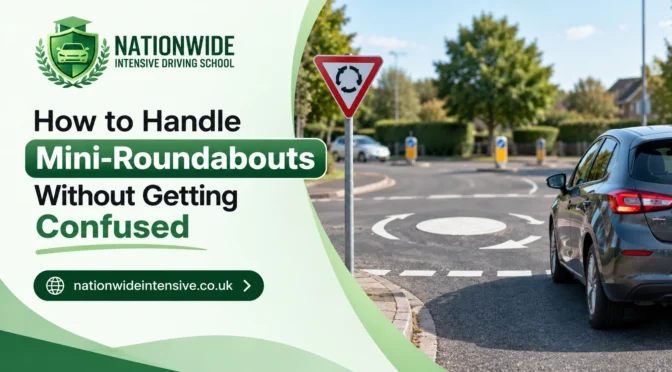
How to Handle Mini-Roundabouts Without Getting Confused

The easiest way to handle a mini-roundabout is to slow down early, observe all approaches, give priority to traffic coming from your right, choose the correct exit and steer smoothly around the central marking. Don’t treat every mini-roundabout like a large roundabout. They’re smaller and often give you less time to react, so good observation and a controlled approach are especially important.

Mini-roundabouts can be surprisingly stressful.

They’re tiny.

They look simple.

And yet, when you’re learning, they can suddenly feel like someone has dropped a complicated puzzle in the middle of the road.

You approach one and your brain starts firing questions:

“Which way is that car going?”

“Do I need to signal?”

“Who has priority?”

“Am I supposed to go around the middle?”

“What if they go first?”

Take a breath.

Mini-roundabouts aren’t as complicated as they initially appear. Once you understand the basic routine, most of the confusion disappears.

I’ve helped plenty of learners get comfortable with them, and the biggest improvement usually comes from slowing down and observing earlier, rather than trying to memorise lots of rules.

What Is a Mini-Roundabout?

A mini-roundabout is a roundabout with a much smaller central island or marking.

You’ll often find them on residential roads and at smaller junctions where a full-size roundabout isn’t practical.

Because they’re compact, vehicles may be closer together and you may have less time to make decisions.

That’s why observation and approach speed matter so much.

Who Has Priority at a Mini-Roundabout?

The basic rule is the same as at other UK roundabouts:

Give priority to traffic approaching from your right, unless signs, markings or the road layout tell you otherwise.

Don’t simply look directly to your right once and then go.

Keep observing.

Traffic can approach quickly, and another vehicle may be hidden by parked cars, buildings or other obstructions.

This is one of the first things I’d practise with a learner during Driving Lessons Waddon.

Slow Down Before You Reach It

A common mistake is approaching a mini-roundabout too quickly.

Because it’s small, learners sometimes think:

“I’ll just deal with it when I get there.”

That’s exactly what you don’t want.

Reduce your speed early enough to give yourself time to:

  • Read the road.
  • Check for signs.
  • Observe approaching vehicles.
  • Identify your exit.
  • Decide whether you need to stop.

You may not need to stop at every mini-roundabout.

But you should approach at a speed that allows you to stop if necessary.

Look Right, But Don’t Forget Left

Priority is generally given to traffic from your right, but that doesn’t mean you should ignore everything else.

Before entering, take in the whole situation.

Look for:

  • Vehicles approaching from the right.
  • Vehicles already on the roundabout.
  • Cyclists.
  • Motorcycles.
  • Pedestrians.
  • Vehicles approaching from other directions.
  • Road signs and markings.

A mini-roundabout can become busy very quickly.

Your eyes should keep moving rather than locking onto one vehicle.

Know Where You’re Going Before You Enter

Another reason learners get confused is not knowing which exit they’re taking.

Before reaching the roundabout, identify your destination.

Are you going:

Left? Straight ahead? Right?

Once you’ve established that, your positioning and signalling become easier to understand.

Don’t wait until you’re already on the roundabout to decide.

Good driving involves planning before the junction.

What About Signalling?

Signalling depends on the direction you’re taking and what would benefit other road users.

As a general guide, you would normally signal left when taking the first exit and signal right when taking a later exit to the right, cancelling the signal as appropriate and indicating left when leaving.

For going straight ahead, signalling practice depends on the road layout and exits.

Your instructor should teach you how to apply the signalling rules to the specific roundabouts you’re practising.

The important point is this:

Don’t signal automatically without considering what information you’re giving other road users.

Don’t Rush Because Someone Is Waiting

This happens all the time.

You’re approaching the mini-roundabout.

A car is waiting.

You think:

“They’re waiting for me, so I need to go.”

Not necessarily.

Priority and safety still matter.

Don’t allow another driver’s position or impatience to make the decision for you.

Take the time you need to assess the situation.

If it’s safe and appropriate to proceed, go.

If not, wait.

What If Two Cars Arrive Together?

This is where things can feel confusing.

Don’t get into a battle of wills.

Instead, look carefully at the road layout, priority and intentions of the other driver.

If another vehicle has priority, allow it to proceed.

If the situation is unclear, don’t force your way through simply because you’re technically allowed to continue.

Good driving involves co-operation as well as knowing the rules. Nationwide Intensive LTD. can help you with that.

Keep Your Steering Smooth

Because mini-roundabouts are compact, learners sometimes make a very sharp steering movement.

Try to keep your steering controlled.

Approach at an appropriate speed and follow the road around the roundabout.

Don’t mount the central island or marking unless the size and layout of the mini-roundabout specifically require a vehicle to do so and your instructor has explained how to negotiate it safely.

Your instructor can show you the appropriate technique for different mini-roundabout layouts.

What If You Miss Your Exit?

Don’t panic.

If you’ve accidentally gone past the exit you intended to take, don’t suddenly cut across another vehicle.

Continue safely and find another route.

Getting lost for a minute is not a driving disaster.

Making a sudden lane change or unsafe turn because you missed an exit is much more serious.

This is an important mindset to develop before your practical test:

Safety comes before getting the route exactly right.

Practise Different Mini-Roundabouts

Not every mini-roundabout feels the same.

Some are:

  • Open and easy to see.
  • Surrounded by parked cars.
  • Located on busy residential roads.
  • Close to pedestrian crossings.
  • Positioned near schools.
  • Used by buses and cyclists.
  • Tight and difficult to see around.

That’s why practising just one repeatedly isn’t enough.

During Driving Lessons Waddon, ask your instructor to take you through different layouts.

You’ll gradually learn to recognise what information matters.

Can an Intensive Driving Course Help With Mini-Roundabouts?

If mini-roundabouts are one of your weak areas, concentrated practice can be particularly useful.

An Intensive Driving Course Waddon gives you more frequent opportunities to work on the same skill rather than waiting several days between lessons.

You can practise mini-roundabouts alongside:

  • Junctions
  • Large roundabouts
  • Lane discipline
  • Mirror checks
  • Speed control
  • Hazard awareness
  • Independent driving
  • Forward planning

The repetition can help turn a confusing process into something much more familiar.

Automatic or Manual: Does It Matter?

The roundabout rules don’t change because you’re driving an automatic.

However, some learners find automatic driving lessons less mentally demanding because they don’t need to coordinate clutch control and gear changes while making their observations.

With manual driving lessons, you’ll need to manage clutch and gear selection alongside steering, observation and traffic awareness.

If you’re nervous, talk to your instructor about which option best suits your circumstances.

A Simple Mini-Roundabout Routine

If you need something easy to remember, try this:

Approach → Slow → Observe → Decide → Signal → Go → Exit

Don’t turn this into a rigid checklist that distracts you from the road.

Use it as a mental framework.

The real skill is learning to read the situation.

Frequently Asked Questions

What is the main rule at a mini-roundabout?

Generally, give priority to traffic approaching from your right, unless signs, road markings or the specific layout indicate otherwise.

Do I always have to stop at a mini-roundabout?

No. You should approach at a suitable speed and stop if necessary to give priority or deal with a hazard. If the roundabout is clear and it’s safe to proceed, you may not need to stop.

Do you signal at a mini-roundabout?

Use signals where appropriate to communicate your intentions to other road users. The direction you’re taking and the road layout determine the appropriate signalling.

Why do I get confused at mini-roundabouts?

They’re small, traffic can be close together and decisions often need to be made quickly. Nervousness and approaching too fast can make the situation feel even more complicated.

Can I practise mini-roundabouts during an intensive course?

Yes. An intensive course can provide concentrated practice across different junctions and roundabouts, helping you develop observation and decision-making skills.

What should I do if I take the wrong exit?

Don’t make a sudden correction. Continue safely and follow the road until you can safely change direction or find another route.

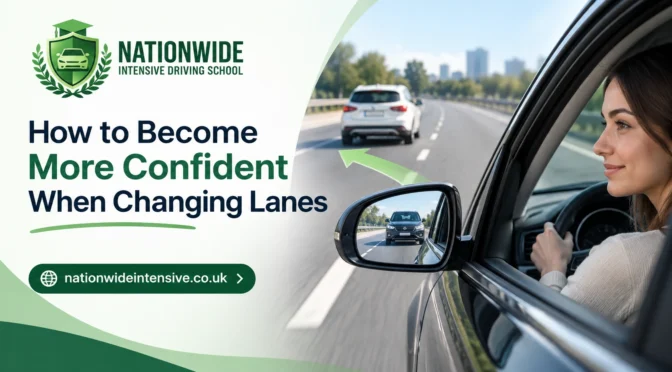
How to Become More Confident When Changing Lanes

To become more confident when changing lanes, build a consistent routine: check your mirrors, assess the blind spot, signal when appropriate, choose a safe gap and move across smoothly. Don’t rush because another driver is behind you. Confidence comes from practising lane changes in different traffic conditions until your observations and decisions become automatic.

Changing lanes can feel surprisingly stressful when you’re learning to drive.

You’re cruising along and suddenly realise you need to move over.

You check one mirror.

Then the other.

“Is there a car there?”

“Is that vehicle getting closer?”

“Should I signal now?”

“What if I move over and they’re already there?”

Before you know it, you’ve missed your opportunity and decide to stay in the lane.

If this sounds familiar, you’re certainly not alone.

As an experienced driving instructor, I’ve seen many learners become nervous about lane changes. Usually, the problem isn’t that they can’t physically move the car into another lane. It’s that they’re trying to process too much information at once.

The solution is to develop a simple, repeatable routine.

Why Do Learners Find Lane Changes Difficult?

Changing lanes requires you to consider several things simultaneously:

  • Your current speed
  • The traffic ahead
  • Vehicles behind
  • Your mirrors
  • Your blind spot
  • The gap in the next lane
  • Your signal
  • Your road position

That’s a lot to think about when you’re still developing your driving skills.

With experience, these checks become much more natural.

During Driving Lessons Kenley, your instructor can help you break the process down until you no longer have to consciously think about every individual step.

1. Look Ahead Before You Need to Change Lanes

One of the biggest mistakes learners make is waiting until the last possible moment.

Suppose you’re approaching a junction or roundabout where you know you’ll need to move into another lane.

Don’t wait until you’re almost there.

Look at the road signs and markings early.

Ask yourself:

“Which lane will I need?”

Once you know, you have more time to find a suitable opportunity.

Good lane changing starts with forward planning.

2. Use a Consistent Mirror Routine

You don’t need to stare at your mirrors for ages.

You need to know what information they give you.

Before changing lanes, check the relevant mirrors so you understand:

  • What’s directly behind you.
  • What’s approaching in the next lane.
  • How quickly another vehicle is travelling.

Your instructor may teach you a specific mirror routine depending on the situation.

The important thing is consistency.

3. Check the Blind Spot

Mirrors don’t show you everything.

A vehicle, cyclist or motorcycle can be positioned where you can’t see it properly in your mirrors.

That’s why a final blind-spot check can be important before moving across.

Don’t turn your head for so long that you lose awareness of what’s happening ahead.

A quick, controlled check is usually enough to confirm whether the space beside you is clear.

4. Don’t Treat the Signal as Permission to Move

This is a really important distinction.

Your signal tells other road users what you intend to do.

It doesn’t automatically give you priority.

Think:

Mirrors → Blind spot → Signal → Safe gap → Move

The exact order can vary depending on the situation, so follow your instructor’s guidance.

The key point is that you should never assume it’s safe simply because you’ve indicated.

5. Judge the Speed of Other Vehicles

A common learner mistake is looking at a vehicle in the next lane and thinking:

“There’s plenty of space.”

But how quickly is that vehicle approaching?

A vehicle that’s several car lengths away but travelling significantly faster may reach you very quickly.

Don’t judge a gap by distance alone.

Consider:

Distance + speed + available time.

With more experience, you’ll become much better at recognising whether a gap is suitable.

6. Don’t Wait for a Perfect Gap

Some nervous learners wait for the next lane to become completely empty.

In normal traffic, that’s unrealistic.

You’re looking for a safe and suitable gap, not an empty road.

If the opportunity isn’t suitable, wait.

If a safe opportunity appears, make a confident decision rather than repeatedly checking until the gap disappears.

Your instructor can help you practise this judgement during your Driving Lessons Kenley.

7. Move Smoothly Once You’ve Decided

One of the worst things you can do after deciding to change lanes is suddenly changing your mind halfway through.

If you’ve completed your observations, identified a safe gap and decided to move, make the manoeuvre smoothly and progressively.

Avoid:

  • Sudden steering
  • Harsh acceleration
  • Abrupt braking
  • Drifting between lanes

Your lane change should be controlled and predictable.

8. Don’t Let Other Drivers Rush You

This is especially important for nervous learners.

You might indicate and notice a car behind you.

Suddenly, you feel pressured.

Don’t rush.

Another driver’s speed doesn’t change whether the gap is safe.

If you need to wait, wait.

If someone is driving aggressively behind you, stay focused on your own observations and don’t make a dangerous lane change simply to get out of their way.

9. Practise on Different Roads

Lane changes can feel very different depending on where you’re driving.

Practise with your instructor on:

  • Multi-lane urban roads
  • Dual carriageways
  • Busy junctions
  • Roundabouts
  • Roads with lane markings
  • Roads where lanes merge
  • Heavier traffic

The more situations you experience, the easier it becomes to recognise what you need to do.

10. Learn to Plan Lane Changes Early

Good drivers aren’t constantly making last-second decisions.

They’re looking ahead.

If you see a sign telling you that your lane will turn into a right-turn lane, start planning.

If you’re approaching a roundabout, check the road signs and lane markings.

If your lane is ending, don’t wait until the final few metres.

Early planning gives you more options.

This is one of the most valuable habits you can develop before your practical driving test.

Can an Intensive Driving Course Improve Lane-Change Confidence?

It can be particularly useful if you understand the basics but lack real-world confidence.

An Intensive Driving Course Kenley gives you more concentrated time behind the wheel, allowing you to practise lane changes repeatedly in different traffic situations.

You can work on:

  • Mirror checks
  • Blind-spot awareness
  • Signalling
  • Lane positioning
  • Gap judgement
  • Dual carriageway driving
  • Roundabouts
  • Independent driving
  • Forward planning

Because the practice is more concentrated, you can often identify patterns in your driving and work on them consistently. 

What If You’re Still Nervous About Changing Lanes?

Don’t try to eliminate the nerves overnight.

Instead, focus on making your process reliable.

Ask yourself:

Have I checked the mirrors?

Have I assessed the gap?

Have I checked the blind spot where appropriate?

Is the move safe?

Can I move smoothly?

If the answer is yes, trust your decision.

Confidence isn’t about never feeling nervous.

It’s about knowing what to do when you feel nervous.

Does Learning in an Automatic Car Make Lane Changes Easier?

For some learners, it can.

With an automatic car, you don’t need to coordinate clutch control and manual gear changes while changing lanes.

That can leave more attention available for:

  • Mirrors
  • Traffic
  • Road signs
  • Blind spots
  • Lane positioning
  • Gap judgement

However, manual driving lessons can also provide excellent preparation if you want to learn full clutch and gear control.

The best option depends on your circumstances and what type of vehicle you plan to drive after passing your test. Nationwide Intensive LTD. is here to help you with that.

Frequently Asked Questions

How can I become more confident changing lanes?

Practise a consistent routine involving mirrors, blind-spot awareness, signalling, gap judgement and smooth steering. Regular practice in different traffic conditions will gradually build confidence.

Should I signal before checking my mirrors?

Your exact routine depends on the situation, but you should establish your observations and intentions appropriately before moving. A signal does not mean you automatically have priority.

What if I’m too nervous to change lanes?

Don’t force yourself into an unsafe gap. Ask your instructor to practise lane changes gradually, starting on quieter roads and progressing to busier routes.

How do I know if there’s enough space to change lanes?

Consider both the distance and speed of vehicles in the target lane. You need enough time and space to move across without causing another road user to alter speed or direction unnecessarily.

Can I change lanes without signalling?

Signals should be used when they would benefit or warn other road users. Your instructor can explain when signalling is appropriate for the particular road situation.

Can intensive driving lessons improve lane-changing skills?

Yes. Concentrated driving practice can give you more opportunities to work on mirror use, blind-spot checks, gap judgement and lane positioning.

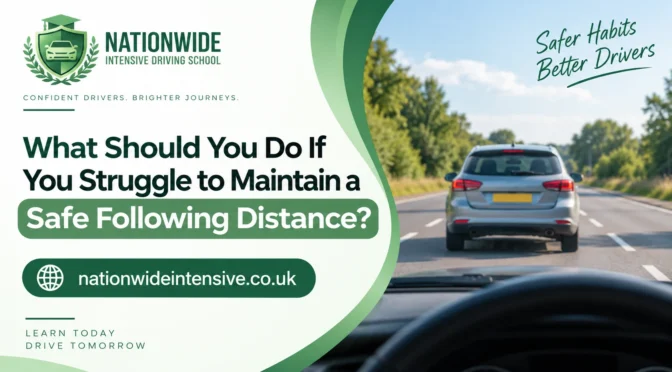
What Should You Do If You Struggle to Maintain a Safe Following Distance?

If you struggle to maintain a safe following distance, stop focusing only on the car directly in front and start looking further ahead. Use the two-second rule in normal conditions and increase the gap when roads are wet, icy or visibility is poor. If the vehicle ahead slows, ease off the accelerator early rather than braking sharply. With regular practice, you’ll learn to judge space without constantly counting or thinking about it.

One of the easiest driving habits to underestimate is your following distance.

When you’re learning, it can feel like you’re constantly thinking about everything:

“Am I too close?”

“Should I brake?”

“Why is that car slowing down?”

“Is this gap actually safe?”

And before you know it, you’re either driving too close to the vehicle ahead or leaving such a huge gap that you’re worried other drivers will pull into it.

Don’t worry. This is extremely common.

As a driving instructor, I’ve found that following distance becomes much easier once learners understand why the gap matters, rather than simply trying to memorise a number.

Why Is a Safe Following Distance Important?

The gap between your car and the vehicle ahead gives you time to react if something unexpected happens.

The driver in front might:

  • Brake suddenly.
  • Slow for a pedestrian.
  • Stop in traffic.
  • Encounter an obstruction.
  • React to a cyclist.
  • Miss a hazard and brake at the last moment.

If you’re already too close, you have much less time to respond.

A safe following distance isn’t about being overly cautious. It’s about giving yourself time and space to react.

What Is the Two-Second Rule?

In normal, dry conditions, a useful way to judge your following distance is the two-second rule.

Choose a fixed point on the road, such as a sign, lamp post or tree.

When the vehicle in front passes it, say:

“Only a fool breaks the two-second rule.”

Your vehicle should reach the same point after at least two seconds.

If you reach it before you’ve finished the phrase, you’re probably too close.

This is a simple technique to practise during Driving Lessons Addiscombe.

Does the Following Distance Need to Change in Bad Weather?

Absolutely.

Two seconds isn’t a universal gap for every situation.

When conditions become more difficult, you need more space.

Think about:

  • Rain
  • Wet roads
  • Ice
  • Snow
  • Fog
  • Poor visibility
  • Darkness
  • Heavy traffic

On wet roads, for example, your vehicle may require more distance to stop safely.

So rather than obsessing over an exact number, develop the habit of asking:

“Do I have enough space to react if that vehicle brakes suddenly?”

If the answer is no, increase the gap.

Why Do Learners Keep Getting Too Close?

There are several common reasons.

You’re Looking Too Close

If you’re staring only at the back of the vehicle ahead, you may not notice that traffic is slowing until it’s already happening.

Look further ahead.

If you can see several vehicles in front beginning to slow, you can ease off earlier.

You’re Matching the Wrong Speed

Sometimes learners unconsciously match the vehicle ahead too closely.

Instead, control your speed independently.

You don’t have to stay exactly the same distance behind the vehicle at every moment.

You’re Not Planning Ahead

Good following distance is connected to forward planning.

If you see a red traffic light ahead, a queue forming or a pedestrian approaching a crossing, start adjusting your speed early.

Don’t wait until you’re right behind the vehicle.

What Should You Do If the Car in Front Suddenly Slows?

Don’t panic.

First, come off the accelerator and assess what’s happening.

If necessary, brake progressively and maintain control.

This is why having a reasonable gap is so useful.

You have more time to respond without immediately needing harsh braking.

Your instructor can deliberately create different traffic situations during a lesson so you can practise responding calmly.

What If Someone Keeps Driving Too Close Behind You?

This is another situation that makes learners nervous.

If another driver is tailgating you, don’t speed up simply because they’re pressuring you.

Continue driving at an appropriate speed for the road and conditions.

Maintain a safe gap from the vehicle in front.

That gives you more room to respond if traffic changes suddenly.

If necessary, your instructor can show you how to deal with tailgaters safely without becoming distracted by them.

Should You Leave a Larger Gap in Heavy Traffic?

Yes, when practical.

Heavy traffic can involve constant stopping and starting.

If you drive extremely close to the vehicle ahead, you’ll constantly need to brake and accelerate.

A little extra space can make your driving smoother and give you more time to react.

However, you also need to remain aware of traffic around you and avoid creating an unnecessarily large gap that causes confusion.

The goal is safe, controlled spacing.

How Can You Practise Following Distance?

Don’t just practise counting seconds.

Try to develop your visual judgement.

During your lessons, ask yourself:

What is happening ahead?

Is traffic slowing?

How quickly am I approaching the vehicle?

What happens if they brake now?

Do I have enough time to react?

Over time, you’ll begin to judge the distance naturally.

This is particularly useful during Driving Lessons Addiscombe, where you may encounter a mixture of residential roads, busier routes, parked vehicles and changing traffic conditions.

Can an Intensive Driving Course Help With Following Distance?

It can be useful if you need more concentrated road practice.

An Intensive Driving Course Addiscombe gives you the opportunity to spend more time developing your observation, speed control and hazard awareness over a shorter period.

Following distance can then be practised alongside:

  • Forward planning
  • Mirror checks
  • Speed control
  • Hazard perception
  • Urban driving
  • Traffic queues
  • Junctions
  • Roundabouts
  • Independent driving

The more varied situations you experience, the easier it becomes to judge appropriate space.

What If You Leave Too Much Space?

This can happen too.

Some nervous learners become so focused on avoiding tailgating that they leave an unnecessarily large gap.

Don’t feel that you have to close the gap immediately.

Instead, maintain a sensible distance and adjust your speed gradually.

If another driver moves into the space, don’t get frustrated.

Simply create another safe gap.

Your job is to drive safely—not to protect a particular piece of road.

Does Your Choice of Car Make a Difference?

Your basic following-distance principles remain the same whether you’re driving a manual or automatic car.

However, some learners find automatic driving lessons easier because they don’t have to manage clutch and gear changes while concentrating on traffic.

That can make it easier to focus on:

  • Vehicle spacing
  • Brake lights
  • Traffic flow
  • Pedestrians
  • Cyclists
  • Road hazards

With manual driving lessons, you’ll need to coordinate gear and clutch control alongside your observations.

Neither option is automatically better. The important thing is choosing the type of driving that suits your circumstances and long-term plans. Nationwide Intensive LTD. is here to help you with that.

Frequently Asked Questions

What is a safe following distance in the UK?

In normal conditions, the two-second rule is a useful guide. Increase the distance when conditions are wet, icy, slippery or visibility is reduced.

How do I stop driving too close to the car in front?

Look further ahead, come off the accelerator earlier when traffic slows and use a fixed roadside point to check your following distance.

Should I use the two-second rule in the rain?

You should increase your following distance in wet conditions because stopping can take longer. Don’t rely on the normal two-second gap when conditions are poor.

What should I do if someone is tailgating me?

Don’t allow the driver behind to pressure you into speeding. Continue driving appropriately, maintain a safe gap ahead and avoid sudden braking.

Can following distance affect my driving test?

Yes. Failing to maintain an appropriate following distance can affect your assessment of vehicle control, planning and awareness. Your instructor can help you identify what is appropriate for different road and traffic conditions.

Can intensive driving lessons improve following-distance judgement?

Yes. Concentrated practice gives you more opportunities to experience different traffic speeds, road conditions and hazards, helping you develop better judgement.

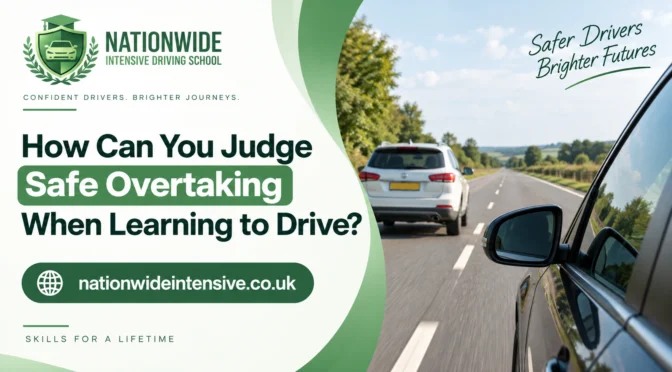
How Can You Judge Safe Overtaking When Learning to Drive?

Safe overtaking is mainly about visibility, speed, distance, road conditions and having enough time to complete the manoeuvre safely. As an experienced driving instructor, I tell learners not to think, “Can I squeeze past?” Instead, ask, “Can I overtake and return to my lane with plenty of time and space?” If you can’t clearly see the road ahead or you’re unsure about the situation, wait. A few extra seconds behind a slower vehicle is far safer than forcing an overtaking manoeuvre.

Overtaking can feel intimidating when you’re learning to drive.

You’re behind a slow-moving vehicle, the road ahead looks clear and you start thinking:

“Should I overtake?”

Then another thought appears:

“What if a car comes around the corner?”

So you stay behind.

Then you wonder whether you should have gone.

If this sounds familiar, don’t worry. Overtaking is a judgement skill, and it takes experience to become comfortable with it.

As a driving instructor, I’d much rather see a learner wait for a genuinely safe opportunity than attempt an overtake simply because they feel pressured by the vehicle behind them.

Let’s look at how you can judge overtaking more confidently and safely on UK roads.

What Makes an Overtaking Manoeuvre Safe?

Before overtaking, you need to consider several things at the same time:

  • Is the road ahead clearly visible?
  • Is there enough distance to complete the manoeuvre?
  • How fast is the vehicle you’re overtaking?
  • How fast can you safely accelerate?
  • Is another vehicle approaching?
  • Are there bends, junctions or hazards ahead?
  • Is the road wide enough?
  • Can you return to your lane safely?

If you’re unsure about any of these, wait.

Overtaking isn’t a race.

1. Look Far Enough Ahead

One of the biggest mistakes learners make is looking only a short distance ahead.

You need enough visibility to understand what’s coming.

A long straight road with good visibility may provide a better opportunity than a road with:

  • A sharp bend
  • A hill
  • A concealed junction
  • Parked vehicles
  • Pedestrians
  • Cyclists
  • Poor visibility

If you can’t see what’s beyond the vehicle you’re overtaking, you don’t have enough information to make a confident decision.

2. Consider the Speed of the Vehicle You’re Passing

Imagine you’re following a vehicle travelling at 30 mph.

You pull out to overtake, but the vehicle is actually travelling faster than you expected.

Now your overtaking manoeuvre takes longer.

This is why you need to consider the relative speed between your vehicle and the vehicle you’re passing.

The greater the speed difference, the more quickly you may complete the manoeuvre, but that doesn’t mean you should drive aggressively.

Your speed must always remain appropriate for the road and conditions.

3. Make Sure You Have a Clear View of Oncoming Traffic

This is critical.

Before overtaking on a two-way road, you need to know what’s happening ahead.

Don’t assume the road is clear simply because you can’t currently see another vehicle.

A bend, crest or obstruction can hide approaching traffic.

If you can’t see far enough ahead, don’t overtake.

Wait until your view improves.

This is one of the simplest rules to remember during Driving Lessons Morden:

If you can’t see it, you can’t safely judge it.

4. Check Your Mirrors Before Moving Out

Overtaking isn’t only about what’s in front of you.

You also need to know what’s happening behind.

A vehicle may already be overtaking you.

Before changing position, check your mirrors and make sure your intended manoeuvre won’t interfere with another road user.

This is where good observation becomes important.

Develop the habit of thinking about the whole traffic environment, not just the vehicle immediately in front.

5. Don’t Let the Driver Behind Pressure You

This happens frequently.

You’re behind a slow vehicle.

A car appears behind you.

You imagine the driver is getting impatient.

Suddenly, you feel you have to overtake.

You don’t.

Another driver’s impatience isn’t a reason to take a risk.

If the conditions aren’t right, stay behind the slower vehicle.

A safe driver is comfortable saying:

“Not yet.”

The opportunity will come.

6. Think About Where You’ll Return

Don’t focus only on getting past the vehicle.

You also need to consider what happens afterwards.

Ask:

Where will I return to my lane?

Is there enough space?

Will I need to slow down immediately?

Is there a hazard ahead?

For example, overtaking a slow vehicle immediately before a junction may not be sensible if you then have to change position again.

Think about the entire manoeuvre, not just the first few seconds.

7. Don’t Overtake Near Places Where Visibility Is Restricted

Certain road situations can make overtaking particularly risky.

Be extremely cautious around:

  • Bends
  • Crests
  • Junctions
  • Pedestrian crossings
  • Narrow roads
  • Areas with parked vehicles
  • Roads with limited visibility

The exact circumstances matter, but the principle is simple:

The less you can see, the less information you have to make a safe decision.

8. Remember That Waiting Is a Driving Skill

Some learners think good drivers are constantly overtaking.

That’s not true.

Good drivers know when not to overtake.

You might follow a slow vehicle for several minutes because the road conditions don’t provide a suitable opportunity.

That’s perfectly acceptable.

Driving isn’t about getting everywhere as quickly as possible.

It’s about making safe, sensible decisions.

9. Practise Overtaking With Your Instructor

Don’t try to teach yourself overtaking through trial and error.

It’s much better to learn the process with an experienced instructor.

During Driving Lessons Morden, your instructor can help you understand:

  • When an overtaking opportunity is developing.
  • What information to look for.
  • How to assess approaching traffic.
  • How to maintain appropriate speed.
  • When to abandon an overtake.
  • How to return safely to your lane.

They can also explain why a particular situation is suitable or unsuitable.

That feedback is extremely valuable because learners don’t always recognise the risks they’re missing.

10. Build Up Your Confidence Gradually

If overtaking makes you nervous, don’t expect to become comfortable immediately. 

Start by observing your instructor.

Watch how they assess:

Visibility → traffic → speed → distance → road conditions → escape space.

Then, when you’re ready, take responsibility for the decision yourself.

Eventually, you’ll begin recognising suitable opportunities without having to consciously analyse every detail.

Can an Intensive Driving Course Help With Overtaking?

It can, particularly if you need more road experience.

An Intensive Driving Course Morden gives you the opportunity to practise frequently over a shorter period.

You can work on overtaking alongside other important skills such as:

  • Mirror checks
  • Hazard awareness
  • Road positioning
  • Speed control
  • Dual carriageway driving
  • Independent driving
  • Forward planning

The advantage of concentrated practice is that you don’t have to wait a full week before applying what you learned.

For some learners, that repetition helps build better judgement and confidence. Nationwide Intensive LTD. is here to help you with this.

What If You’re Still Unsure Whether to Overtake?

Use this simple rule:

If you aren’t confident that you have enough visibility, time and space, don’t go.

There’s no prize for overtaking first.

Stay behind, maintain a safe following distance and wait for a better opportunity.

As you gain experience, you’ll become better at identifying situations where an overtake is appropriate. Contact us today.

Frequently Asked Questions

How do I know when overtaking is safe?

You need sufficient visibility, time and space to complete the manoeuvre safely. You should also consider your speed, the speed of the vehicle you’re passing, approaching traffic and what happens after you return to your lane.

Should learner drivers overtake?

Learners should learn how to assess overtaking situations as part of their driving education. However, they should never feel pressured to overtake when the conditions aren’t clearly safe.

Why do I struggle to judge overtaking gaps?

Gap judgement develops through experience. Your instructor can help you understand the relationship between vehicle speed, distance, visibility and the time required to complete an overtaking manoeuvre.

Should I overtake if the driver behind me is impatient?

No. Another driver’s impatience shouldn’t influence your safety decisions. If the conditions aren’t suitable, wait for a safer opportunity.

Can an intensive driving course improve overtaking confidence?

Concentrated driving practice can give you more opportunities to experience different traffic situations and develop your observation and decision-making skills.

Is overtaking necessary to pass the UK driving test?

You aren’t expected to force an overtaking manoeuvre simply to demonstrate that you can overtake. The examiner is interested in safe, competent driving and appropriate decisions for the circumstances.

How to Stop Hesitating at Junctions When Learning to Drive

Hesitating at junctions is very common when you’re learning to drive. Usually, it happens because you’re unsure about your observations, speed, positioning or whether a gap is safe. The best way to improve is to slow your approach, observe early, make a clear decision and act when it’s safe. With regular practice and constructive feedback from an instructor, junction decisions become much more natural.

If there’s one part of driving that can make a learner suddenly doubt everything they know, it’s a busy junction.

You approach it thinking:

“Is it safe to go?”

Then:

“Maybe I should wait.”

Then:

“Actually, I think I can go…”

And by the time you’ve decided, you’ve missed the opportunity.

If that sounds familiar, don’t worry. As an experienced driving instructor, I’ve seen this countless times. Junction hesitation doesn’t necessarily mean you’re a bad driver. More often, it means you haven’t yet developed enough confidence in your observations and decision-making.

The good news? It can be improved.

Why Do Learners Hesitate at Junctions?

Hesitation usually comes down to uncertainty.

You might not be sure:

  • Whether there’s enough visibility.
  • How fast another vehicle is approaching.
  • Whether a gap is safe.
  • When to emerge.
  • Whether you should wait for another car.
  • What other road users are going to do.

You then spend too long trying to make the “perfect” decision.

But driving isn’t about predicting everything perfectly.

It’s about observing, assessing the situation and making a safe decision.

1. Approach the Junction at the Right Speed

Your speed can make a huge difference.

If you approach too quickly, you have less time to observe and make a decision.

If you approach too slowly without a reason, you may become overly cautious and create unnecessary hesitation.

As you approach a junction, plan ahead.

Check your mirrors, reduce your speed appropriately and prepare yourself to stop if necessary.

The aim is to reach the point where you can make a clear decision without rushing.

2. Look Early, Not at the Last Second

One of the most useful habits you can develop during Driving Lessons Colliers Wood is early observation.

Don’t wait until you’re almost at the give-way line before looking.

Look as far ahead as the road allows.

Ask yourself:

What can I see?

What can’t I see?

Is my view blocked?

Is anything approaching?

Early observation gives your brain more time to process what’s happening.

It also makes your decision feel less sudden.

3. Learn to Judge Gaps

Gap judgement takes practice.

A common mistake is looking only at the distance between you and another vehicle.

You also need to consider its speed.

A vehicle that looks far away but is travelling quickly may reach you much sooner than you expect.

On the other hand, a vehicle that’s closer but travelling slowly may give you more time.

Don’t focus purely on distance.

Consider:

Distance + speed + your available time.

Your instructor can help you practise this safely until your judgement becomes more instinctive.

4. Don’t Wait for Every Vehicle to Disappear

Some learners think a safe junction means waiting until the road is completely empty.

In real driving, that’s rarely practical.

You need to learn when a gap is genuinely safe for you to proceed.

That doesn’t mean rushing.

It means avoiding unnecessary over-caution when the conditions clearly allow you to go.

Your instructor can help you understand the difference between appropriate caution and hesitation.

5. Remember That You Don’t Have to Take Every Gap

This is equally important.

Trying to eliminate hesitation doesn’t mean you should force yourself into every available gap.

If you’re genuinely unsure, waiting can be the safest decision.

The goal isn’t:

“Go as quickly as possible.”

The goal is:

“Make a safe, timely and well-observed decision.”

There’s a big difference.

6. Stop Looking for Reassurance From Your Instructor

This is something I often notice with learners.

They look at the instructor after approaching a junction as if they’re waiting for confirmation:

“Should I go?”

But eventually, you need to make that decision yourself.

During your lessons for your next driving test, ask your instructor to gradually reduce prompts.

Instead of them telling you when it’s safe, they can let you assess the situation first and then discuss your decision afterwards.

This helps build independent judgement.

7. Use a Simple Observation Routine

When approaching a junction, don’t let your thoughts become chaotic.

Use a simple routine:

Mirrors → Speed → Position → Observation → Decision

The exact sequence can vary depending on the junction, but having a mental framework can stop you from overthinking.

For example:

Mirrors: What’s happening around me?

Speed: Am I approaching at an appropriate speed?

Position: Am I positioned correctly?

Observation: What can I see?

Decision: Is it safe to proceed or should I wait?

With practice, this becomes much more automatic.

8. Practise Different Types of Junctions

Don’t only practise the easy junctions near your home.

You need experience with different situations, including:

  • T-junctions
  • Crossroads
  • Open junctions
  • Closed junctions
  • Busy urban junctions
  • Traffic-light-controlled junctions
  • Junctions with parked vehicles
  • Junctions with restricted visibility

Each one teaches you something different.

The more situations you experience, the easier it becomes to recognise patterns.

9. Don’t Panic If You Miss an Opportunity

Suppose you’re waiting at a junction and a safe gap appears.

You hesitate.

The car passes.

It’s gone.

Don’t panic.

You haven’t ruined the drive.

Wait for the next suitable opportunity.

Trying to force yourself into the next gap because you missed the previous one is far more dangerous.

One missed opportunity is simply another learning opportunity.

10. Practise With a Clear Goal

If you’re repeatedly making the same mistake, don’t simply keep doing more lessons without addressing it.

Tell your instructor:

“I keep hesitating at junctions. Can we specifically work on my observations and gap judgement today?”

A focused lesson can be much more productive.

You can practise the same type of junction repeatedly, receive feedback and gradually reduce the amount of guidance. Nationwide Intensive LTD. can help you with that.

Can an Intensive Driving Course Help With Junction Hesitation?

Yes, particularly if your main problem is a lack of consistent experience.

An Intensive Driving Course Colliers Wood can provide concentrated driving practice over a shorter period.

Instead of having several days between lessons, you may get repeated opportunities to work on:

  • Junction approach
  • Gap judgement
  • Emerging safely
  • Mirror checks
  • Road positioning
  • Busy traffic
  • Independent decision-making

For some learners, this repetition helps the process become more familiar.

An intensive course isn’t a shortcut around learning, but concentrated practice can be useful when you already understand the basics and need to build consistency.

What If You’re Still Nervous at Junctions?

Don’t measure your progress by whether you feel completely relaxed.

Instead, look for practical improvements.

Maybe you used to wait for five cars and now you’re confidently identifying safe gaps.

Maybe you used to need your instructor to tell you when to go, but now you’re making your own decisions.

Those are signs of progress.

Confidence usually comes after repeated successful experiences, not before them. You can reach out to us for more information.

Would Automatic Driving Make Junctions Easier?

For some learners, yes.

With automatic driving lessons, you don’t have to coordinate clutch control and manual gear changes while approaching a junction.

That can reduce the amount of information you’re processing at once.

You can then put more attention into:

  • Traffic
  • Pedestrians
  • Cyclists
  • Road signs
  • Mirror checks
  • Gap judgement
  • Positioning

However, manual driving lessons remain a good choice if you want to learn clutch and gear control and drive a manual vehicle.

The important thing is choosing the option that suits your confidence, learning style and long-term plans.

Frequently Asked Questions

Why do I hesitate so much at junctions?

Usually because you’re uncertain about whether a gap is safe or you’re trying to make the perfect decision. More practice with observations and gap judgement can help.

Is hesitation at junctions normal for learner drivers?

Yes. Many learners initially struggle with timing and gap judgement. These skills improve as you gain experience with different junctions and traffic situations.

How can I improve my gap judgement?

Look at both the distance and speed of approaching vehicles. Practise with an instructor who can explain why a particular gap is suitable or unsuitable.

Should I go if I’m not sure at a junction?

If you’re genuinely unsure, don’t force the decision. Wait for a safer opportunity. The aim is to make a safe and timely decision, not simply to go quickly.

Can an intensive driving course help with junctions?

It can. An intensive course provides concentrated practice, allowing you to work repeatedly on junctions, observations, positioning and independent decision-making.

Are automatic cars easier for nervous learners at junctions?

Some learners find them easier because there’s no clutch or manual gear changing to manage. This can leave more attention for observations and traffic.

How to Improve Your Steering Control Before Taking Your Driving Test

To improve your steering before the UK driving test, focus on smooth inputs, accurate road positioning, looking well ahead and avoiding unnecessary steering corrections. As an experienced driving instructor, I find that learners often steer too much because they’re looking too close to the car rather than where they want the vehicle to go. Practise on different roads, keep your hands controlled and relaxed, and learn to make small, deliberate adjustments instead of constantly correcting the wheel.

“I can control the car, but my steering still feels messy.”

This is something I hear regularly from learners approaching their driving test.

Maybe you’re constantly correcting the steering.

Perhaps you get too close to the kerb.

Or you turn into corners too early and then have to correct your position.

The good news is that steering control usually improves significantly with the right practice.

And you don’t necessarily need to spend every lesson doing complicated exercises.

Often, it’s about changing a few basic habits.

What Does Good Steering Control Look Like?

Good steering isn’t about keeping the steering wheel completely still.

Your hands will naturally make small adjustments as you drive.

What matters is that those adjustments are:

  • Smooth
  • Controlled
  • Appropriate for your speed
  • Suitable for the road
  • Not excessive

Your vehicle should generally follow the path you intend without constant large corrections.

During Driving Lessons Norbury, your instructor should be able to identify whether your steering issue is related to your hand position, vision, road positioning or speed.

1. Look Further Ahead

This is one of the biggest steering improvements you can make.

Learners often stare directly in front of the bonnet.

That makes the car feel like it’s constantly moving towards the edge of the road, so they keep correcting the steering.

Instead, look further along the road.

When approaching a bend, don’t stare at the kerb.

Look through the bend towards where you want the car to travel.

Your hands will naturally make smoother steering movements when your eyes are looking further ahead.

Think:

Look where you want to go, not where you don’t want to go.

2. Avoid Over-Correcting

Let’s say you’re slightly too close to the kerb.

You turn the steering wheel away from it.

Then you realise you’ve moved too far towards the centre.

So you correct again.

Then again.

Suddenly, you’re making several steering movements just to keep the car straight.

This is called over-correction.

Instead, make a small adjustment, allow the car to respond and reassess.

You don’t need to fight the steering wheel.

3. Slow Down Before Sharp Turns

Your steering and speed work together.

If you approach a tight corner too quickly, you’ll have less time to position the vehicle and control the steering.

Approach the corner at an appropriate speed.

That gives you more time to:

  • Observe
  • Position
  • Steer
  • Check for hazards
  • Respond to other road users

Smooth driving often starts with good speed control.

4. Practise Following the Road’s Shape

A useful exercise is simply paying attention to how the road curves.

On a left-hand bend, look through the curve.

On a right-hand bend, look towards the road ahead rather than focusing on the kerb.

Don’t try to make the steering wheel perfectly match every tiny movement in the road.

Let the vehicle follow the road naturally and make small adjustments where necessary.

5. Don’t Grip the Wheel Too Tightly

Some nervous learners hold the steering wheel extremely tightly.

It feels like you’re gaining control, but excessive tension can actually make steering movements less smooth.

Keep your grip secure but relaxed.

Your hands should be ready to make controlled adjustments without constantly fighting the steering.

If you notice your shoulders becoming tense, take a moment to relax.

6. Get Your Hand Movements Consistent

Your instructor may teach you a particular steering technique depending on the situation.

For normal driving, you want controlled steering that allows you to maintain a stable road position.

For tighter turns and manoeuvres, you’ll naturally need more steering input.

The important thing is to avoid random or rushed hand movements.

Your steering should match the road and the speed of the vehicle.

7. Practise Corners Without Rushing

If you struggle with steering around corners, don’t immediately practise on the most complicated roads.

Start somewhere quieter.

Work on:

Approach → Speed → Position → Look → Steer → Exit

For example, before turning left:

  1. Check your mirrors.
  2. Position appropriately.
  3. Reduce speed.
  4. Look where you’re going.
  5. Make the turn smoothly.
  6. Straighten the steering as you leave the corner.

Repeating this process helps turn it into a habit.

8. Watch Your Road Position

Steering control and road positioning are closely connected.

You can have good hand movements but still position the car poorly.

Pay attention to:

  • Your distance from the kerb.
  • Your position within your lane.
  • Parked vehicles.
  • Cyclists.
  • Oncoming traffic.
  • Road markings.

Your instructor can help you identify whether you’re actually steering poorly or simply reacting to incorrect positioning.

9. Practise Roundabouts

Roundabouts are excellent for developing steering control.

They require you to combine:

  • Speed control
  • Observation
  • Lane positioning
  • Steering
  • Sign awareness
  • Mirror checks

Don’t rush your steering onto a roundabout.

Approach at an appropriate speed, choose the correct lane and look where you’re going.

Once you’re on the roundabout, keep your steering controlled and make adjustments based on the road layout.

10. Practise Your Manoeuvres

Your driving test includes a reversing manoeuvre, so steering control matters when completing manoeuvres.

Practise things such as:

  • Parallel parking
  • Bay parking
  • Forward bay parking
  • Reversing into a parking bay

Don’t try to memorise exactly how many turns of the steering wheel you need.

Instead, learn to observe the vehicle’s position and adjust accordingly.

That makes your skills much more adaptable.

What Are Common Steering Mistakes Before the Test?

Some of the most common problems I see include:

Steering Too Much

The learner makes large corrections when only a small adjustment is required.

Looking Too Close

They focus on the kerb or bonnet instead of looking further ahead.

Turning Too Early

They begin steering before reaching the appropriate point for the turn.

Turning Too Late

They leave the steering too long and then make a sudden correction.

Steering While Travelling Too Fast

The learner enters a bend or corner faster than they’re comfortable controlling.

The good news is that each of these problems can be addressed through targeted practice.

Can an Intensive Driving Course Improve Steering?

It can, particularly if you’re approaching your test and need concentrated practice.

An Intensive Driving Course Norbury allows you to spend more time driving over a shorter period.

That can give you repeated opportunities to work on:

  • Steering control
  • Road positioning
  • Corners
  • Roundabouts
  • Manoeuvres
  • Independent driving
  • Test routes and common road situations

Frequent practice can help you recognise and correct steering habits while the feedback from your instructor is still fresh.

Should You Learn in a Manual or Automatic Car?

Steering itself is similar in both types of vehicles, but the overall workload can feel different.

With automatic driving lessons, you don’t need to coordinate clutch control and manual gear changes. Some learners therefore find it easier to concentrate on steering, observations and positioning.

With manual driving lessons, you’ll need to coordinate steering alongside clutch and gear control.

Neither option is automatically better.

The right choice depends on your goals, confidence and the type of car you want to drive after passing. Contact us for information.

How to Practise Steering Between Lessons

If you’re able to practise with a suitable supervising driver, make your sessions purposeful.

Don’t simply drive around randomly.

Choose one focus at a time.

For example:

Drive 1: Straight-line steering and lane position.

Drive 2: Left and right turns.

Drive 3: Bends and roundabouts.

Drive 4: Parking manoeuvres.

Drive 5: A mixture of everything.

This makes it easier to see improvement.

You can reach out to us at Nationwide Intensive LTD. if you have any issue regarding that.

Frequently Asked Questions

How can I improve my steering before my driving test?

Look further ahead, maintain appropriate speed, use smooth steering inputs and avoid unnecessary corrections. Practise different road layouts and ask your instructor for specific feedback.

Why do I keep moving too close to the kerb?

You may be looking too close to the vehicle or using large steering corrections. Try looking further along the road and making smaller adjustments.

Should I grip the steering wheel tightly?

No. Your grip should be secure but relaxed enough to allow smooth, controlled steering movements.

Why do I keep over-steering on corners?

You may be approaching too quickly, looking too close to the car or making larger steering movements than necessary. Slowing down and looking through the corner can help.

Does steering affect my driving test?

Yes. Steering control can affect your vehicle control and road positioning. Poor steering may result in driving faults, particularly if it creates a safety issue or causes you to lose proper control.

Can intensive driving lessons help improve steering?

Yes. Concentrated practice can provide more opportunities to work on steering, corners, roundabouts, manoeuvres and general vehicle control.

Returning to Driving After a Long Break? Here’s How to Build Confidence Again

If you haven’t driven for months or years, feeling nervous when you get back behind the wheel is completely normal. You don’t necessarily need to start learning from scratch, but you may need to refresh your vehicle control, road awareness and confidence. As an experienced driving instructor, I usually recommend starting with familiar, quieter roads, taking a few refresher lessons and gradually increasing the difficulty. The key is to rebuild confidence through regular, safe practice rather than trying to do everything on your first drive.

“I passed my test years ago, but I haven’t driven since. I’m honestly scared to start again.”

I’ve heard this from many drivers.

Some passed their test but never bought a car. Others stopped driving after moving to London, changing jobs, having children or simply not needing a car for a while.

Then something changes.

Perhaps you’ve got a new job that requires driving. Maybe you’ve moved somewhere where public transport isn’t as convenient. Or perhaps you simply want the freedom of getting behind the wheel again.

Whatever the reason, there’s one thing I’d say straight away:

You probably haven’t forgotten everything. You just need to get comfortable driving again.

Is It Normal to Feel Nervous After a Long Driving Break?

Absolutely.

Even experienced drivers can feel rusty after spending a long time away from the road.

You may suddenly find yourself thinking about things that used to feel automatic:

  • When should I change gear?
  • How close should I be to the kerb?
  • Am I checking my mirrors enough?
  • What speed should I use here?
  • Can I handle this roundabout?

That’s normal.

Driving relies heavily on experience and repetition. After a long break, your confidence can disappear faster than your underlying skills.

The good news is that familiarity usually comes back with practice.

1. Don’t Immediately Drive on the Busiest Roads

One of the biggest mistakes returning drivers make is trying to prove they can still drive.

They get back into the car and immediately tackle busy roads, complicated junctions or unfamiliar routes.

There’s no need.

Start somewhere manageable.

A quiet residential area can give you the opportunity to refresh:

  • Steering
  • Braking
  • Moving off
  • Gear changes
  • Mirror checks
  • Road positioning
  • Speed control

Once these feel comfortable again, gradually introduce more demanding roads.

2. Take a Refresher Driving Lesson

Even if you’ve held a full UK driving licence for years, refresher lessons can be extremely useful.

An experienced instructor can give you an objective assessment without the pressure you might feel when driving with a family member.

During Driving Lessons Morden, you can work specifically on the areas you’re least confident about rather than spending time relearning everything.

For example, you may discover that your basic car control is still good but you need more practice with:

  • Busy roundabouts
  • Dual carriageways
  • Parking
  • Lane discipline
  • Motorway preparation
  • Hazard awareness

A few focused lessons can make a big difference.

3. Don’t Compare Yourself With How You Used to Drive

This is an easy trap to fall into.

You remember being confident five years ago, so you expect yourself to feel exactly the same today.

But your first few drives after a long break may feel awkward.

That’s okay.

Your brain needs time to rebuild familiarity.

Instead of thinking:

“I used to be much better.”

think:

“I’m getting comfortable again.”

That small change in mindset can remove a lot of unnecessary pressure.

4. Practise the Same Routes Repeatedly

If you’re nervous, repetition is your friend.

Choose a few familiar routes and drive them several times.

For example:

First drive: Quiet local roads.

Second drive: Local shops or workplace route.

Third drive: Busier roads.

Fourth drive: More complicated junctions.

Fifth drive: Unfamiliar destination.

Each successful journey gives you more confidence.

Eventually, you’ll stop concentrating on every individual control and start thinking more naturally about the road around you.

5. Get Comfortable With Modern Road Conditions

If you’ve been away from driving for a long time, some things may feel different.

Traffic levels may have changed.

Road layouts may have been modified.

You may encounter more cyclists, bus lanes, speed cameras or different junction arrangements than you remember.

Don’t assume that because you passed your test years ago, you already know everything.

Take some time to refresh your knowledge of the Highway Code, road signs and current road rules.

6. Don’t Let One Difficult Drive Destroy Your Motivation

Your first few drives might not go perfectly.

You could stall.

You might take a wrong turn.

Perhaps a busy roundabout feels intimidating.

Don’t let one difficult moment convince you that you can’t drive anymore.

Ask yourself:

“What can I learn from that situation?”

If you struggled with a particular junction, practise it again.

If you were nervous on a busy road, build up gradually.

Progress comes from solving individual problems rather than expecting yourself to suddenly feel confident everywhere.

7. Consider an Intensive Driving Course

If you’ve been away from driving for a long time and need to rebuild your confidence quickly, an Intensive Driving Course Morden may be worth considering.

Intensive training allows you to practise over consecutive days rather than having long gaps between sessions.

This can be useful when you need to refresh several areas, such as:

  • Vehicle control
  • Roundabouts
  • Junctions
  • Parking
  • Road positioning
  • Independent driving
  • Hazard awareness

Frequent practice can help you regain familiarity while everything is still fresh.

An intensive course isn’t necessary for everyone, but it can be a practical option if you want focused support.

8. Decide Whether Manual or Automatic Suits You Now

If you originally learned in a manual car but haven’t driven for years, you might find the clutch and gears less comfortable than you remember.

That’s worth considering.

Automatic driving lessons can remove the need to manage clutch control and manual gear changes, allowing you to focus more on traffic, hazards and road positioning.

Alternatively, manual driving lessons can help you rebuild confidence with gears and clutch control if you want to continue driving a manual vehicle.

There’s no requirement to stick with the same type of car simply because that’s what you originally learned in.

9. Build Confidence Gradually

You don’t need to drive every day.

But consistency helps.

If possible, create a realistic routine where you’re driving regularly rather than leaving several weeks between attempts.

Each session should have a purpose.

For example:

Week 1: Vehicle control and quiet roads.

Week 2: Junctions and local traffic.

Week 3: Roundabouts and busier roads.

Week 4: Longer and less familiar journeys.

The exact timeline doesn’t matter.

What matters is gradual progression.

Simple Ways to Stay Motivated

If you’re struggling to get back into driving, try these:

  • Set small driving goals.
  • Keep a record of what you’ve improved.
  • Start with routes you know.
  • Don’t rush into difficult traffic.
  • Take refresher lessons if you’re unsure.
  • Practice consistently.
  • Don’t compare your current driving with your past driving.
  • Celebrate small improvements.

Remember, confidence usually follows experience.

You don’t have to feel confident before you start practising.

Frequently Asked Questions

Can I drive again after years without driving?

Yes. Many full licence holders return to driving after long breaks. However, it’s sensible to refresh your skills gradually and consider refresher lessons if you’re nervous or unsure.

Do I need to retake my driving test after a long break?

Generally, simply not driving for a period doesn’t mean you have to retake your test. However, you remain responsible for ensuring you’re competent, safe and legally fit to drive. If you’re unsure about your current ability, refresher training can help.

How can I regain confidence after not driving for years?

Start with familiar, quieter roads, practise regularly and gradually increase the difficulty. A refresher lesson with a professional instructor can also help identify areas that need attention.

Are refresher driving lessons worth it?

They can be very useful. An instructor can assess your current driving objectively and focus lessons on specific areas such as roundabouts, parking, road positioning and busy traffic.

Can an intensive driving course help after a long break?

Yes. An intensive course can provide concentrated practice over consecutive days, which may help you rebuild confidence and refresh several driving skills efficiently.

Should I switch from manual to automatic after a long break?

It depends on your needs. Automatic cars can simplify vehicle control, while manual driving gives you experience with clutch and gear changes. Consider which option best suits your current confidence and future driving plans.

Final Thoughts

Returning to driving after a long break can feel intimidating, but you shouldn’t assume you’ve lost everything you learned.

From my experience as a driving instructor, most returning drivers need reassurance, practice and familiarity, rather than starting completely from zero. Begin with easier roads, refresh the skills that feel rusty and gradually challenge yourself with more complicated situations.

If you’re looking for professional Driving Lessons Morden, refresher training at Nationwide Intensive LTD. can give you an experienced second pair of eyes and help identify exactly where your confidence needs rebuilding. And if you want a more concentrated approach, an Intensive Driving Course Morden can provide regular practice over consecutive days.

You can also consider whether automatic driving lessons or manual driving lessons are more suitable for your current needs.

Most importantly, don’t expect yourself to drive exactly as you did years ago on your first attempt. Give yourself time to settle back in. Confidence comes from experience, and every safe journey you complete is another step towards feeling comfortable behind the wheel again.