

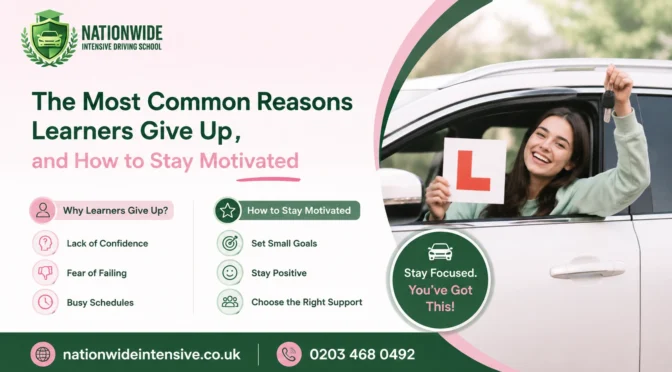
Learners often give up because they lose confidence, feel they’re not progressing, fail their driving test, struggle with nerves, or become frustrated by the cost and time involved. In my experience as a driving instructor, most learners don’t quit because they can’t learn to drive, they quit because they temporarily lose sight of their progress. Breaking the journey into smaller goals, celebrating improvements and choosing the right learning schedule can make it much easier to keep going.
I’ve lost count of how many learners have said to me:
“Maybe driving just isn’t for me.”
Usually, they’re saying it after a difficult lesson, a failed driving test or a few weeks where they feel like they’re making the same mistakes.
But here’s something I’ve learned after years of teaching learner drivers:
Most people who want to give up aren’t actually incapable of learning. They’re simply frustrated.
Learning to drive takes time. Some people progress quickly, while others need more practice before everything starts to feel natural.
If you’re currently thinking about giving up, here are some of the most common reasons learners lose motivation, and what you can do about them.
1. You Feel Like You’re Not Improving
This is probably the biggest reason learners become discouraged.
You might have completed 20 lessons but still be struggling with roundabouts, parking or clutch control.
It can feel like you’re paying for lessons without getting anywhere.
Before deciding you’re not improving, look at what you can do now compared with your first few lessons.
Perhaps you can now:
- Drive independently.
- Handle busy junctions.
- Change gears smoothly.
- Park without constant help.
- Recognise hazards earlier.
- Drive with fewer instructor prompts.
Those are real improvements.
Progress isn’t always obvious from one lesson to the next. Sometimes you only notice how far you’ve come when you look back several weeks or months.
2. You’re Comparing Yourself to Other Learners
“My friend passed for the first time.”
“My brother only needed 25 lessons.”
“Why am I still learning?”
I’ve heard all of these.
The problem with comparing lesson numbers is that everyone starts from a different point.
One learner may already have strong road awareness.
Another may have very little experience around traffic.
Someone else may be naturally confident, while another learner needs more time to feel comfortable.
There’s no prize for learning faster.
The goal is to become a safe and confident driver, not simply to finish your lessons as quickly as possible.
3. You’ve Failed Your Driving Test
Failing the practical driving test can be incredibly frustrating, particularly if you were convinced you were ready.
It’s tempting to think:
“What’s the point of trying again?”
But a failed test isn’t the end of your driving journey.
Look carefully at your test result and identify what actually went wrong.
Were the problems related to:
- Observation?
- Junctions?
- Speed?
- Road positioning?
- Independent driving?
- Manoeuvres?
- Test nerves?
Once you know the problem, you can work on it.
A failed test becomes much more useful when you treat it as feedback rather than a judgement on your ability.
4. You’re Nervous Every Time You Get Behind the Wheel
Driving anxiety can drain your motivation quickly.
If every lesson feels stressful, you may start associating driving with fear rather than progress.
The answer isn’t to force yourself into the most difficult situations immediately.
Instead, build confidence gradually.
During Driving Lessons Forestdale, your instructor can help you work through difficult situations step by step, whether that’s busy roundabouts, dual carriageways, parking or independent driving.
Confidence grows through successful experiences.
5. You’re Taking Long Gaps Between Lessons
Long gaps can make learning feel harder than it needs to be.
You might finally master something one week, then spend the next lesson trying to remember it again because you haven’t driven since.
If your schedule allows, consistent lessons can help maintain momentum.
Even better, supervised private practice can reinforce what you’ve learned during professional instruction.
Regular exposure makes driving feel more familiar and reduces the feeling that you’re constantly starting again.
6. Lessons Don’t Fit Your Lifestyle
Sometimes learners don’t give up because they dislike driving.
They give up because learning to drive doesn’t fit around work, university, family commitments or other responsibilities.
If weekly lessons are difficult to maintain, consider whether a more concentrated learning approach would suit you.
An Intensive Driving Course Forestdale can allow you to complete focused training over consecutive days rather than spreading lessons across a long period.
For some learners, this creates momentum and makes it easier to stay motivated.
7. You’re Spending Too Much Energy Trying to Be Perfect
This is something I notice particularly with nervous learners.
They think every stall, missed mirror check or hesitation means they’ve failed.
It doesn’t.
You’re learning.
Mistakes are part of the process.
Instead of asking:
“Did I drive perfectly?”
ask:
“What did I do better today?”
Maybe you handled a roundabout with less help.
Maybe you made a better decision at a junction.
Maybe you stayed calm after making a small mistake.
Those are the improvements worth noticing.
8. You’re Not Setting Small Goals
“I need to pass my driving test.”
That’s a useful long-term goal, but it can feel overwhelming.
Break it down.
This week’s goals might be:
- Improve mirror checks.
- Practise two parking manoeuvres.
- Handle three different roundabouts.
- Drive for 20 minutes independently.
Small goals are easier to achieve, and every achievement gives you another reason to keep going.
9. You’re Using the Wrong Learning Approach
Not everyone learns in the same way.
Some learners prefer weekly lessons because they like having time to process each skill.
Others learn better through frequent repetition.
If you keep forgetting what you learned between lessons, an intensive approach may be worth considering.
Likewise, if clutch control and gear changes are making you unnecessarily anxious, automatic driving lessons could simplify the learning process.
If you want the flexibility of learning to drive a manual car, manual driving lessons may still be the better option.
The important thing is finding an approach that works for you.
How to Stay Motivated When Learning to Drive
If you’re struggling to stay motivated, try these simple habits:
Track Your Progress
Keep a note of the skills you’ve improved rather than only recording mistakes.
Celebrate Small Wins
A smoother roundabout or better observation is still progress.
Ask for Honest Feedback
Ask your instructor what your biggest improvement has been and what you should focus on next.
Avoid Comparing Yourself
Your driving journey doesn’t need to match anyone else’s.
Take a Short Break If Necessary
If you’re genuinely exhausted or overwhelmed, a short break can be better than forcing yourself through lessons without concentration.
Just avoid turning a short break into abandoning your goal altogether.
Frequently Asked Questions
Why do learners give up driving lessons?
Common reasons include anxiety, slow progress, failed driving tests, cost, lack of time and frustration with repeated mistakes. These problems can often be addressed with a better learning plan and realistic goals.
Is it normal to lose motivation while learning to drive?
Yes. Learning to drive can be stressful, particularly when progress feels slow. Most learners experience periods where their motivation drops.
Should I stop driving lessons if I’m not improving?
Not necessarily. First, talk to your instructor about what’s holding you back. You may need more practice in a particular area, a different teaching approach or a more consistent lesson schedule.
Can an intensive driving course help me stay motivated?
It can. An intensive course provides concentrated training and can help learners maintain momentum, particularly if long gaps between weekly lessons are affecting their progress.
Are automatic driving lessons easier for learners who are struggling?
Many learners find automatic cars easier because there is no clutch control or manual gear changing. This can allow more attention to be placed on road awareness and decision-making.
Final Thoughts
If you’re thinking about giving up learning to drive, take a step back before making that decision.
After years of teaching learners, I’ve seen people go from saying “I’ll never pass” to confidently driving on their own. The turning point usually isn’t suddenly becoming a perfect driver. It’s recognising small improvements, dealing with setbacks properly and continuing to practise.
You don’t have to learn as quickly as someone else.
You don’t have to pass first time.
And you certainly don’t have to be perfect.
If you’re looking for supportive Driving Lessons Forestdale, choosing an instructor at Nationwide Intensive LTD. who understands your individual strengths, weaknesses and confidence level can make the journey much easier. If weekly lessons don’t suit your schedule or you need a concentrated boost before your practical driving test, an Intensive Driving Course Forestdale may be worth considering.
You can also explore whether automatic driving lessons or manual driving lessons better suit your learning style and long-term needs.
Keep your goal in sight, focus on one improvement at a time, and remember: a difficult lesson is only one lesson. It doesn’t decide whether you’ll become a confident driver.
