

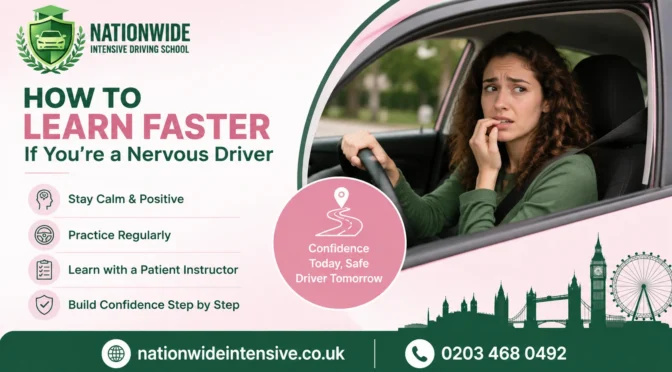
Nervous drivers can learn faster by making lessons consistent, breaking difficult skills into smaller steps, and gradually getting comfortable with situations they find stressful. As an experienced driving instructor, I’ve found that nervous learners often don’t need more pressure, they need the right pace, clear explanations and plenty of repetition. With the right approach, confidence and driving ability can improve together.
If you’re nervous about learning to drive, you might feel like you’re progressing more slowly than everyone else.
Maybe you hesitate at junctions, panic when a car drives close behind you, overthink roundabouts or worry about stalling before you’ve even started the engine.
I’ve worked with many nervous learners, and there’s one thing I always tell them:
You don’t need to become confident first and then learn to drive. You build confidence by learning and practising.
The trick is to make that process manageable rather than overwhelming.
Here are some practical ways nervous drivers can learn faster without putting themselves under unnecessary pressure.
Why Do Nervous Drivers Sometimes Learn More Slowly?
Driving requires you to process lots of information at once.
You’re thinking about:
- Steering
- Speed
- Mirrors
- Road signs
- Pedals and gears
- Other road users
- Junctions
- Hazards
- Your next decision
When you’re nervous, your brain can spend even more energy worrying about what might go wrong.
That can make simple tasks feel harder than they actually are.
The solution isn’t simply to “stop being nervous”. It’s to reduce the amount of pressure you’re putting on yourself while gradually increasing your experience.
1. Don’t Try to Fix Everything in One Lesson
One of the biggest mistakes nervous learners make is trying to improve everything simultaneously.
Instead, choose one or two specific goals.
For example, today’s lesson might focus on:
- Smooth clutch control
- Approaching roundabouts
- Better mirror checks
- Parking
- Junction observations
Once those skills become more comfortable, move on to the next challenge.
This makes progress easier to see and gives you small wins that build confidence.
2. Take Driving Lessons Consistently
Long gaps between lessons can be particularly difficult for nervous learners.
If you only drive every two or three weeks, you may spend the beginning of each lesson getting comfortable again.
Regular Driving Lessons Selsdon can help you maintain momentum and make driving feel more familiar.
You don’t necessarily need lessons every day. The important thing is creating a schedule you can maintain without feeling overwhelmed.
Consistency is usually more useful than cramming too much into a single session.
3. Tell Your Instructor Exactly What Makes You Nervous
Don’t simply tell your instructor, “I’m nervous.”
Be specific.
For example:
“I panic when approaching busy roundabouts.”
Or:
“I lose confidence when cars are waiting behind me.”
This gives your instructor something practical to work with.
A good lesson can then introduce that situation gradually, starting somewhere quieter before moving towards busier roads.
The aim isn’t to throw you into the most difficult situation immediately.
It’s to make the situation feel increasingly normal.
4. Stop Avoiding the Things That Scare You
Avoidance can make driving anxiety stronger.
If roundabouts make you nervous and you avoid them every lesson, they’ll continue to feel unfamiliar.
Instead, practise them gradually.
Start with:
- Quiet roundabouts.
- Simple traffic conditions.
- Different times of day.
- Busier multi-lane roundabouts.
- More independent decision-making.
Each successful attempt gives you another experience to draw on.
Eventually, something that once felt intimidating can become routine.
5. Practise Between Professional Lessons
If you have access to a suitable supervising driver, private practice can significantly reinforce what you’re learning with your instructor.
You don’t need to spend hours driving.
Even 20–30 minutes focused on one skill can be useful.
You could practise:
- Moving off and stopping
- Junctions
- Parking
- Roundabouts
- Speed control
- Mirror routines
- Reading road signs
Always make sure any private practice is carried out legally and safely with an appropriate supervising driver.
6. Don’t Treat Every Mistake as a Failure
This is a major confidence killer.
You miss a mirror check and immediately think:
“I’m terrible at driving.”
That’s not useful.
Instead ask:
“Why did I miss it?”
Maybe you were concentrating too heavily on a junction.
Maybe you were nervous because traffic was building up.
Maybe you simply forgot.
Once you understand the reason, you can work on the solution.
Mistakes are feedback. They’re part of the learning process.
7. Use Mock Driving Tests to Reduce Test Anxiety
Nervous learners often struggle more during the practical driving test because the situation feels unfamiliar.
Mock tests can help.
Your instructor can recreate test conditions, including:
- Independent driving
- Sat-nav directions
- Manoeuvres
- Junctions
- Different road types
- Minimal prompting
The more familiar the experience becomes, the less intimidating the real test can feel.
8. Consider an Intensive Driving Course
For some nervous learners, weekly lessons leave too much time between sessions.
An Intensive Driving Course Selsdon can provide concentrated practice over consecutive days, allowing you to reinforce skills while they’re still fresh.
This doesn’t mean an intensive course is automatically better than weekly lessons.
It depends on how you learn.
However, learners who benefit from repetition and routine may find intensive training particularly useful.
It can also be helpful if you’re preparing for a practical driving test and want to build confidence within a shorter timeframe.
9. Consider Whether Automatic Driving Would Reduce Your Stress
If you’re learning in a manual car, you have to coordinate:
- Clutch
- Accelerator
- Gears
- Steering
- Mirrors
- Road awareness
That’s a lot to manage when you’re already nervous.
For some learners, automatic driving lessons make the process easier because there is no clutch control or manual gear changing to worry about.
Others prefer manual driving lessons because they want the flexibility associated with a manual licence.
Neither option is universally better. The right choice is the one that allows you to concentrate on becoming a safe, confident driver.
A Simple Routine for Nervous Learners
Before each lesson, try this:
Before driving: Take a few slow breaths and decide on one goal.
During the lesson: Focus on the road immediately in front of you rather than worrying about the entire journey.
After the lesson: Write down one thing you improved and one thing to practise next time.
This simple routine keeps your attention on progress rather than mistakes.
Frequently Asked Questions
Can nervous drivers learn to drive quickly?
Yes. Nervousness doesn’t determine how quickly you can learn. With consistent lessons, targeted practice and gradual exposure to difficult situations, nervous learners can make excellent progress.
How can I stop being nervous during driving lessons?
Tell your instructor what specifically makes you anxious, then work on those situations gradually. Regular practice can make unfamiliar roads and situations feel much more normal.
Are weekly driving lessons enough for nervous learners?
They can be. The most important factor is consistency. If you can combine regular professional lessons with safe private practice, you may progress more steadily.
Is an intensive driving course good for nervous drivers?
It can be, particularly for learners who benefit from frequent repetition. An intensive course can help keep skills fresh and build confidence over consecutive days.
Is an automatic car easier for nervous learners?
Many learners find automatic cars easier because they don’t need to manage clutch control and manual gear changes. This can allow them to focus more on observations, hazards and road positioning.
Final Thoughts
Learning to drive when you’re nervous can feel frustrating, especially when you see other learners progressing quickly.
But don’t assume that being nervous means you’ll always be a slow learner.
From an instructor’s perspective, the biggest improvements often happen when learners stop putting pressure on themselves to be perfect. Break difficult skills into smaller steps, practise consistently, and gradually expose yourself to the situations you find challenging.
If you’re looking for supportive Driving Lessons Selsdon, choosing an instructor at Nationwide Intensive LTD. who understands nervous learners can make the learning process much more comfortable. And if you prefer concentrated training, an Intensive Driving Course Selsdon can help you build consistency and confidence through regular practice.
You can also explore whether automatic driving lessons or manual driving lessons better suit your confidence and long-term driving goals.
The goal isn’t to become fearless before you drive. It’s to become comfortable enough to keep driving, keep learning and gradually realise that the situations that once scared you aren’t as difficult as they seemed.
