

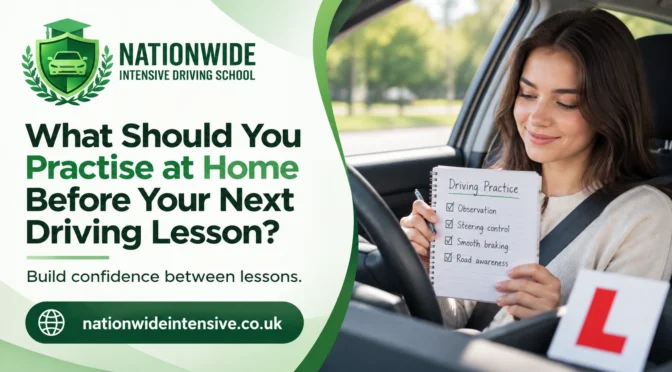
Before your next driving lesson, practise the things that don’t require you to be behind the wheel. Review road signs, mentally rehearse routines such as moving off and junctions, study common hazards, revisit your instructor’s feedback and plan what you want to improve next time. A little preparation at home can make your actual lesson more focused and productive.
You don’t have to be sitting in the driver’s seat to practise driving.
In fact, some of the best preparation happens when the car is parked and you’ve got a cup of tea in your hand.
When learners come back to a lesson after several days, they sometimes say:
“I’ve forgotten everything we did last time.”
Usually, they haven’t.
They just haven’t thought about it since.
As a driving instructor, one of the simplest things I’d recommend is spending 10–20 minutes between lessons thinking about what you’ve already learned.
It doesn’t need to feel like homework.
You simply want to keep the information fresh in your mind.
1. Go Over Your Last Instructor Feedback
Start here.
Think about the last lesson and ask:
What did I do well?
What did I struggle with?
What did my instructor tell me to improve?
Maybe you were told to:
- Check mirrors earlier.
- Approach junctions more slowly.
- Improve clutch control.
- Look further ahead.
- Position better at roundabouts.
- Keep a safer following distance.
- Make decisions earlier.
Pick one or two points.
Trying to remember every piece of feedback at once can make your next lesson feel overwhelming.
If you’re taking Driving Lessons Pollards Hill, keeping a simple note of your main improvement points can help you and your instructor focus your next session.
2. Revise UK Road Signs
Road signs are something you can easily practise at home.
Look through common UK signs and make sure you understand what they mean.
Pay particular attention to signs relating to:
- Speed limits
- Give Way
- Stop
- No Entry
- One-way roads
- Roundabouts
- Pedestrian crossings
- Parking restrictions
- Bus lanes
- Warning hazards
Don’t just memorise the picture.
Ask yourself:
“If I saw this sign while driving, what would I need to do differently?”
That’s a much more useful way to learn.
3. Practise Hazard Awareness
You can also improve your hazard perception without driving.
Watch a road scene and identify potential hazards.
For example:
A parked van: Could someone step out?
A cyclist: Could they move around an obstruction?
A pedestrian near the kerb: Might they cross?
A junction ahead: Could another vehicle emerge?
You’re training yourself to think ahead rather than simply react when something happens.
This type of hazard awareness is extremely useful when you’re learning to drive.
4. Mentally Rehearse Your Driving Routine
This might sound strange at first, but mental rehearsal can be useful.
Imagine yourself sitting in the driver’s seat.
Picture:
Starting the engine → checking your surroundings → moving off → checking mirrors → approaching a junction → adjusting speed → observing → making a safe decision.
You don’t need to sit there for an hour doing this.
A few minutes is enough.
The purpose isn’t to memorise a rigid script.
It’s to become familiar with the sequence of actions so you’re less likely to feel overwhelmed during the actual lesson.
5. Study the Roads Around You
If you regularly have Driving Lessons Pollards Hill, pay attention to the roads you travel on as a passenger.
Look at:
- Lane markings
- Junction layouts
- Traffic lights
- Pedestrian crossings
- Bus stops
- Roundabouts
- Speed-limit signs
- Road markings
- Parking restrictions
Ask yourself:
“If I were driving here, what would I need to watch for?”
This turns an ordinary journey into a useful observation exercise.
Of course, don’t distract the driver you’re travelling with. Your attention should remain on being a passenger.
6. Use Maps to Plan Routes
Before your next lesson, you can look at the general area where you’ll be driving.
You don’t need to memorise the route.
Instead, identify the types of roads you might encounter.
For example:
- Residential streets
- Busy main roads
- Multi-lane roads
- Roundabouts
- Narrow roads
- Junctions
- Areas with parked vehicles
This can reduce the surprise factor when you encounter them during a lesson.
Remember, though: your instructor may deliberately choose a different route based on your ability and the skills you’re practising.
7. Practise Explaining What You Would Do
Here’s a simple exercise.
Imagine you’re approaching a junction.
Talk yourself through the situation:
“I’d check my mirrors.”
“I’d reduce my speed.”
“I’d look for signs and road markings.”
“I’d check for traffic and pedestrians.”
“I’d decide whether it’s safe to proceed.”
You’re practising decision-making, not pretending you’re actually driving.
This can be particularly useful if you tend to freeze when your instructor asks:
“What are you thinking?”
8. Review Your Weakest Skill
Don’t spend all your preparation time practising things you’re already good at.
If you consistently struggle with roundabouts, revise roundabout rules.
If junctions cause problems, think about approach speed and observation.
If you struggle with parking, mentally review the reference points your instructor has taught you.
The aim is simple:
Turn your weakest area into your next practice target.
9. Don’t Try to Teach Yourself Everything
This is important.
The internet is full of driving advice, but not every technique you find online will be appropriate for your particular situation.
Your instructor can see how you actually drive and explain what needs changing.
So use online resources and revision materials to support your lessons—not to replace professional instruction.
If you’re unsure about something you’ve read, ask your instructor at the next lesson.
10. Can You Practise Actual Driving at Home?
Only if you have access to a suitable vehicle, an appropriately qualified and experienced supervising driver, and the correct insurance and legal requirements are met.
Never practise on private or public roads simply because you think an area is quiet.
If you are practising legally with a supervisor, follow their instructions and your instructor’s guidance.
Otherwise, there is plenty you can do without moving the car at all.
What About Learners Taking an Intensive Course?
The same preparation can be particularly useful during an Intensive Driving Course Pollards Hill.
With lessons closer together, you have less time between sessions.
That means reviewing what you learned immediately after each lesson can help keep important information fresh.
For example:
Lesson 1: Junctions
At home: Review junction observations and signs
Lesson 2: Roundabouts
At home: Revisit positioning and priorities
Lesson 3: Independent driving
At home: Think about planning and following directions
This creates a continuous learning cycle rather than treating every lesson as a separate event.
What About Manual and Automatic Learners?
Your at-home preparation can be useful regardless of the car you’re learning in.
With manual driving lessons, you may want to mentally review clutch control, gear selection and moving-off routines.
With automatic driving lessons, you can focus more heavily on observation, speed control, road positioning, junctions and hazard awareness.
The exact areas you need to practise will depend on your current ability.
A Simple 15-Minute At-Home Routine
If you don’t know where to start, try this before your next lesson:
5 minutes: Review your instructor’s last feedback.
5 minutes: Revise road signs or hazard awareness.
5 minutes: Mentally rehearse the skill you’re currently learning.
That’s it.
You don’t need to turn learning to drive into a second full-time job.
Consistency matters more than spending hours studying.
Frequently Asked Questions
Can I practise driving skills without a car?
Yes. You can revise road signs, study hazards, mentally rehearse driving routines and review your instructor’s feedback without physically driving.
How long should I practise at home?
Even 10–20 minutes can be useful. Short, regular preparation is generally more practical than trying to study for hours.
Should I practise driving with a family member?
You can only do so legally if you meet the relevant UK learner-driver requirements, including appropriate supervision and insurance. If you’re unsure, check the current rules before driving.
What should I revise before my next lesson?
Focus on what your instructor identified as your weakest area. This could be junctions, roundabouts, clutch control, mirror checks, road positioning or hazard awareness.
Can home practice help with an intensive driving course?
Yes. Reviewing each lesson while it’s still fresh can help you maintain continuity during concentrated training.
Should I memorise every driving routine?
No. You want to understand what you’re doing and why, rather than blindly memorising a sequence that may not apply to every road situation.
