

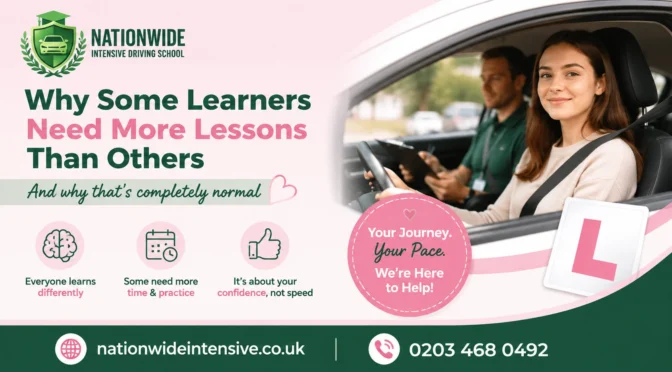
Some learners need more driving lessons because everyone starts with different levels of confidence, coordination, road experience and learning speed. As an experienced driving instructor, I’ve seen learners become test-ready after very different amounts of training. Needing more lessons doesn’t mean you’re a poor driver. What matters is whether you’re becoming safer, more consistent and more confident behind the wheel.
One of the questions I hear from learners all the time is:
“My friend passed after 25 lessons. Why do I still need more?”
It’s a completely understandable question.
When you’re spending money on driving lessons and someone you know seems to be progressing much faster, it’s easy to wonder whether you’re doing something wrong.
But after years of teaching learner drivers, I’ve learned that comparing lesson numbers is rarely useful.
I’ve had learners who picked up vehicle control almost immediately but struggled with road awareness. I’ve also taught learners who needed more time with clutch control but became excellent at planning and hazard awareness.
Everyone learns differently.
Here’s why some people need more lessons, and why that’s perfectly normal.
How Many Driving Lessons Does a Learner Need?
There isn’t one fixed number of driving lessons that every UK learner needs.
Some people become test-ready relatively quickly, while others need significantly more practice before they can drive safely and independently.
Your total lesson requirement can depend on:
- Previous driving experience
- Confidence levels
- How regularly you practise
- Your ability to process information
- Vehicle control
- Road awareness
- How quickly new skills become automatic
- The amount of private practice you get
The number of lessons you’ve taken isn’t as important as the standard of your driving.
1. Everyone Starts With Different Experience
Not every learner starts from the same place.
Someone who has spent years riding a bicycle, driving off-road or travelling regularly as a passenger may already have a strong understanding of traffic movement and road positioning.
Another learner may have never controlled a vehicle before.
Naturally, their learning journeys will be different.
Neither learner is better.
They’re simply starting with different experiences.
2. Confidence Can Affect How Quickly You Learn
Confidence plays a surprisingly important role in driving.
A nervous learner may understand exactly what they’re supposed to do but hesitate when they have to make a decision independently.
For example, they might know how to approach a roundabout but become unsure when several vehicles arrive at the same time.
That’s not necessarily a knowledge problem.
It’s often an experience problem.
The more safe situations you experience, the easier it becomes to make decisions without overthinking them.
This is why Driving Lessons Addiscombe should be adapted to the individual learner rather than following exactly the same pace for everyone.
3. Some Skills Simply Take Longer to Become Automatic
When you’re learning to drive, you’re doing several things at once.
You might be thinking about:
- Steering
- Clutch control
- Gear changes
- Mirrors
- Signals
- Speed
- Road signs
- Pedestrians
- Other vehicles
- Hazards
At first, your brain has to consciously process many of these actions.
Over time, they become more automatic.
For some learners, this happens quickly.
For others, it takes more repetition.
There’s nothing unusual about that.
4. The Type of Roads You Drive On Matters
Someone who regularly practises on quiet residential roads may feel confident there but struggle when introduced to busy town centres.
Another learner might live near complicated junctions and gain experience with heavy traffic much earlier.
Your driving environment can therefore affect your progress.
A good instructor should gradually expose you to different situations, including:
- Residential roads
- Busy town centres
- Multi-lane roundabouts
- Dual carriageways
- Different speed limits
- Rural roads
- Independent driving
The wider your experience, the better prepared you’ll be for your practical driving test.
5. Private Practice Can Make a Big Difference
Professional instruction is important, but supervised practice between lessons can reinforce what you’re learning.
If you have access to an appropriate supervising driver and a suitable vehicle, additional practice can help develop:
- Clutch control
- Parking
- Junction observations
- Speed awareness
- Roundabout confidence
- Independent driving
Even relatively short practice sessions can help keep skills fresh.
However, private practice should complement, not replace, professional driving instruction.
6. Weekly Lessons May Not Suit Everyone
Some learners progress well with one lesson each week.
Others find that the gaps between lessons make it harder to retain new skills.
If you repeatedly feel like you’re starting again every week, a more concentrated approach could be worth considering.
An Intensive Driving Course Addiscombe gives learners the opportunity to practise regularly over consecutive days.
This can help reinforce:
- Vehicle control
- Observation routines
- Road positioning
- Hazard awareness
- Decision-making
- Driving confidence
An intensive course isn’t automatically better than weekly lessons. It simply suits a different learning approach.
7. Nervous Learners Often Need More Repetition
If you’re anxious behind the wheel, don’t be surprised if certain situations take longer to master.
A nervous learner may need several attempts at the same roundabout before feeling comfortable.
That’s not wasted time.
Each repetition builds familiarity.
Eventually, the situation that once caused anxiety becomes something you can handle without thinking too much about it.
Trying to rush this process can actually make anxiety worse.
8. Don’t Measure Progress by Lesson Numbers
This is probably the most important point.
Instead of asking:
“How many lessons have I had?”
ask:
“What can I do now that I couldn’t do three months ago?”
Maybe you’re now comfortable driving independently.
Maybe you’ve stopped stalling.
Maybe you can handle busy roundabouts.
Maybe you’re much better at spotting hazards.
Those are meaningful signs of progress.
A learner who needs 45 lessons but becomes a safe, confident driver has achieved far more than someone who rushes through 25 lessons without developing the necessary skills.
When Do You Know You’re Ready for the Practical Test?
You should be approaching test readiness when you can consistently:
- Drive safely without constant instructor prompts.
- Make appropriate decisions independently.
- Handle different road conditions.
- Complete manoeuvres safely.
- Maintain suitable speed and positioning.
- Identify and respond to hazards.
- Recover calmly from minor mistakes.
Your instructor should give you honest feedback about your readiness rather than simply booking a test because you’ve completed a certain number of lessons.
Frequently Asked Questions
Is it normal to need more than 40 driving lessons?
Yes. Some learners need more professional instruction than others. The number of lessons required depends on your experience, confidence, practice and individual learning pace.
Does needing more driving lessons mean I’m a bad driver?
No. Lesson numbers don’t determine whether you’re a good or bad driver. Safe decision-making, road awareness and consistent vehicle control are much more important.
Can private practice reduce the number of lessons I need?
It can help. Regular supervised practice can reinforce skills learned during professional lessons and give you more experience between sessions.
Are intensive driving courses better for learners who need more lessons?
Not necessarily. Intensive courses can be useful for learners who benefit from frequent repetition, while others may prefer the slower pace of weekly lessons. The right option depends on how you learn.
Is automatic driving easier to learn?
Many learners find automatic driving lessons easier because there is no clutch control or manual gear changing. However, manual driving lessons can provide greater flexibility if you want to drive manual vehicles after passing your test.
Final Thoughts
There is no magic number of driving lessons that guarantees you’ll become test-ready.
From my experience as a driving instructor, the learners who make the best progress are usually the ones who stop worrying about how many lessons they’ve had and start focusing on what they’re actually improving.
If you need more time to master roundabouts, parking, clutch control, observations or independent driving, that’s completely fine. Learning at a steady pace is far better than rushing towards a test before you’re ready.
If you’re looking for structured Driving Lessons Addiscombe, choose an instructor at Nationwide Intensive LTD. who is willing to adapt lessons around your individual strengths and weaknesses. And if you learn better through frequent repetition, an Intensive Driving Course Addiscombe could help you build confidence and consistency over a shorter period.
You can also consider whether automatic driving lessons or manual driving lessons better suit your goals.
The aim isn’t to finish your lessons as quickly as possible. It’s to leave them as a safe, confident driver who can handle real roads independently, and that’s worth taking the time to achieve.
