

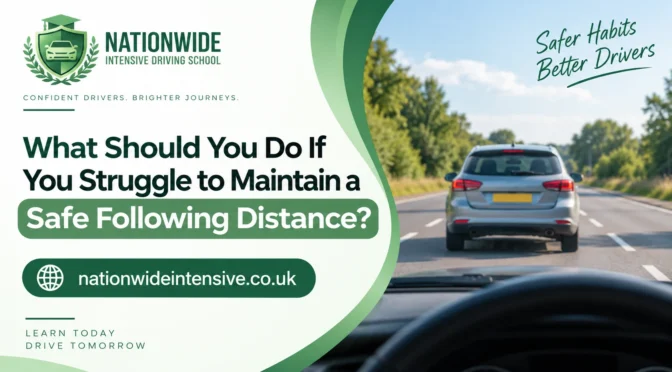
If you struggle to maintain a safe following distance, stop focusing only on the car directly in front and start looking further ahead. Use the two-second rule in normal conditions and increase the gap when roads are wet, icy or visibility is poor. If the vehicle ahead slows, ease off the accelerator early rather than braking sharply. With regular practice, you’ll learn to judge space without constantly counting or thinking about it.
One of the easiest driving habits to underestimate is your following distance.
When you’re learning, it can feel like you’re constantly thinking about everything:
“Am I too close?”
“Should I brake?”
“Why is that car slowing down?”
“Is this gap actually safe?”
And before you know it, you’re either driving too close to the vehicle ahead or leaving such a huge gap that you’re worried other drivers will pull into it.
Don’t worry. This is extremely common.
As a driving instructor, I’ve found that following distance becomes much easier once learners understand why the gap matters, rather than simply trying to memorise a number.
Why Is a Safe Following Distance Important?
The gap between your car and the vehicle ahead gives you time to react if something unexpected happens.
The driver in front might:
- Brake suddenly.
- Slow for a pedestrian.
- Stop in traffic.
- Encounter an obstruction.
- React to a cyclist.
- Miss a hazard and brake at the last moment.
If you’re already too close, you have much less time to respond.
A safe following distance isn’t about being overly cautious. It’s about giving yourself time and space to react.
What Is the Two-Second Rule?
In normal, dry conditions, a useful way to judge your following distance is the two-second rule.
Choose a fixed point on the road, such as a sign, lamp post or tree.
When the vehicle in front passes it, say:
“Only a fool breaks the two-second rule.”
Your vehicle should reach the same point after at least two seconds.
If you reach it before you’ve finished the phrase, you’re probably too close.
This is a simple technique to practise during Driving Lessons Addiscombe.
Does the Following Distance Need to Change in Bad Weather?
Absolutely.
Two seconds isn’t a universal gap for every situation.
When conditions become more difficult, you need more space.
Think about:
- Rain
- Wet roads
- Ice
- Snow
- Fog
- Poor visibility
- Darkness
- Heavy traffic
On wet roads, for example, your vehicle may require more distance to stop safely.
So rather than obsessing over an exact number, develop the habit of asking:
“Do I have enough space to react if that vehicle brakes suddenly?”
If the answer is no, increase the gap.
Why Do Learners Keep Getting Too Close?
There are several common reasons.
You’re Looking Too Close
If you’re staring only at the back of the vehicle ahead, you may not notice that traffic is slowing until it’s already happening.
Look further ahead.
If you can see several vehicles in front beginning to slow, you can ease off earlier.
You’re Matching the Wrong Speed
Sometimes learners unconsciously match the vehicle ahead too closely.
Instead, control your speed independently.
You don’t have to stay exactly the same distance behind the vehicle at every moment.
You’re Not Planning Ahead
Good following distance is connected to forward planning.
If you see a red traffic light ahead, a queue forming or a pedestrian approaching a crossing, start adjusting your speed early.
Don’t wait until you’re right behind the vehicle.
What Should You Do If the Car in Front Suddenly Slows?
Don’t panic.
First, come off the accelerator and assess what’s happening.
If necessary, brake progressively and maintain control.
This is why having a reasonable gap is so useful.
You have more time to respond without immediately needing harsh braking.
Your instructor can deliberately create different traffic situations during a lesson so you can practise responding calmly.
What If Someone Keeps Driving Too Close Behind You?
This is another situation that makes learners nervous.
If another driver is tailgating you, don’t speed up simply because they’re pressuring you.
Continue driving at an appropriate speed for the road and conditions.
Maintain a safe gap from the vehicle in front.
That gives you more room to respond if traffic changes suddenly.
If necessary, your instructor can show you how to deal with tailgaters safely without becoming distracted by them.
Should You Leave a Larger Gap in Heavy Traffic?
Yes, when practical.
Heavy traffic can involve constant stopping and starting.
If you drive extremely close to the vehicle ahead, you’ll constantly need to brake and accelerate.
A little extra space can make your driving smoother and give you more time to react.
However, you also need to remain aware of traffic around you and avoid creating an unnecessarily large gap that causes confusion.
The goal is safe, controlled spacing.
How Can You Practise Following Distance?
Don’t just practise counting seconds.
Try to develop your visual judgement.
During your lessons, ask yourself:
What is happening ahead?
Is traffic slowing?
How quickly am I approaching the vehicle?
What happens if they brake now?
Do I have enough time to react?
Over time, you’ll begin to judge the distance naturally.
This is particularly useful during Driving Lessons Addiscombe, where you may encounter a mixture of residential roads, busier routes, parked vehicles and changing traffic conditions.
Can an Intensive Driving Course Help With Following Distance?
It can be useful if you need more concentrated road practice.
An Intensive Driving Course Addiscombe gives you the opportunity to spend more time developing your observation, speed control and hazard awareness over a shorter period.
Following distance can then be practised alongside:
- Forward planning
- Mirror checks
- Speed control
- Hazard perception
- Urban driving
- Traffic queues
- Junctions
- Roundabouts
- Independent driving
The more varied situations you experience, the easier it becomes to judge appropriate space.
What If You Leave Too Much Space?
This can happen too.
Some nervous learners become so focused on avoiding tailgating that they leave an unnecessarily large gap.
Don’t feel that you have to close the gap immediately.
Instead, maintain a sensible distance and adjust your speed gradually.
If another driver moves into the space, don’t get frustrated.
Simply create another safe gap.
Your job is to drive safely—not to protect a particular piece of road.
Does Your Choice of Car Make a Difference?
Your basic following-distance principles remain the same whether you’re driving a manual or automatic car.
However, some learners find automatic driving lessons easier because they don’t have to manage clutch and gear changes while concentrating on traffic.
That can make it easier to focus on:
- Vehicle spacing
- Brake lights
- Traffic flow
- Pedestrians
- Cyclists
- Road hazards
With manual driving lessons, you’ll need to coordinate gear and clutch control alongside your observations.
Neither option is automatically better. The important thing is choosing the type of driving that suits your circumstances and long-term plans. Nationwide Intensive LTD. is here to help you with that.
Frequently Asked Questions
What is a safe following distance in the UK?
In normal conditions, the two-second rule is a useful guide. Increase the distance when conditions are wet, icy, slippery or visibility is reduced.
How do I stop driving too close to the car in front?
Look further ahead, come off the accelerator earlier when traffic slows and use a fixed roadside point to check your following distance.
Should I use the two-second rule in the rain?
You should increase your following distance in wet conditions because stopping can take longer. Don’t rely on the normal two-second gap when conditions are poor.
What should I do if someone is tailgating me?
Don’t allow the driver behind to pressure you into speeding. Continue driving appropriately, maintain a safe gap ahead and avoid sudden braking.
Can following distance affect my driving test?
Yes. Failing to maintain an appropriate following distance can affect your assessment of vehicle control, planning and awareness. Your instructor can help you identify what is appropriate for different road and traffic conditions.
Can intensive driving lessons improve following-distance judgement?
Yes. Concentrated practice gives you more opportunities to experience different traffic speeds, road conditions and hazards, helping you develop better judgement.
