

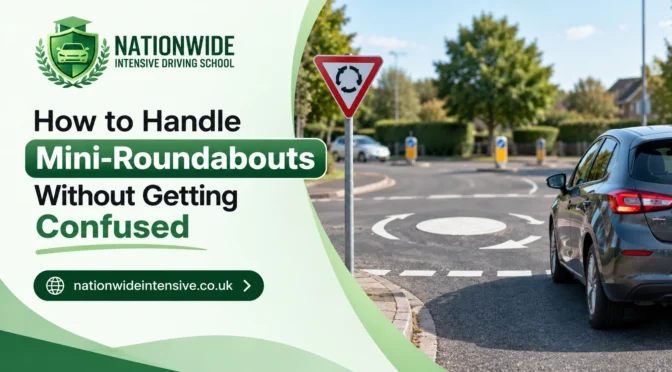
The easiest way to handle a mini-roundabout is to slow down early, observe all approaches, give priority to traffic coming from your right, choose the correct exit and steer smoothly around the central marking. Don’t treat every mini-roundabout like a large roundabout. They’re smaller and often give you less time to react, so good observation and a controlled approach are especially important.
Mini-roundabouts can be surprisingly stressful.
They’re tiny.
They look simple.
And yet, when you’re learning, they can suddenly feel like someone has dropped a complicated puzzle in the middle of the road.
You approach one and your brain starts firing questions:
“Which way is that car going?”
“Do I need to signal?”
“Who has priority?”
“Am I supposed to go around the middle?”
“What if they go first?”
Take a breath.
Mini-roundabouts aren’t as complicated as they initially appear. Once you understand the basic routine, most of the confusion disappears.
I’ve helped plenty of learners get comfortable with them, and the biggest improvement usually comes from slowing down and observing earlier, rather than trying to memorise lots of rules.
What Is a Mini-Roundabout?
A mini-roundabout is a roundabout with a much smaller central island or marking.
You’ll often find them on residential roads and at smaller junctions where a full-size roundabout isn’t practical.
Because they’re compact, vehicles may be closer together and you may have less time to make decisions.
That’s why observation and approach speed matter so much.
Who Has Priority at a Mini-Roundabout?
The basic rule is the same as at other UK roundabouts:
Give priority to traffic approaching from your right, unless signs, markings or the road layout tell you otherwise.
Don’t simply look directly to your right once and then go.
Keep observing.
Traffic can approach quickly, and another vehicle may be hidden by parked cars, buildings or other obstructions.
This is one of the first things I’d practise with a learner during Driving Lessons Waddon.
Slow Down Before You Reach It
A common mistake is approaching a mini-roundabout too quickly.
Because it’s small, learners sometimes think:
“I’ll just deal with it when I get there.”
That’s exactly what you don’t want.
Reduce your speed early enough to give yourself time to:
- Read the road.
- Check for signs.
- Observe approaching vehicles.
- Identify your exit.
- Decide whether you need to stop.
You may not need to stop at every mini-roundabout.
But you should approach at a speed that allows you to stop if necessary.
Look Right, But Don’t Forget Left
Priority is generally given to traffic from your right, but that doesn’t mean you should ignore everything else.
Before entering, take in the whole situation.
Look for:
- Vehicles approaching from the right.
- Vehicles already on the roundabout.
- Cyclists.
- Motorcycles.
- Pedestrians.
- Vehicles approaching from other directions.
- Road signs and markings.
A mini-roundabout can become busy very quickly.
Your eyes should keep moving rather than locking onto one vehicle.
Know Where You’re Going Before You Enter
Another reason learners get confused is not knowing which exit they’re taking.
Before reaching the roundabout, identify your destination.
Are you going:
Left? Straight ahead? Right?
Once you’ve established that, your positioning and signalling become easier to understand.
Don’t wait until you’re already on the roundabout to decide.
Good driving involves planning before the junction.
What About Signalling?
Signalling depends on the direction you’re taking and what would benefit other road users.
As a general guide, you would normally signal left when taking the first exit and signal right when taking a later exit to the right, cancelling the signal as appropriate and indicating left when leaving.
For going straight ahead, signalling practice depends on the road layout and exits.
Your instructor should teach you how to apply the signalling rules to the specific roundabouts you’re practising.
The important point is this:
Don’t signal automatically without considering what information you’re giving other road users.
Don’t Rush Because Someone Is Waiting
This happens all the time.
You’re approaching the mini-roundabout.
A car is waiting.
You think:
“They’re waiting for me, so I need to go.”
Not necessarily.
Priority and safety still matter.
Don’t allow another driver’s position or impatience to make the decision for you.
Take the time you need to assess the situation.
If it’s safe and appropriate to proceed, go.
If not, wait.
What If Two Cars Arrive Together?
This is where things can feel confusing.
Don’t get into a battle of wills.
Instead, look carefully at the road layout, priority and intentions of the other driver.
If another vehicle has priority, allow it to proceed.
If the situation is unclear, don’t force your way through simply because you’re technically allowed to continue.
Good driving involves co-operation as well as knowing the rules. Nationwide Intensive LTD. can help you with that.
Keep Your Steering Smooth
Because mini-roundabouts are compact, learners sometimes make a very sharp steering movement.
Try to keep your steering controlled.
Approach at an appropriate speed and follow the road around the roundabout.
Don’t mount the central island or marking unless the size and layout of the mini-roundabout specifically require a vehicle to do so and your instructor has explained how to negotiate it safely.
Your instructor can show you the appropriate technique for different mini-roundabout layouts.
What If You Miss Your Exit?
Don’t panic.
If you’ve accidentally gone past the exit you intended to take, don’t suddenly cut across another vehicle.
Continue safely and find another route.
Getting lost for a minute is not a driving disaster.
Making a sudden lane change or unsafe turn because you missed an exit is much more serious.
This is an important mindset to develop before your practical test:
Safety comes before getting the route exactly right.
Practise Different Mini-Roundabouts
Not every mini-roundabout feels the same.
Some are:
- Open and easy to see.
- Surrounded by parked cars.
- Located on busy residential roads.
- Close to pedestrian crossings.
- Positioned near schools.
- Used by buses and cyclists.
- Tight and difficult to see around.
That’s why practising just one repeatedly isn’t enough.
During Driving Lessons Waddon, ask your instructor to take you through different layouts.
You’ll gradually learn to recognise what information matters.
Can an Intensive Driving Course Help With Mini-Roundabouts?
If mini-roundabouts are one of your weak areas, concentrated practice can be particularly useful.
An Intensive Driving Course Waddon gives you more frequent opportunities to work on the same skill rather than waiting several days between lessons.
You can practise mini-roundabouts alongside:
- Junctions
- Large roundabouts
- Lane discipline
- Mirror checks
- Speed control
- Hazard awareness
- Independent driving
- Forward planning
The repetition can help turn a confusing process into something much more familiar.
Automatic or Manual: Does It Matter?
The roundabout rules don’t change because you’re driving an automatic.
However, some learners find automatic driving lessons less mentally demanding because they don’t need to coordinate clutch control and gear changes while making their observations.
With manual driving lessons, you’ll need to manage clutch and gear selection alongside steering, observation and traffic awareness.
If you’re nervous, talk to your instructor about which option best suits your circumstances.
A Simple Mini-Roundabout Routine
If you need something easy to remember, try this:
Approach → Slow → Observe → Decide → Signal → Go → Exit
Don’t turn this into a rigid checklist that distracts you from the road.
Use it as a mental framework.
The real skill is learning to read the situation.
Frequently Asked Questions
What is the main rule at a mini-roundabout?
Generally, give priority to traffic approaching from your right, unless signs, road markings or the specific layout indicate otherwise.
Do I always have to stop at a mini-roundabout?
No. You should approach at a suitable speed and stop if necessary to give priority or deal with a hazard. If the roundabout is clear and it’s safe to proceed, you may not need to stop.
Do you signal at a mini-roundabout?
Use signals where appropriate to communicate your intentions to other road users. The direction you’re taking and the road layout determine the appropriate signalling.
Why do I get confused at mini-roundabouts?
They’re small, traffic can be close together and decisions often need to be made quickly. Nervousness and approaching too fast can make the situation feel even more complicated.
Can I practise mini-roundabouts during an intensive course?
Yes. An intensive course can provide concentrated practice across different junctions and roundabouts, helping you develop observation and decision-making skills.
What should I do if I take the wrong exit?
Don’t make a sudden correction. Continue safely and follow the road until you can safely change direction or find another route.