

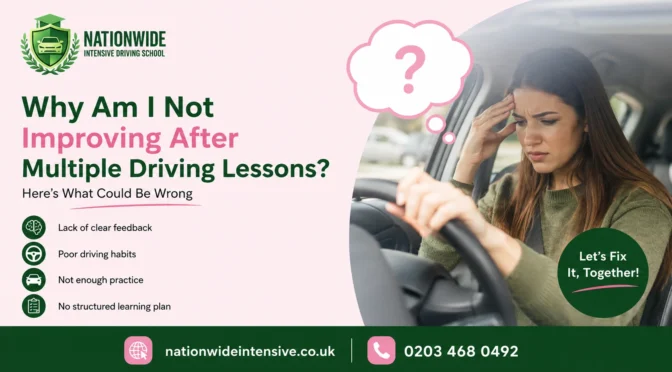
If you’ve had 15, 20, or even 30 driving lessons and still don’t feel like you’re getting better, you’re not alone. In my experience working with learner drivers, this usually isn’t because you’re a “bad driver.” More often, it’s because of inconsistent practice, low confidence, gaps between lessons, or a learning approach that doesn’t suit you. Once you identify what’s holding you back, your progress can improve much faster.
Learning to drive can feel frustrating, especially when you’ve invested time and money but still don’t feel ready for your practical driving test.
As someone who has worked with learner drivers for years, I’ve noticed something interesting. The students who worry the most about their progress are often the ones who eventually become safe, confident drivers. They care about improving, and that’s a good sign.
Many learners reach a stage where it feels like they’re making the same mistakes repeatedly. We call this a learning plateau, and it’s completely normal. It doesn’t mean you’ve stopped learning it simply means your brain is processing more advanced driving skills.
Let’s look at why this happens and what you can do about it.
What Is a Driving Learning Plateau?
A driving learning plateau is a stage where your improvement feels slower, even though you’re still attending lessons.
This usually happens once you’ve mastered the basics like moving off, steering and changing gears. Now you’re expected to combine several skills at once, including:
- Reading road signs
- Planning ahead
- Using the Mirror-Signal-Manoeuvre (MSM) routine
- Judging speed at roundabouts
- Spotting developing hazards
- Making safe decisions under pressure
These skills take time to become automatic.
1. You’re Leaving Too Much Time Between Driving Lessons
One of the biggest reasons learners stop improving is inconsistent practice.
I’ve seen learners who take one lesson every three weeks and spend half the session trying to remember what they learned last time.
Regular lessons help build momentum.
If you’re booking Driving Lessons Beddington every week, you’ll usually retain more information and develop confidence much faster than someone who drives only once a month.
Consistency is often more important than lesson length.
2. You’re Trying to Pass the Test Instead of Becoming a Good Driver
Many learners become focused on passing the DVSA practical test.
That’s understandable but it can actually slow your progress.
A good instructor should teach you how to:
- Read traffic early
- Anticipate hazards
- Drive independently
- Make safe decisions
- Adapt to different road conditions
When you become a confident driver, passing the test often becomes the natural outcome.
3. You’re Overthinking Every Decision
This is something I see regularly.
After around 15–20 lessons, many learners know what to do, but they’re still consciously thinking through every step.
For example:
“Mirror… signal… clutch… gear… check mirror again…”
That mental overload creates hesitation.
With regular practice, these actions gradually become automatic, allowing you to focus more on what’s happening around you rather than what your hands and feet are doing.
4. Confidence Is Affecting Your Driving More Than Your Ability
One of the biggest misconceptions is that confidence comes before skill.
In reality, confidence usually comes after repeated success.
I’ve taught learners who drove perfectly during lessons but made simple mistakes because they worried about making mistakes.
If you feel nervous approaching roundabouts, dual carriageways or busy junctions, you’re in good company.
Building confidence happens gradually through controlled exposure not by avoiding challenging situations.
5. You’re Not Practising Outside Professional Lessons
According to DVSA guidance, most learners benefit from combining professional instruction with additional supervised practice between lessons.
Even one hour a week with a qualified supervising driver can reinforce:
- Clutch control
- Bay parking
- Parallel parking
- Junction observations
- Speed awareness
- Independent driving
The more quality practice you get, the quicker these skills become natural.
6. Your Instructor’s Teaching Style May Not Suit You
- Every learner is different.
- Some people learn best through demonstrations.
- Others need detailed explanations.
- Some simply need more repetition.
If you’ve had several lessons but still don’t understand why you’re making certain mistakes, it’s worth having an honest conversation with your instructor.
Sometimes changing the teaching approach not necessarily changing instructors can make a remarkable difference.
7. You’re Avoiding the Skills That Challenge You
We naturally prefer practising things we’re already comfortable with.
Unfortunately, that’s rarely where improvement happens.
The learners who progress fastest gradually challenge themselves with:
- Busy roundabouts
- Multi-lane junctions
- Dual carriageways
- Hill starts
- Independent driving routes
- Heavy traffic
Every difficult road you successfully complete builds confidence for the next one.
8. An Intensive Driving Course Could Suit Your Learning Style
Not everyone learns effectively with one lesson every week.
Some learners make much faster progress by immersing themselves in driving over consecutive days.
An Intensive Driving Course Beddington allows you to reinforce yesterday’s lesson immediately instead of waiting another week.
Many learners find this improves:
- Confidence
- Muscle memory
- Decision-making
- Road awareness
- Overall driving consistency
If you’re working towards a practical test in the near future, an intensive course may be worth considering.
9. You’re Comparing Yourself to Other Learners
This is probably the most damaging habit of all.
One learner may pass after 25 hours.
Another may need 50.
Neither outcome means someone is a better driver.
Everyone starts with different levels of confidence, coordination and previous road experience.
The only progress that matters is your own.
How Can You Start Improving Faster?
If your progress has slowed, try these practical steps:
- Take lessons consistently rather than leaving long gaps.
- Ask your instructor exactly which three skills need the most improvement.
- Practise between lessons whenever possible.
- Stop avoiding difficult roads or manoeuvres.
- Focus on becoming a safe driver rather than simply passing the test.
- Consider an intensive course if weekly lessons aren’t helping you build momentum.
Small adjustments often produce surprisingly big improvements.
Frequently Asked Questions
Is it normal not to improve after 20 driving lessons?
Yes. Many learners experience a learning plateau after mastering the basics. Progress often slows before confidence increases, especially when learning more complex driving situations like roundabouts and independent driving.
How many driving lessons does the average learner need in the UK?
The DVSA states that many learners need around 45 hours of professional lessons, alongside additional private practice. However, every learner develops at a different pace.
Should I change my driving instructor if I’m not improving?
Not necessarily. Start by discussing your concerns openly. Sometimes adjusting the teaching approach is enough. If you still don’t feel you’re progressing after several conversations, changing instructors may be the right decision.
Are intensive driving courses better than weekly lessons?
It depends on your learning style. Many learners retain information better during intensive courses because they’re practising consistently over consecutive days rather than waiting a week between lessons.
Can driving anxiety slow my progress?
Absolutely. Anxiety can affect judgement, observations and decision-making. A patient instructor, regular practice and gradually tackling more challenging roads can help build confidence over time.
Final Thoughts
If you’re wondering why you’re not improving after multiple driving lessons, remember that feeling stuck doesn’t mean you’re failing.
In fact, many learners experience this stage before they make their biggest breakthrough.
The key is to identify what’s holding you back, whether that’s inconsistent practice, confidence, your learning style or simply needing more structured guidance.
If you’re looking for professional Driving Lessons Beddington, Contact Nationwide Intensive LTD. learning with experienced instructors who tailor lessons to your pace can make all the difference. And if you’d prefer to build confidence more quickly, an Intensive Driving Course Beddington could help you gain momentum and prepare for your practical test sooner.
Whether you’re considering regular lessons, an intensive course, or deciding between automatic driving lessons and manual driving lessons, choosing the right learning approach is just as important as the number of lessons you take.
Remember, every confident driver on UK roads was once a learner. Progress isn’t measured by how quickly you pass, it’s measured by how safely and confidently you drive for years to come.
