

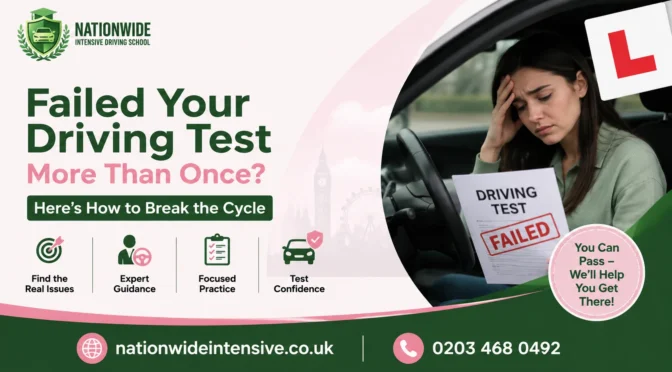
Failing your driving test more than once doesn’t mean you’re a bad driver. In my experience as a driving instructor, most learners who fail repeatedly aren’t lacking driving skills,they’re repeating the same mistakes, struggling with nerves, or going into the test before they’re truly ready. The good news is that once you identify the reason behind your previous test failures, you can make targeted improvements and significantly increase your chances of passing next time.
Learning to drive is a journey, and for some people, that journey includes more than one practical driving test.
Over the years, I’ve worked with many learner drivers who walked back to the car feeling disappointed after another failed test. Some had failed twice, others three or four times. Almost every one of them asked the same question:
“Maybe I’m just not good enough to drive?”
The answer was almost always no.
In reality, most learners don’t fail because they can’t drive. They fail because they’re making the same small mistakes under test pressure. Once we identified those patterns and worked on them, many of those same learners passed with confidence.
If you’ve failed your driving test more than once, here’s how you can finally break the cycle.
Why Do People Keep Failing Their Driving Test?
A failed driving test is rarely caused by one major mistake.
More often, it’s a combination of small issues such as:
- Test-day nerves
- Poor observations
- Rushing decisions
- Lack of confidence
- Weak planning skills
- Not enough experience in different traffic conditions
The important thing to remember is that these are all skills that can be improved.
Failing a test doesn’t define your ability,it simply highlights the areas that need a little more work.
1. Read Your Driving Test Report Carefully
One mistake I often see is learners booking another test without reviewing their previous result.
After every practical driving test, the examiner explains why you didn’t pass.
Pay attention to recurring faults.
For example, if you’ve received faults for:
- Mirror checks
- Junction observations
- Roundabouts
- Speed awareness
- Positioning
across multiple tests, those should become the main focus of your next lessons.
Don’t practise everything equally, practise what actually caused you to fail.
2. Stop Chasing the Pass Certificate
It’s understandable to want your full UK driving licence as soon as possible.
But when learners become obsessed with passing, they often put themselves under unnecessary pressure.
Instead, focus on becoming a calm, safe and confident driver.
The pass certificate usually follows naturally.
As instructors, we often say:
“Drive as if there isn’t an examiner in the car.”
That mindset alone can reduce unnecessary nerves.
3. Test Nerves Can Undo Good Driving
One of the biggest differences between a driving lesson and the practical test is pressure.
I’ve taught learners who drove confidently every week but suddenly forgot simple routines like Mirror-Signal-Manoeuvre (MSM) during the test.
If this sounds familiar, you’re not alone.
Building confidence comes from:
- Regular practice
- Mock driving tests
- Driving unfamiliar routes
- Learning breathing techniques before the test
The more familiar the experience feels, the less intimidating test day becomes.
4. You’re Booking the Next Test Too Soon
After failing, it’s tempting to book the next available test immediately.
Sometimes that’s the right decision.
Sometimes it isn’t.
If you haven’t corrected the faults that caused the previous failure, another test may simply produce the same outcome.
Take time to improve before sitting another practical test.
Quality preparation is far more valuable than rushing back into the examiner’s car.
5. Get Honest Feedback From Your Instructor
One of the most valuable conversations you can have is asking:
“If you were the examiner today, would you pass me?”
A good instructor will give you an honest answer.
Sometimes learners are surprised to hear they’re not quite test-ready yet.
Although it may feel disappointing, it’s much better than paying for another unsuccessful driving test.
If you’re taking Driving Lessons Hackbridge, your instructor should help you build a lesson plan around the exact skills that need improvement rather than repeating things you’ve already mastered.
6. Practise Different Roads and Traffic Conditions
Confidence grows through experience.
If you’ve only driven on familiar roads, the practical test can feel overwhelming when you’re faced with unfamiliar situations.
Try practising:
- Busy roundabouts
- Dual carriageways
- Residential streets
- Multi-lane junctions
- Different speed limits
- Independent driving routes using sat nav
The more situations you’ve experienced before your test, the fewer surprises you’ll face on the day.
7. Consider an Intensive Driving Course
Some learners lose momentum between weekly lessons.
If you’ve failed more than once, an Intensive Driving Course Hackbridge could help you rebuild confidence more quickly.
Learning over consecutive days allows you to reinforce new habits immediately instead of waiting another week before practising again.
Many learners also find intensive courses particularly helpful before a retest because everything stays fresh in their mind.
8. Stop Comparing Yourself to Other Learners
- One learner passes for the first time.
- Another passes on the fourth attempt.
- Both receive exactly the same full UK driving licence.
- Your journey is your own.
The DVSA practical test measures whether you’re a safe driver,not how quickly you learned.
Some of the safest drivers I’ve taught were the ones who took a little longer to pass because they developed strong habits along the way.
How to Improve Your Chances of Passing Next Time
If you’re preparing for another practical driving test, here’s what I recommend:
- Review your previous test report carefully.
- Focus on repeated faults first.
- Take mock driving tests with your instructor.
- Practise on unfamiliar roads.
- Improve your observation routines.
- Don’t book another test until both you and your instructor feel you’re genuinely ready.
- Stay consistent with your lessons and private practice.
Remember, confidence is built through preparation, not luck.
Frequently Asked Questions
Is it common to fail a driving test more than once?
Yes. Many UK learner drivers need more than one attempt to pass their practical driving test. Failing doesn’t mean you won’t become a safe and confident driver.
Should I change my driving instructor after failing?
Not always. If your instructor provides constructive feedback and adapts lessons to your weaknesses, staying with them may be the best option. If you don’t feel you’re progressing, it’s worth discussing your concerns before considering a change.
How long should I wait before booking another driving test?
There’s no fixed answer. It’s usually better to book your next test once you’ve addressed the faults from your previous attempt rather than rushing into another test.
Can an intensive driving course help after failing?
Yes. Many learners find that an intensive course helps them rebuild confidence, improve consistency and prepare more effectively for a retest through focused daily practice.
Should I choose automatic or manual driving lessons?
It depends on your goals and confidence. If you’re unsure which option suits you, comparing automatic driving lessons and manual driving lessons can help you choose the learning style that matches your needs.
Final Thoughts
Failing your driving test more than once can feel discouraging, but it doesn’t mean you’re not capable of passing.
In my experience, learners who take the time to understand why they failed often come back stronger, more confident and better prepared than before. Every test provides valuable feedback, and every lesson is another opportunity to improve.
If you’re looking for professional Driving Lessons Hackbridge, contact Nationwide Intensive LTD. as we are working with experienced instructors who tailor lessons to your individual weaknesses can make a real difference. And if you want to rebuild confidence quickly before your next test, an Intensive Driving Course Hackbridge could help you develop the consistency and road awareness needed to pass.
Whether you’re exploring regular lessons, an intensive course, or deciding between automatic driving lessons and manual driving lessons, remember that success isn’t about passing for the first time,it’s about becoming a safe, confident driver for life.
