

Tag Archives: Driving Test London

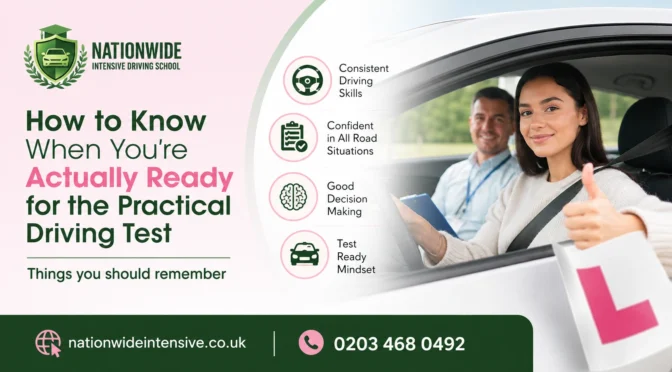
How to Know When You’re Actually Ready for the Practical Driving Test

You’re usually ready for your practical driving test when you can drive safely and consistently without relying on prompts from your instructor, handle different road situations independently, complete mock tests to a good standard, and manage your nerves. As an experienced driving instructor, I don’t recommend booking a test simply because you’ve completed a certain number of lessons. Readiness is about your driving ability, not your lesson count.

One question I hear almost every week is:

“Do you think I’m ready for my driving test?”

Sometimes the learner is ready.

Sometimes they need a little more practice.

And occasionally, they’re somewhere in between.

The difficult part is that learners often judge themselves based on how they feel rather than how they actually drive.

You might feel nervous but drive very well.

Or you might feel confident while still making mistakes that could cause a test failure.

After teaching learners for years, I’ve found that the best way to judge readiness is to look at your consistency, independence and safety.

Here’s how to tell where you really stand.

Is There a Set Number of Lessons Before Your Test?

No.

There’s no magic number of driving lessons that automatically makes you ready for the practical driving test.

Some learners need fewer lessons, while others need considerably more.

Your progress can depend on:

  • Previous driving experience
  • Private practice
  • Confidence
  • Vehicle control
  • Hazard awareness
  • How regularly you practise
  • How quickly you develop independent decision-making

That’s why booking a test simply because you’ve reached a certain number of hours isn’t a good strategy.

1. You Can Drive Without Constant Instructor Prompts

This is one of the clearest signs that you’re getting close.

Ask yourself:

Does my instructor still have to tell me what to do at every junction?

If the answer is yes, you probably need more practice.

You should increasingly be able to:

  • Spot hazards yourself.
  • Check mirrors without reminders.
  • Choose appropriate speed.
  • Position the car correctly.
  • Read road signs.
  • Select lanes independently.
  • Make safe decisions at junctions.

Current DVSA “Ready to Pass?” guidance specifically recommends taking the test when you no longer need prompts from your instructor.

2. You Can Handle Different Road Situations

Being good at one familiar route doesn’t necessarily mean you’re test-ready.

Your driving should remain safe when you’re dealing with different environments, such as:

  • Quiet residential roads
  • Busy town centres
  • Roundabouts
  • Dual carriageways
  • Traffic lights
  • Complex junctions
  • Different speed limits
  • Unfamiliar roads

A practical driving test isn’t about memorising a particular route.

It’s about demonstrating that you can drive safely in situations you can’t completely predict.

3. Your Driving Is Consistent

This is something I pay close attention to when assessing learners.

Anyone can have one brilliant lesson.

The real question is:

Can you repeat that standard consistently?

For example, you might handle five roundabouts perfectly during one lesson and then struggle with three of them the following week.

That suggests the skill isn’t fully established yet.

Before your test, you want safe driving to feel like your normal driving, not something you occasionally manage when everything goes perfectly.

4. You Can Make Independent Decisions

During the practical test, you’ll have a section of independent driving. The current car test lasts around 35 minutes and includes independent driving, reversing and general driving ability.

You therefore need to be comfortable making your own decisions.

That includes:

  • Following road signs.
  • Following sat-nav instructions.
  • Choosing appropriate lanes.
  • Planning ahead.
  • Responding to unexpected situations.
  • Recovering safely if you make a wrong turn.

You don’t need to know every road.

You need to know how to deal with the road you’re on.

5. You Don’t Regularly Make Serious or Dangerous Mistakes

This is a major consideration.

The current pass standard allows up to 15 driving faults, but you must have no serious or dangerous faults.

However, don’t use the 15-fault limit as a target.

If you’re regularly making several driving faults during lessons, particularly in the same areas, you may still have work to do.

Current DVSA guidance highlights common test-failure areas including junction observations, mirror use, moving off safely, positioning, steering control, traffic lights and road signs.

The aim should be safe and consistent driving, not trying to stay below a numerical limit.

6. You Can Complete Mock Tests Successfully

This is one of the best ways to judge readiness.

Ask your instructor to conduct a realistic mock test.

That means:

  • Minimal prompting.
  • Independent driving.
  • Test-style manoeuvres.
  • Different road conditions.
  • Normal test instructions.
  • No unnecessary help.

If you can repeatedly complete mock tests to a good standard, that’s a strong indication that you’re getting close.

The DVSA’s current guidance specifically recommends being able to pass mock driving tests before taking the real test.

7. You Can Manage Your Nerves

You don’t need to feel completely calm before your test.

Almost everyone feels nervous.

The important question is:

Can you still drive safely when you’re nervous?

If your nerves cause you to forget observations, rush decisions or lose control of the vehicle, you may need more preparation.

Try practising under test-like conditions so the experience doesn’t feel completely unfamiliar on the day.

8. You Know How to Recover From Mistakes

Here’s something I regularly tell learners:

Making a mistake doesn’t automatically mean you’ve failed.

You might take the wrong turn or stall the car.

The important thing is what you do next.

Can you stay calm?

Can you correct the situation safely?

Can you continue without letting one mistake affect the rest of your drive?

Good drivers aren’t perfect drivers.

They’re drivers who can respond safely when something doesn’t go exactly as planned.

9. Your Instructor Agrees You’re Ready

Your instructor’s opinion matters.

They’ve watched your driving develop over many lessons and can compare your current performance with your previous ability.

If they say:

“You’re ready.”

that’s encouraging.

If they say:

“You’re close, but we need to work on your observations first.”

listen to them.

It’s much better to spend a few more lessons fixing a weakness than book a test simply because you’re impatient to finish.

The current DVSA guidance also recommends that your instructor agrees you’re ready before taking the test.

What If You’re Nearly Ready But Still Struggling?

This is where targeted training can help.

Instead of taking lessons without a clear goal, identify your weakest areas.

For example:

Week 1: Roundabouts and junction observations.

Week 2: Independent driving and lane discipline.

Week 3: Mock tests and manoeuvres.

This gives every lesson a purpose.

If you prefer concentrated training, an Intensive Driving Course South Wimbledon can provide focused practice over consecutive days and help you work on specific weaknesses without long gaps between sessions.

For some learners, this concentrated approach can also help maintain motivation.

What If You Don’t Feel Confident Enough Yet?

Don’t panic.

Confidence often comes after competence, not before it.

You might think:

“I’ll never feel ready.”

Then, after several successful mock tests, suddenly you realise you’re handling situations without thinking about them.

If you’re looking for structured Driving Lessons South Wimbledon, work with an instructor who gives you honest feedback rather than simply telling you what you want to hear.

A good instructor should be able to explain:

  • What you’re doing well.
  • What still needs work.
  • Why it matters.
  • What you should practise next.
  • Whether you’re genuinely ready for the test.

How to Stay Motivated While Preparing for Your Test

The final stage can sometimes feel frustrating because you’re close but not quite there.

Try these habits:

Set Small Goals

Instead of “I need to pass”, aim for:

“Today I want to improve my roundabout observations.”

Track Your Progress

Write down improvements after each lesson.

Don’t Compare Yourself

Someone else’s lesson count has nothing to do with your readiness.

Treat Mock Tests as Practice

A mock test isn’t a judgement. It’s a way to identify what needs improving.

Don’t Rush

Taking a few extra lessons is far better than taking a test before you’re ready and losing confidence after a failed attempt.

Frequently Asked Questions

How do I know if I’m ready for my practical driving test?

You should be able to drive safely and consistently without regular instructor prompts, handle different road situations independently, manage your nerves and perform well in mock tests. Your instructor should also agree that you’re ready.

Should I book my test as soon as I feel confident?

Not necessarily. Confidence is useful, but consistent safe driving is more important. Your instructor should assess whether you’re genuinely test-ready.

How many driving lessons do I need before taking my test?

There is no fixed number. Different learners need different amounts of training depending on their experience, practice and individual progress.

Can I pass if I make a minor driving fault?

Yes. The current pass standard allows up to 15 driving faults, provided you have no serious or dangerous faults.

What happens if I’m not ready for my driving test?

You can move your test to a later date if you meet the appointment-change rules. DVSA recommends moving the test back if you aren’t fully prepared so you have more time to practise and build confidence.

Can an intensive driving course help me prepare for my test?

It can. An intensive course provides concentrated practice and can be particularly useful when you already have a reasonable level of driving ability but need focused work on specific weaknesses.

Final Thoughts

Knowing when you’re ready for your practical driving test isn’t about reaching a certain number of lessons or simply feeling confident.

From my experience as a driving instructor, you’re ready when safe driving has become consistent. You can make your own decisions, deal with different road situations, complete mock tests without regular prompts and remain reasonably calm when something unexpected happens.

If you’re looking for professional Driving Lessons South Wimbledon, choose an instructor at Nationwide Intensive LTD. who will give you an honest assessment rather than rushing you towards a test. And if you’re close to test standard but need concentrated preparation, an Intensive Driving Course South Wimbledon can help you focus on the areas that still need work.

You can also consider whether automatic driving lessons or manual driving lessons are the right fit for your long-term driving plans.

Most importantly, don’t measure your readiness by how quickly someone else passed. Your goal isn’t simply to get through the test. It’s to become a safe, confident driver who can handle real-world roads independently. When you’re consistently doing that, you’ll know you’re getting genuinely ready to pass.
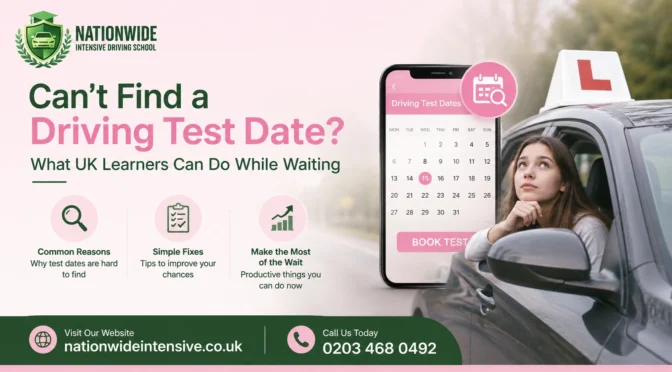
Can’t Find a Driving Test Date? What UK Learners Can Do While Waiting

If you can’t find a practical driving test date, don’t panic,you’re not alone. Many learner drivers across the UK face long waiting times due to high demand. Rather than putting your learning on hold, use this time to improve your driving skills, build confidence, and prepare for the test. In my experience as a driving instructor, learners who stay consistent while waiting often perform much better when their test day finally arrives.

If you’ve logged into the DVSA booking system only to find there are no driving test appointments available, I completely understand how frustrating it feels.

Over the past few years, I’ve spoken to countless learners who were ready for their practical test but couldn’t secure a suitable date for weeks,or even months.

The first reaction is usually:

“Should I stop taking lessons until I get a test date?”

My answer is almost always no.

In fact, the waiting period can become one of the most valuable parts of your learning journey if you use it wisely. Instead of seeing it as lost time, think of it as an opportunity to become a more confident and capable driver.

Here’s what I recommend to learners while they’re waiting for a practical driving test.

Why Are Driving Test Dates So Difficult to Find?

Driving test availability across the UK can change depending on demand, examiner availability and your chosen test centre.

It’s common for popular areas to have longer waiting times than others, especially during busy periods.

While it’s understandable to feel disappointed, constantly refreshing the booking page won’t improve your driving ability.

Instead, focus on the one thing you can control,your preparation.

1. Keep Taking Regular Driving Lessons

One of the biggest mistakes learners make is stopping lessons while waiting for a test date.

Driving is a practical skill.

If you leave several weeks between lessons, you may spend valuable time relearning techniques you’ve already mastered.

Continuing Driving Lessons Roundshaw helps you:

  • Maintain confidence
  • Improve observation skills
  • Refine parking manoeuvres
  • Build safer driving habits
  • Stay test-ready

Consistency is one of the biggest factors in long-term improvement.

2. Work on the Skills That Still Need Improvement

Ask your instructor one simple question:

“If my driving test was tomorrow, what would I still need to improve?”

An honest instructor will quickly identify areas such as:

  • Roundabouts
  • Bay parking
  • Parallel parking
  • Junction observations
  • Mirror checks
  • Independent driving
  • Speed awareness

Rather than repeating everything, focus your lessons on those specific weaknesses.

That’s where the biggest improvements happen.

3. Practise With a Supervising Driver

If you have access to a family member or friend who meets the legal requirements to supervise learner drivers, make the most of it.

Extra practice helps reinforce what you’ve learned during professional lessons.

Spend time driving in different situations, including:

  • Residential roads
  • Busy town centres
  • Dual carriageways
  • Different weather conditions
  • Evening driving
  • Hill starts

The wider your driving experience, the more confident you’ll feel on test day.

4. Take Mock Driving Tests

Mock tests are one of my favourite ways to prepare learners.

Why?

Because they recreate the pressure of the real practical driving test without the consequences of failing.

They also help identify habits that don’t always appear during normal lessons.

For example:

  • Missing mirror checks
  • Poor lane discipline
  • Rushed observations
  • Hesitation at junctions

By the time your actual test arrives, the experience feels much more familiar.

5. Improve Your Hazard Awareness

Passing the practical driving test isn’t just about controlling the car.

It’s about reading the road ahead.

Use the waiting period to improve your:

  • Hazard perception
  • Observation routines
  • Road positioning
  • Planning ahead
  • Decision-making

These are the skills that separate confident drivers from nervous learners.

The more naturally they become part of your driving, the less stressful the practical test will feel.

6. Consider an Intensive Driving Course Before Your Test

If you’ve finally secured a driving test date but haven’t driven consistently for a while, an Intensive Driving Course Roundshaw can be a great way to refresh your skills.

Driving over consecutive days helps:

  • Rebuild confidence
  • Improve consistency
  • Strengthen clutch control
  • Refresh manoeuvres
  • Prepare mentally for the practical test

Many learners find this especially useful after a long gap between booking and test day.

7. Decide Whether Automatic or Manual Still Suits You

The waiting period is also a good time to think about your learning approach.

If you’re finding clutch control or gear changes difficult, it may be worth discussing automatic driving lessons with your instructor.

If you’re confident with gears and want the flexibility of a manual licence, continuing with manual driving lessons may still be the right choice.

There’s no universal answer, only the option that best matches your confidence and long-term driving goals.

Don’t Let the Waiting Time Affect Your Confidence

I’ve seen learners become discouraged simply because they couldn’t find a test appointment.

Remember, the delay isn’t a reflection of your ability.

In fact, many learners who wait a little longer become stronger drivers because they have more time to practise.

Confidence doesn’t disappear because your test is delayed,it grows every time you get behind the wheel.

Frequently Asked Questions

Why are driving test dates so hard to book in the UK?

Driving test availability depends on demand, examiner capacity and your chosen test centre. Waiting times can vary significantly across different parts of the UK.

Should I stop taking driving lessons while waiting for my test?

No. Continuing lessons helps you maintain your driving skills, improve confidence and stay prepared for your practical driving test.

Is it worth taking mock driving tests?

Absolutely. Mock tests help you experience real test conditions, identify weak areas and reduce nerves before your official practical driving test.

Can an intensive driving course help before my driving test?

Yes. Many learners use an intensive course shortly before their test to refresh key skills, improve confidence and become fully test-ready.

Should I switch from manual to automatic?

If you’re consistently struggling with clutch control or gear changes, automatic lessons may suit you better. Speak to your instructor about which option aligns with your driving goals.

Final Thoughts

Waiting for a driving test date can be frustrating, but it doesn’t have to slow down your progress.

In my experience, the learners who make the best use of this waiting period are often the ones who pass with greater confidence. Instead of focusing on what you can’t control, use the extra time to strengthen your observations, improve your road awareness and build the habits that make you a safe driver for life.

If you’re looking for professional Driving Lessons Roundshaw,  in Nationwide Intensive LTD. you continue to learn with experienced instructors can help you stay confident and fully prepared while waiting for your test. And if your test date is approaching, an Intensive Driving Course Roundshaw can be an excellent way to sharpen your skills before the big day.

Whether you’re planning to continue with regular lessons, book an intensive course, or decide between automatic driving lessons and manual driving lessons, remember that every extra hour of quality practice brings you one step closer to passing your practical driving test, and becoming a confident driver on UK roads.

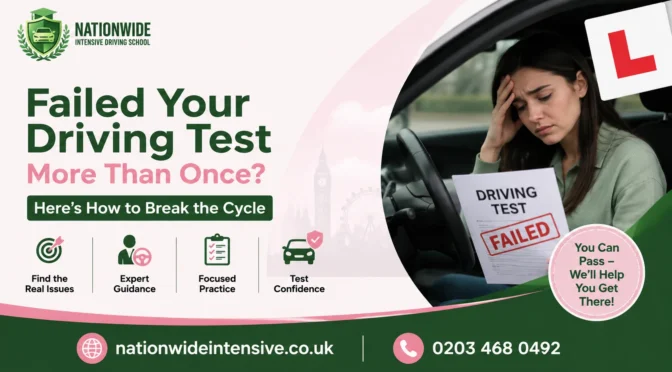
Failed Your Driving Test More Than Once? Here’s How to Break the Cycle

Failing your driving test more than once doesn’t mean you’re a bad driver. In my experience as a driving instructor, most learners who fail repeatedly aren’t lacking driving skills,they’re repeating the same mistakes, struggling with nerves, or going into the test before they’re truly ready. The good news is that once you identify the reason behind your previous test failures, you can make targeted improvements and significantly increase your chances of passing next time.

Learning to drive is a journey, and for some people, that journey includes more than one practical driving test.

Over the years, I’ve worked with many learner drivers who walked back to the car feeling disappointed after another failed test. Some had failed twice, others three or four times. Almost every one of them asked the same question:

“Maybe I’m just not good enough to drive?”

The answer was almost always no.

In reality, most learners don’t fail because they can’t drive. They fail because they’re making the same small mistakes under test pressure. Once we identified those patterns and worked on them, many of those same learners passed with confidence.

If you’ve failed your driving test more than once, here’s how you can finally break the cycle.

Why Do People Keep Failing Their Driving Test?

A failed driving test is rarely caused by one major mistake.

More often, it’s a combination of small issues such as:

  • Test-day nerves
  • Poor observations
  • Rushing decisions
  • Lack of confidence
  • Weak planning skills
  • Not enough experience in different traffic conditions

The important thing to remember is that these are all skills that can be improved.

Failing a test doesn’t define your ability,it simply highlights the areas that need a little more work.

1. Read Your Driving Test Report Carefully

One mistake I often see is learners booking another test without reviewing their previous result.

After every practical driving test, the examiner explains why you didn’t pass.

Pay attention to recurring faults.

For example, if you’ve received faults for:

  • Mirror checks
  • Junction observations
  • Roundabouts
  • Speed awareness
  • Positioning

across multiple tests, those should become the main focus of your next lessons.

Don’t practise everything equally, practise what actually caused you to fail.

2. Stop Chasing the Pass Certificate

It’s understandable to want your full UK driving licence as soon as possible.

But when learners become obsessed with passing, they often put themselves under unnecessary pressure.

Instead, focus on becoming a calm, safe and confident driver.

The pass certificate usually follows naturally.

As instructors, we often say:

“Drive as if there isn’t an examiner in the car.”

That mindset alone can reduce unnecessary nerves.

3. Test Nerves Can Undo Good Driving

One of the biggest differences between a driving lesson and the practical test is pressure.

I’ve taught learners who drove confidently every week but suddenly forgot simple routines like Mirror-Signal-Manoeuvre (MSM) during the test.

If this sounds familiar, you’re not alone.

Building confidence comes from:

  • Regular practice
  • Mock driving tests
  • Driving unfamiliar routes
  • Learning breathing techniques before the test

The more familiar the experience feels, the less intimidating test day becomes.

4. You’re Booking the Next Test Too Soon

After failing, it’s tempting to book the next available test immediately.

Sometimes that’s the right decision.

Sometimes it isn’t.

If you haven’t corrected the faults that caused the previous failure, another test may simply produce the same outcome.

Take time to improve before sitting another practical test.

Quality preparation is far more valuable than rushing back into the examiner’s car.

5. Get Honest Feedback From Your Instructor

One of the most valuable conversations you can have is asking:

“If you were the examiner today, would you pass me?”

A good instructor will give you an honest answer.

Sometimes learners are surprised to hear they’re not quite test-ready yet.

Although it may feel disappointing, it’s much better than paying for another unsuccessful driving test.

If you’re taking Driving Lessons Hackbridge, your instructor should help you build a lesson plan around the exact skills that need improvement rather than repeating things you’ve already mastered.

6. Practise Different Roads and Traffic Conditions

Confidence grows through experience.

If you’ve only driven on familiar roads, the practical test can feel overwhelming when you’re faced with unfamiliar situations.

Try practising:

  • Busy roundabouts
  • Dual carriageways
  • Residential streets
  • Multi-lane junctions
  • Different speed limits
  • Independent driving routes using sat nav

The more situations you’ve experienced before your test, the fewer surprises you’ll face on the day.

7. Consider an Intensive Driving Course

Some learners lose momentum between weekly lessons.

If you’ve failed more than once, an Intensive Driving Course Hackbridge could help you rebuild confidence more quickly.

Learning over consecutive days allows you to reinforce new habits immediately instead of waiting another week before practising again.

Many learners also find intensive courses particularly helpful before a retest because everything stays fresh in their mind.

8. Stop Comparing Yourself to Other Learners

  • One learner passes for the first time.
  • Another passes on the fourth attempt.
  • Both receive exactly the same full UK driving licence.
  • Your journey is your own.

The DVSA practical test measures whether you’re a safe driver,not how quickly you learned.

Some of the safest drivers I’ve taught were the ones who took a little longer to pass because they developed strong habits along the way.

How to Improve Your Chances of Passing Next Time

If you’re preparing for another practical driving test, here’s what I recommend:

  • Review your previous test report carefully.
  • Focus on repeated faults first.
  • Take mock driving tests with your instructor.
  • Practise on unfamiliar roads.
  • Improve your observation routines.
  • Don’t book another test until both you and your instructor feel you’re genuinely ready.
  • Stay consistent with your lessons and private practice.

Remember, confidence is built through preparation, not luck.

Frequently Asked Questions

Is it common to fail a driving test more than once?

Yes. Many UK learner drivers need more than one attempt to pass their practical driving test. Failing doesn’t mean you won’t become a safe and confident driver.

Should I change my driving instructor after failing?

Not always. If your instructor provides constructive feedback and adapts lessons to your weaknesses, staying with them may be the best option. If you don’t feel you’re progressing, it’s worth discussing your concerns before considering a change.

How long should I wait before booking another driving test?

There’s no fixed answer. It’s usually better to book your next test once you’ve addressed the faults from your previous attempt rather than rushing into another test.

Can an intensive driving course help after failing?

Yes. Many learners find that an intensive course helps them rebuild confidence, improve consistency and prepare more effectively for a retest through focused daily practice.

Should I choose automatic or manual driving lessons?

It depends on your goals and confidence. If you’re unsure which option suits you, comparing automatic driving lessons and manual driving lessons can help you choose the learning style that matches your needs.

Final Thoughts

Failing your driving test more than once can feel discouraging, but it doesn’t mean you’re not capable of passing.

In my experience, learners who take the time to understand why they failed often come back stronger, more confident and better prepared than before. Every test provides valuable feedback, and every lesson is another opportunity to improve.

If you’re looking for professional Driving Lessons Hackbridge, contact Nationwide Intensive LTD. as we are working with experienced instructors who tailor lessons to your individual weaknesses can make a real difference. And if you want to rebuild confidence quickly before your next test, an Intensive Driving Course Hackbridge could help you develop the consistency and road awareness needed to pass.

Whether you’re exploring regular lessons, an intensive course, or deciding between automatic driving lessons and manual driving lessons, remember that success isn’t about passing for the first time,it’s about becoming a safe, confident driver for life.
