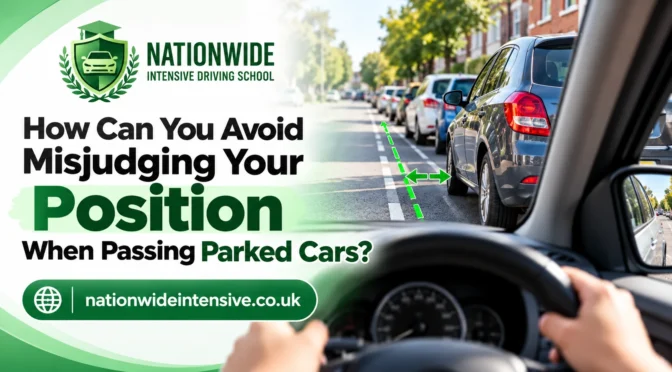
To avoid misjudging your position when passing parked cars, look well ahead, judge the available space early, check your mirrors and blind spots, and maintain a safe clearance from the parked vehicle. If an oncoming vehicle makes the gap too narrow, slow down and be prepared to wait. Never squeeze through a space if it puts you or another road user at risk.
Why Do Learner Drivers Misjudge Their Position Near Parked Cars?
Passing parked cars can be surprisingly tricky when you are learning to drive. You need to judge the width of your car, the distance from the parked vehicle and whether there is enough room for oncoming traffic.
From a driving instructor’s perspective, one common problem is that learners focus too much on the parked car directly beside them. This leaves less time to assess the road ahead and spot approaching vehicles, cyclists or pedestrians.
Another challenge is judging the left-hand side of the car. If you are unsure how close you are to the parked vehicle, you might move too far towards the centre of the road or leave an unnecessarily large gap.
If you are taking Driving Lessons Riddlesdown, ask your instructor to help you practise passing parked vehicles on quieter roads before tackling busier streets. Building this skill gradually can make your positioning much more consistent.
6 Tips for Passing Parked Cars Safely
1. Look Ahead and Plan Early
Do not wait until you are right beside a parked car to decide what to do. Look further down the road to identify parked vehicles, oncoming traffic, bends and potential hazards.
If you can see a clear section of road ahead, you can plan your approach and decide whether you have enough space to pass safely.
Practical tip: Try to identify several parked cars ahead rather than focusing only on the nearest one. This helps you anticipate where you might need to wait or adjust your position.
2. Judge the Available Space Carefully
Before moving around a parked car, consider its width, your vehicle’s width and the space available on the other side. Remember that a parked van or large vehicle may require more room than a small car.
You should leave adequate clearance rather than trying to pass as closely as possible. If the road is too narrow for you to pass safely alongside an approaching vehicle, wait in a suitable position until there is enough space.
Never assume that another driver will slow down or move over to accommodate you. Reach out to Nationwide Intensive LTD. for more such information.
3. Check Your Mirrors Before Moving Out
Passing a parked car often means moving slightly towards the centre of the road. Before changing your position, check your mirrors for vehicles, cyclists and motorcyclists approaching from behind.
Signal if it would help other road users understand your intention, and check your blind spot where appropriate before moving laterally.
Practical tip: Make your observations early. Last-second mirror checks can leave you with too little time to react safely.
4. Use Reference Points Without Relying on Them Completely
Some learners use parts of the dashboard or windscreen as reference points to estimate the car’s position. These can be helpful during lessons, but they are not exact measurements.
Your view changes depending on the vehicle you drive, your seating position and the shape of the parked car.
Instead, practise judging space through repeated experience. Ask your instructor to explain where the car is positioned and how much clearance you have, then gradually learn to assess it independently.
5. Watch for Doors, Pedestrians and Cyclists
A parked car is not always an inactive hazard. Someone might open a door, step out from between vehicles or walk around the back of a van.
Look for brake lights, occupants inside vehicles and signs that someone may be about to move. Leave extra room where possible and reduce your speed if visibility is restricted.
Be particularly careful around cyclists travelling past parked cars, as they may need space to avoid opening doors. Do not squeeze between a cyclist and a parked vehicle.
6. Know When to Wait
You do not have to pass every parked car immediately. If an oncoming vehicle is approaching and the gap is too narrow, slow down and wait where it is safe and appropriate.
Look for a suitable space that allows the other vehicle to pass without forcing either driver into a dangerous position. Avoid stopping where you obstruct a junction, crossing or other road users unnecessarily.
Waiting for a safe opportunity demonstrates good judgement, not poor driving.
Can Poor Positioning Cause You to Fail Your Driving Test?
Yes, depending on the circumstances. The examiner assesses whether you can maintain safe road positioning, observe other road users and make sensible decisions.
A minor positioning error may result in a driving fault. However, moving too close to parked cars, forcing an oncoming driver to take evasive action or failing to respond to a hazard could lead to a serious or dangerous fault.
The aim is not to pass every parked car perfectly. It is to show that you can recognise risks, maintain control and choose a safe course of action.
If you need more practice before your test, an Intensive Driving Course Riddlesdown may help you work on road positioning, hazard perception and other essential driving skills over a concentrated period.
You can explore our intensive driving courses in London for more information. If you are deciding which type of car to learn in, you can also read about our manual driving lessons in London and automatic driving lessons in London.
Frequently Asked Questions
How much space should I leave when passing a parked car?
Leave enough clearance to pass without risking contact with the vehicle or its occupants. The amount of space depends on the road width, vehicle size and surrounding hazards.
Should I move towards the centre of the road to pass parked cars?
Only when it is safe and necessary. Check your mirrors, assess oncoming traffic and make sure you have enough room before moving out.
What should I do if a car approaches while I am passing parked vehicles?
Assess the available space. If there is not enough room for both vehicles to pass safely, slow down and wait in a suitable position.
Is it better to drive slowly past parked cars?
A suitable speed gives you more time to identify hazards and respond. Adjust your speed to the visibility, road width, traffic and likelihood of someone entering your path.