
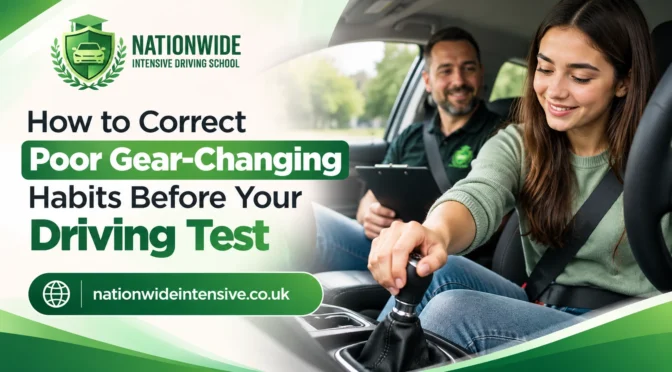
To correct poor gear-changing habits before your UK driving test, practise selecting the right gear for your speed and road conditions, use the clutch smoothly, and avoid looking down at the gear stick. Focus on changing gears at the right time without losing control of the car or your awareness of traffic. Regular practice with a qualified driving instructor can help you build smoother, safer driving habits before test day.
Why Do Learners Struggle with Gear Changes?
Changing gears might seem simple when you first learn the basics, but doing it smoothly in real traffic takes practice. You need to coordinate the clutch, accelerator, gear stick and your observations while staying aware of other road users.
From a driving instructor’s perspective, one of the most common challenges is that learners concentrate so much on selecting a gear that they forget what is happening around them. Others change gears too early, leave the car in a gear that is unsuitable for their speed, or release the clutch too quickly.
The good news is that these habits can improve with the right approach. If you are taking Driving Lessons St Helier, ask your instructor to identify your most frequent gear-changing mistakes so you can work on them before your practical test.
5 Common Gear-Changing Mistakes and How to Fix Them
1. Looking Down at the Gear Stick
Looking down to find a gear takes your attention away from the road. Even a brief distraction can affect your awareness of pedestrians, cyclists and vehicles ahead.
How to fix it: Learn the gear positions while the car is stationary and practise selecting gears without looking down. During lessons, keep your eyes on the road and listen to your engine to help judge when a gear change may be needed.
2. Releasing the Clutch Too Quickly
Lifting the clutch too quickly can make the car jerk or stall, particularly when moving off or changing into a lower gear.
How to fix it: Practise releasing the clutch progressively and coordinating it with the accelerator. When moving off, find the biting point and release the clutch smoothly as the car begins to move. Avoid rushing the process.
3. Choosing the Wrong Gear for Your Speed
Driving in a gear that is too high can make the engine struggle, while staying in a low gear for too long can cause excessive engine noise and poor fuel efficiency.
How to fix it: Pay attention to your speed, engine sound and the road ahead. Choose a gear that gives you suitable control and acceleration. Remember that there is no single speed at which every gear change must happen; road conditions and the vehicle both matter.
4. Changing Gears at the Wrong Time
Changing gear while approaching a hazard, negotiating a junction or entering a roundabout can distract you from important observations.
How to fix it: Plan ahead. Where appropriate, select a suitable gear before reaching a junction or roundabout, while maintaining proper control and observation. Avoid unnecessary gear changes when your attention needs to be on traffic.
5. Coasting with the Clutch Depressed
Coasting happens when you travel with the clutch held down for longer than necessary or with the car in neutral. This can reduce your control over the vehicle, particularly when slowing down or approaching bends.
How to fix it: Keep the car in an appropriate gear and use the brakes as needed to manage your speed. Depress the clutch when required for a gear change or when coming to a stop, rather than holding it down unnecessarily.
How to Improve Gear Changing Before Your Driving Test
You do not need to practise every skill at once. Instead, work on one habit at a time. You can reach out to Nationwide Intensive LTD. for the same.
- Start on quieter roads: Practise moving off, changing up and changing down before tackling busier routes.
- Listen to the engine: Learn to recognise when the engine sounds strained or when a higher gear may be suitable.
- Look well ahead: Anticipate junctions, bends, traffic lights and changes in speed so you have time to prepare.
- Stay relaxed: Tensing up can make clutch and gear-stick movements less smooth.
- Ask for specific feedback: Request that your instructor notes repeated gear-selection errors and helps you correct them.
If you need structured preparation before your test, an Intensive Driving Course St Helier may help you focus on gear control, road positioning and other driving skills over a concentrated period. The right course depends on your current ability and how much practice you need.
You can explore our intensive driving courses in London to find out more.
Can Poor Gear Changing Make You Fail Your Driving Test?
Poor gear changing does not automatically mean you will fail. The examiner assesses whether you can control the car safely and drive independently.
An occasional clumsy gear change may be recorded as a driving fault if it does not create a safety concern. However, repeated poor control, selecting an unsuitable gear that affects your driving, or allowing a gear-changing mistake to create danger could lead to a more serious fault.
If you are struggling with manual gear changes, you could also consider whether automatic lessons would suit your needs. An automatic car removes the need to operate a clutch and select gears manually, although you must still demonstrate safe observation, positioning and decision-making.
Find out more about manual driving lessons in London or automatic driving lessons in London.
Frequently Asked Questions
When should I change gears during a driving test?
Change gears according to your speed, engine response and road conditions. Your instructor can help you understand suitable gear choices for different situations.
Is stalling an automatic fail?
No. A stall does not automatically mean you have failed. What matters is why it happened, how you respond and whether you create a safety risk.
Should I change gear before a roundabout?
Where practical, select a suitable gear before entering the roundabout so you can concentrate on observations, lane position and traffic. The correct choice depends on your speed and the situation.
Can I learn gear changing quickly before my test?
You can improve with focused practice, but progress varies. If gear changes remain inconsistent, discuss your readiness with your instructor rather than rushing into the test.