
Category Archives: Driving Lesson

How to Fit Driving Lessons Around a Full-Time Job Without Burning Out

Balancing a full-time job with driving lessons can feel challenging, but it’s absolutely possible with the right approach. As a driving instructor who’s worked with busy professionals across London, I’ve found that the most successful learners don’t try to fit driving into every spare moment, they create a realistic routine that works around their job. By planning lessons wisely, avoiding burnout, and focusing on quality practice instead of quantity, you can make steady progress towards your practical driving test.

One conversation I’ve had countless times with learners goes something like this:

“I’d love to learn to drive, but I work Monday to Friday and I’m exhausted by the end of the day.”

If that sounds familiar, you’re not alone.

Many of my learners work full-time. Some commute long hours, others work shifts, and plenty are juggling family responsibilities as well. Despite their busy schedules, they still manage to pass their practical driving tests.

The difference isn’t that they have more free time.

It’s that they learn to make driving lessons fit their lifestyle instead of trying to force them into an already packed schedule.

Here’s what I’ve found works best.

Can You Learn to Drive While Working Full-Time?

Absolutely.

In fact, many learner drivers in the UK complete their driving lessons while working a full-time job.

The key is understanding that learning to drive is a marathon, not a sprint.

Trying to squeeze too many lessons into an already stressful week often leads to frustration, fatigue and slower progress.

A realistic learning plan is far more effective than an overloaded one.

1. Choose Lesson Times That Match Your Energy Levels

One mistake I often see is learners booking lessons at times when they’re already mentally exhausted.

For example, if you’ve just finished a demanding nine-hour shift, your concentration may not be at its best.

Ask yourself:

  • Am I more alert before work?
  • Would Saturday mornings suit me better?
  • Do I prefer Sunday afternoons?
  • Would one evening each week feel manageable?

There’s no perfect schedule, only the one that works for you.

During Driving Lessons Kenley, choosing lesson times when you’re mentally fresh often leads to quicker progress and a more enjoyable learning experience.

2. Quality Matters More Than Quantity

Many learners think taking multiple lessons every week is the fastest route to passing.

Not always.

In my experience, one focused lesson where you’re fully engaged is often more valuable than several lessons taken when you’re tired and distracted.

Driving requires concentration, good judgement and quick decision-making.

When you’re mentally drained, learning becomes much harder.

3. Plan Your Lessons in Advance

Busy work schedules can change quickly.

That’s why I always recommend booking several lessons in advance rather than arranging them week by week.

Having regular sessions in your calendar helps you:

  • Stay consistent.
  • Avoid long gaps between lessons.
  • Keep building confidence.
  • Maintain steady progress.

Consistency is one of the biggest factors in becoming test-ready.

4. Practise Little and Often

If you have access to a supervising driver, you don’t need to spend hours practising.

Even a short drive can help reinforce what you’ve learned.

For example, you could spend 20–30 minutes working on:

  • Moving off smoothly.
  • Mirror checks.
  • Roundabouts.
  • Parking manoeuvres.
  • Junction observations.
  • Speed awareness.

Small amounts of regular practice often make a bigger difference than occasional long sessions.

5. Don’t Rush to Book Your Driving Test

It’s understandable to want your full UK driving licence as quickly as possible.

But rushing because of work deadlines can increase stress.

Instead, focus on becoming a confident driver first.

Your instructor should tell you when you’re consistently ready for your practical driving test.

Passing first time is usually less stressful than taking multiple tests before you’re fully prepared.

6. Consider an Intensive Driving Course If Time Is Limited

Some busy professionals struggle to commit to weekly lessons for several months.

If that’s the case, an Intensive Driving Course Kenley could be a practical alternative.

Instead of spreading lessons across many weeks, you’ll complete your training over consecutive days.

Many learners choose this option because it:

  • Fits around annual leave.
  • Reduces the overall learning timeline.
  • Keeps driving skills fresh.
  • Builds confidence through consistent practice.

If your work schedule makes weekly lessons difficult, intensive learning may be worth discussing with your instructor.

7. Decide Whether Automatic or Manual Is Right for You

Another way to simplify learning is choosing the type of car that best suits your needs.

If you’re mainly learning so you can commute or travel more easily, automatic driving lessons may help you feel confident more quickly by removing clutch control and gear changes.

If you want the flexibility to drive both manual and automatic vehicles in the future, manual driving lessons remain a great option.

Think about your long-term driving goals rather than what other people choose.

8. Make Time to Rest

This is probably the advice learners least expect from me.

Rest matters.

Learning while you’re exhausted isn’t productive.

If you’ve had a particularly stressful week at work, it’s perfectly reasonable to discuss adjusting your lesson rather than pushing through while mentally drained.

Driving safely always comes before sticking rigidly to a schedule.

Simple Tips for Balancing Work and Driving Lessons

If you’re learning while working full-time, these habits can help:

  • Book lessons at times when you feel most alert.
  • Keep a consistent weekly schedule.
  • Practise little and often if possible.
  • Avoid comparing your progress with others.
  • Don’t rush your driving test.
  • Take breaks when work becomes particularly demanding.
  • Focus on becoming a safe driver rather than passing as quickly as possible.

Steady progress is always better than burnout.

Frequently Asked Questions

Can I learn to drive while working full-time?

Yes. Many UK learners successfully complete their driving lessons while working full-time. Planning lessons around your schedule and staying consistent are the keys to success.

Is one driving lesson a week enough?

For many learners, yes. Regular weekly lessons combined with private practice can provide steady progress towards your practical driving test.

Would an intensive driving course suit busy professionals?

Often, yes. Intensive courses allow learners to complete their training over consecutive days, making them a popular option for people with limited long-term availability.

Should I choose automatic or manual driving lessons?

If convenience and confidence are your priorities, automatic lessons may suit you well. If you want greater flexibility after passing your test, manual lessons remain an excellent choice.

What’s the best time to book driving lessons?

The best time is when you’re mentally alert and able to concentrate. Many learners prefer weekends, mornings or evenings that don’t immediately follow a demanding workday.

Final Thoughts

Learning to drive while working full-time isn’t always easy, but it’s far from impossible.

After teaching many busy professionals over the years, I’ve found that success doesn’t come from filling every spare hour with driving lessons. It comes from creating a routine that’s realistic, sustainable and built around your lifestyle. When you balance work, rest and consistent practice, you’ll make progress without feeling overwhelmed.

If you’re looking for flexible Driving Lessons Kenley, working with experienced instructors at Nationwide Intensive LTD. who understand the demands of full-time employment can make learning much more manageable. And if your schedule makes weekly lessons difficult, an Intensive Driving Course Kenley could help you build confidence and prepare for your practical driving test in a shorter, more focused timeframe.

Whether you’re choosing regular lessons, an intensive course, or deciding between automatic driving lessons and manual driving lessons, remember that learning to drive isn’t about rushing the process. It’s about building the skills and confidence you’ll rely on every time you get behind the wheel.
Is It Normal to Forget Everything Between Weekly Driving Lessons?

Yes, it’s completely normal to feel like you’ve forgotten everything between weekly driving lessons,especially if you’re only driving once a week and not practising in between. As a driving instructor, I’ve seen this happen with many learner drivers. The good news is that you’re probably forgetting less than you think. With regular practice, a few simple habits, and the right learning approach, you’ll retain your driving skills much more easily and build confidence faster.

One of the most common things I hear from learner drivers at the start of a lesson is:

“I feel like I’ve forgotten everything since last week.”

If you’ve ever said that yourself, don’t worry,you’re definitely not alone.

In fact, I’ve worked with plenty of learners who felt exactly the same. They’d spend the first ten minutes of every lesson trying to remember clutch control, mirror checks or how to approach a roundabout. Then, by the end of the lesson, they were driving confidently again.

That’s because learning to drive isn’t just about remembering information,it’s about building muscle memory and confidence through repetition.

So, if you feel like you’re starting from scratch every week, let’s look at why it happens and what you can do to stop it.

Why Do You Forget Driving Skills Between Lessons?

Learning to drive is different from studying for an exam.

You’re training your brain and body to work together at the same time.

During every lesson, you’re thinking about:

  • Steering
  • Clutch control
  • Gear changes
  • Mirror checks
  • Road signs
  • Hazard perception
  • Speed control
  • The Mirror-Signal-Manoeuvre (MSM) routine

That’s a huge amount of information to process.

If there’s a long gap before your next lesson, it’s perfectly natural to feel a little rusty when you get back behind the wheel.

The important thing to remember is that your skills haven’t disappeared, they simply need a few minutes to come back.

1. Weekly Lessons Can Slow Down Muscle Memory

In my experience, the biggest challenge with weekly driving lessons isn’t learning new skills, it’s maintaining them.

When learners only drive once every seven days, they often spend the beginning of each lesson refreshing what they learned previously.

That’s completely normal.

After 15–20 minutes, most learners settle back into their routine and begin driving confidently again.

This is why consistency matters more than perfection.

2. You’re Probably Remembering More Than You Think

Many learners judge themselves too harshly.

You might think you’ve forgotten everything because you stalled once or hesitated at a junction.

But then, a few minutes later, you’re:

  • Changing gears smoothly.
  • Completing roundabouts.
  • Parking confidently.
  • Reading traffic well.
  • Making safe decisions.

That’s proof your learning is still there.

You’re simply warming up.

I often tell learners not to judge their progress by the first five minutes of a lesson.

Judge it by the last twenty.

3. Confidence and Memory Go Hand in Hand

Something I’ve noticed over the years is that learners often confuse nervousness with forgetting.

If you’re feeling anxious, your brain focuses on what might go wrong instead of what you already know.

That’s why simple tasks can suddenly feel difficult.

Once you relax, those same skills usually return naturally.

Confidence isn’t about never making mistakes, it’s about trusting yourself to deal with them calmly.

4. Practise Between Lessons If You Can

If you have access to a supervising driver, even one extra hour of practice each week can make a huge difference.

Focus on simple skills like:

  • Moving off smoothly.
  • Junction observations.
  • Parking manoeuvres.
  • Mirror checks.
  • Speed awareness.
  • Hill starts.

Regular practice helps strengthen muscle memory and reduces that “starting again” feeling.

During Driving Lessons Waddon, learners who combine professional instruction with supervised practice often build confidence much faster than those who only drive once a week.

5. Keep a Simple Driving Journal

This is one tip I recommend to many learners, and it’s surprisingly effective.

After each lesson, write down:

  • Three things you did well.
  • Two things to practise.
  • One question to ask next time.

Reading those notes before your next lesson helps refresh your memory and keeps your progress clear in your mind.

It’s a simple habit that many learners overlook.

6. An Intensive Driving Course Can Help You Retain Skills

If you feel like you’re constantly relearning the same things, it may not be your ability that’s the problem, it could be the gap between lessons.

An Intensive Driving Course Waddon allows you to drive over consecutive days instead of once a week.

This consistent practice helps:

  • Build muscle memory.
  • Improve clutch control.
  • Strengthen observation routines.
  • Increase confidence.
  • Prepare more effectively for the practical driving test.

Many learners tell me they finally feel like everything “clicks” because they aren’t forgetting skills between sessions.

7. Don’t Rush Your Progress

It’s easy to compare yourself with friends who seem to be progressing faster.

But every learner develops differently.

Some people need more repetition before new skills become automatic.

Others gain confidence quickly.

Neither approach is right or wrong.

The goal isn’t to learn the fastest.

The goal is to become a safe, confident driver for life.

Simple Ways to Remember More Between Lessons

If you want to make steady progress, try these practical tips:

  • Book lessons consistently where possible.
  • Practise with a supervising driver if you can.
  • Review your lesson notes before each session.
  • Watch educational driving videos to reinforce key techniques.
  • Focus on one improvement at a time.
  • Don’t panic if you feel rusty at the start of a lesson.
  • Trust that repetition builds confidence.

Remember, every lesson builds on the last, even if it doesn’t always feel that way.

Frequently Asked Questions

Is it normal to forget things between weekly driving lessons?

Yes. Many learner drivers feel rusty after a week without driving. Once you spend a few minutes back behind the wheel, most of your skills return naturally.

Will practising between lessons help?

Absolutely. Even a small amount of supervised driving practice can improve confidence, strengthen muscle memory and help you retain what you’ve learned.

Would an intensive driving course help me learn faster?

For many learners, yes. Intensive courses reduce long gaps between lessons, allowing skills to develop through consistent daily practice.

Should I choose automatic or manual driving lessons?

If you’re finding clutch control stressful, automatic driving lessons may help simplify the learning process. If you want the flexibility of driving both manual and automatic cars, manual driving lessons remain an excellent choice.

How do I know if I’m ready for my practical driving test?

Your instructor should be able to assess whether you’re consistently driving safely, making good decisions and handling different road conditions confidently before recommending your practical driving test.

Final Thoughts

If you feel like you’ve forgotten everything between weekly driving lessons, don’t be too hard on yourself.

From my experience teaching learner drivers, this is one of the most common concerns I hear, and it’s rarely as serious as learners think. Most of the time, you’re simply shaking off the rust before your confidence returns. With regular practice, patience and the right guidance, those driving skills become second nature.

If you’re looking for supportive Driving Lessons Waddon, learning with experienced instructors at  Nationwide Intensive LTD. who understand how people learn can help you make steady, long-term progress. And if you’d like to reduce the gap between lessons and build confidence more quickly, an Intensive Driving Course Waddon could be the ideal way to strengthen your skills and prepare for your practical driving test.

Whether you’re continuing with weekly lessons, exploring an intensive course, or deciding between automatic driving lessons and manual driving lessons, remember that learning to drive is a journey. Every lesson, every mile and every small improvement brings you one step closer to becoming a safe and confident driver.

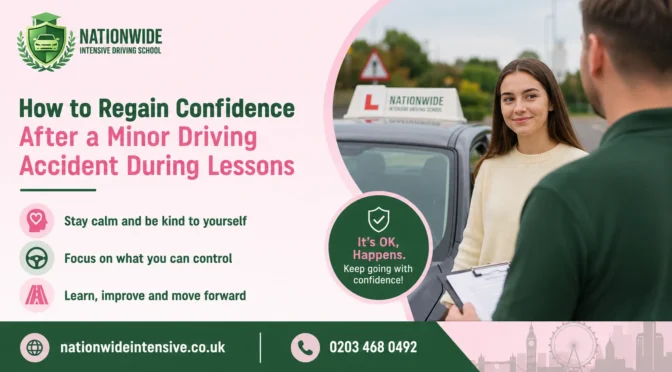
How to Regain Confidence After a Minor Driving Accident During Lessons

If you’ve had a minor accident during a driving lesson, it’s completely normal to feel nervous about getting back behind the wheel. In my experience as a driving instructor, most learner drivers lose confidence after even a small bump or near miss. The important thing to remember is that one mistake doesn’t define your ability. With the right guidance, regular practice, and a step-by-step approach, you can rebuild your confidence and continue progressing towards your practical driving test.

A few years ago, one of my learners clipped a kerb while trying to avoid a parked van on a narrow road.

The damage was minor, nobody was hurt, and we dealt with the situation safely. But what stayed with that learner wasn’t the kerb,it was the fear.

At the start of the next lesson, they admitted,

“I don’t know if I trust myself to drive anymore.”

A few months later, that same learner passed their practical driving test on the first attempt after the accident.

Why?

Because we didn’t ignore what had happened,we learned from it.

If you’ve experienced a minor accident during your driving lessons Pollards Hill, you’re not alone. More importantly, it doesn’t mean you’re not capable of becoming a safe and confident driver.

Let’s look at how you can rebuild your confidence.

First, Remember That Mistakes Are Part of Learning

Every experienced driver has made mistakes.

Some have stalled in traffic.

Some have misjudged a junction.

Others have clipped a curb or bumped another vehicle while parking.

The difference is that experienced drivers learn from those moments instead of letting them define their confidence.

As a learner driver, you’re still developing skills like:

  • Hazard perception
  • Road positioning
  • Speed judgement
  • Observation routines
  • Decision-making

It’s unrealistic to expect perfection while you’re still learning.

Understand What Actually Happened

One of the biggest mistakes learners make after a minor accident is blaming themselves without understanding the real cause.

Instead, ask your instructor questions like:

  • What caused the incident?
  • Could I have recognised the hazard earlier?
  • What should I do differently next time?
  • Was it caused by nerves, observations or judgement?

A good instructor won’t criticise you.

They’ll help you turn the experience into a valuable learning opportunity.

That’s how confident drivers are built.

Don’t Avoid Driving Afterwards

It’s natural to feel nervous.

However, taking a long break often makes those fears feel even bigger.

In my experience, learners who return to driving within a reasonable time usually rebuild confidence much faster than those who avoid getting behind the wheel for weeks.

Your first lesson back doesn’t have to involve busy roundabouts or heavy traffic.

Start with quieter roads and gradually increase the difficulty as your confidence grows.

Small successes create lasting confidence.

Focus on One Skill at a Time

After an accident, many learners try to overthink everything.

Instead, simplify your approach.

Concentrate on improving one area at a time.

For example:

  • Better mirror checks
  • Earlier observations
  • Smoother steering
  • Safer road positioning
  • More controlled speed

When you improve individual skills, your overall confidence naturally improves too.

Trust Your Instructor

One thing I always remind my learners is this:

If I wasn’t confident in your ability to continue learning, I wouldn’t ask you to drive.

Driving instructors are trained to manage risk and recognise when learners are ready for new challenges.

If your instructor encourages you to continue, it’s because they believe you’re capable.

That reassurance often helps learners regain confidence much sooner than they expected.

Practise Different Driving Situations

Sometimes confidence disappears because learners associate one type of road or manoeuvre with the accident.

The solution isn’t avoiding those situations.

It’s practising them safely.

Gradually work through:

  • Residential roads
  • Roundabouts
  • Junctions
  • Bay parking
  • Parallel parking
  • Dual carriageways
  • Independent driving

Each successful experience helps replace fear with confidence.

Consider an Intensive Driving Course

If you’ve lost confidence after a long break, an Intensive Driving Course Pollards Hill can help you regain momentum.

One advantage of intensive training is consistency.

Instead of waiting a week between lessons, you’re reinforcing new habits every day.

Many learners tell me this helps them stop dwelling on previous mistakes because they’re focused on making progress.

Whether you’re preparing for your practical driving test or simply rebuilding confidence, intensive learning can be an effective option.

Don’t Compare Yourself to Other Learners

After an accident, it’s easy to think everyone else is progressing faster.

The reality is very different.

Some learners recover their confidence within one lesson.

Others need a little longer.

Both outcomes are completely normal.

Learning to drive isn’t a race.

The goal isn’t to be the fastest learner, it’s to become a safe one.

How to Rebuild Your Confidence Faster

If you’re feeling nervous after a minor accident, try these practical steps:

  • Talk honestly with your instructor about your concerns.
  • Return to driving as soon as you’re comfortable.
  • Focus on one driving skill at a time.
  • Practise in quieter areas before tackling busy roads.
  • Learn from the incident instead of dwelling on it.
  • Celebrate small improvements after every lesson.
  • Remember that mistakes are part of becoming an experienced driver.

Confidence isn’t something you suddenly find, it grows every time you successfully handle another driving situation.

Frequently Asked Questions

Is it normal to lose confidence after a minor driving accident?

Yes. Many learner drivers feel anxious after even a small accident or near miss. With regular practice and support from a qualified instructor, confidence usually returns over time.

Should I stop taking driving lessons after an accident?

In most cases, no. Taking a long break can make anxiety worse. Returning to lessons gradually often helps rebuild confidence more quickly.

Can I still pass my driving test after an accident during lessons?

Absolutely. A minor accident while learning doesn’t affect your ability to pass your practical driving test. Many successful drivers have experienced setbacks during training.

Would an intensive driving course help rebuild confidence?

Yes. An intensive course allows you to practise consistently over consecutive days, helping replace uncertainty with confidence through regular repetition.

Should I choose automatic or manual driving lessons after losing confidence?

It depends on your circumstances. If clutch control or gear changes are increasing your anxiety, discussing automatic driving lessons with your instructor may be worthwhile. If you’re comfortable with manual driving, continuing your manual driving lessons can help rebuild confidence naturally.

Final Thoughts

A minor accident during your driving lessons can shake your confidence, but it doesn’t define your future as a driver.

In my experience, the learners who become the safest drivers aren’t the ones who never make mistakes,they’re the ones who learn from them, stay positive and keep moving forward. Every lesson after a setback is another opportunity to improve your judgement, strengthen your road awareness and become a more confident driver.

If you’re looking for supportive Driving Lessons Pollards Hill, learning with experienced instructors who understand how to rebuild confidence can make all the difference. And if you’re ready to get back behind the wheel with focused daily practice, an Intensive Driving Course Pollards Hill can help you regain momentum and prepare for your practical driving test with confidence.

Whether you’re continuing with regular lessons, considering an intensive course, or deciding between automatic driving lessons and manual driving lessons, remember that every experienced driver has faced challenges along the way. What matters isn’t the mistake itself,it’s the confidence you build by getting back on the road.

Why Do Learners Stall So Much? Common Causes and Simple Fixes

If you keep stalling during your driving lessons, don’t worry,it’s one of the most common challenges for learner drivers, especially when learning in a manual car. In my experience as a driving instructor, stalling usually happens because of clutch control, rushing to move off, or feeling nervous rather than a lack of driving ability. The good news is that once you understand why it’s happening, it’s usually one of the easiest driving habits to fix.

If you’ve ever stalled the car at a busy junction or when the traffic lights turned green, you’re definitely not the only one.

I’ve taught hundreds of learner drivers over the years, and almost every one of them has apologised after stalling.

Some even say,

“I don’t think I’ll ever get the hang of this.”

The funny thing is, a few weeks later, those same learners are moving off smoothly without even thinking about it.

Stalling isn’t a sign that you’re a bad driver. It’s simply part of learning how to control a manual car. Like every driving skill, it becomes easier with practice, confidence and the right guidance.

Let’s look at why learners stall so often and, more importantly, how you can stop it from happening.

Why Does a Car Stall?

A car stalls when the engine doesn’t receive enough power to keep running.

For learner drivers, this usually happens because the clutch is released too quickly before the engine has enough power to move the vehicle.

Although it can feel embarrassing, it’s completely normal and something every experienced driver has dealt with at some point.

The important thing is understanding why it happens so you can avoid repeating the same mistake.

1. Releasing the Clutch Too Quickly

This is by far the most common reason learners stall.

Many new drivers lift the clutch too fast because they’re eager to move away, especially when other vehicles are waiting behind them.

Instead, focus on finding the biting point.

Once you feel the car gently wanting to move forward, pause briefly before releasing the clutch fully.

In my experience, slowing this one movement down often solves most stalling problems within a couple of lessons.

2. You’re Feeling Rushed by Other Drivers

Pressure from traffic can make even confident learners panic.

You stop at a junction.

The lights change.

A car behind you starts creeping forward.

Suddenly you’re trying to move off too quickly,and the engine stalls.

Remember this:

Other drivers would rather wait a few extra seconds than see you make an unsafe decision.

Take your time, follow your Mirror-Signal-Manoeuvre (MSM) routine and move away safely instead of rushing because of pressure from other road users.

3. You’re Not Using Enough Accelerator

Another common mistake is trying to move off without giving the engine enough power.

Every car is slightly different.

Some require a little more acceleration than others before releasing the clutch.

During Driving Lessons The Wrythe, your instructor will help you understand how your training vehicle responds so moving off becomes much smoother and more consistent.

With practice, you’ll begin to recognise the sound and feel of the engine without consciously thinking about it.

4. You’re Looking at the Pedals Instead of the Road

Many learners instinctively glance down at their feet while finding the biting point.

This creates two problems:

  • You lose awareness of what’s happening around you.
  • It increases your anxiety because you’re trying to do too many things at once.

Trust your feet.

Clutch control develops through muscle memory, not by watching the pedals.

The more you practise, the more natural it becomes.

5. Test Nerves and Driving Anxiety

Something I often notice is that learners stall more during mock driving tests than during normal lessons.

Why?

Because nerves affect timing and coordination.

You start overthinking every movement:

“Is the clutch high enough?”

“Am I giving enough gas?”

“What if I stall again?”

Ironically, worrying about stalling often makes it more likely to happen.

Confidence grows through repetition, and that’s why regular driving practice is so important.

6. You’re Learning in a Manual Car

Here’s something worth remembering.

If you’re taking manual driving lessons, learning clutch control is simply part of the process.

Unlike automatic cars, manual vehicles require you to coordinate:

  • Clutch
  • Accelerator
  • Brake
  • Gear changes

That’s a lot to manage when you’re still learning road awareness, observations and hazard perception.

Be patient with yourself,it gets easier.

7. You’re Not Practising Moving Off Enough

Many learners spend lots of time practising roundabouts and parking but don’t spend enough time mastering simple moving-off exercises.

One exercise I often recommend is practising:

  • Moving off and stopping
  • Hill starts
  • Pulling over safely
  • Moving away from the kerb

Repeating these basic skills builds confidence much faster than only practising long drives.

Could an Intensive Driving Course Help?

If you’re struggling with clutch control after weeks of lessons, it may not be because you’re incapable, it could simply be because there’s too much time between sessions.

An Intensive Driving Course The Wrythe gives you the chance to practise every day instead of once a week.

Many learners find this helps build muscle memory much faster because yesterday’s lesson is still fresh in their mind.

For learners who want to improve quickly before their practical driving test, this approach can make a noticeable difference.

How to Stop Stalling More Often

If stalling is affecting your confidence, try these simple tips:

  • Slow down when releasing the clutch.
  • Learn to recognise the biting point.
  • Use gentle acceleration before moving off.
  • Don’t rush because of traffic behind you.
  • Practise hill starts regularly.
  • Stay calm if the car stalls,it happens to everyone.
  • Remember that smooth driving comes with repetition, not perfection.

Most learners are surprised by how quickly this habit improves once they stop worrying about it.

Frequently Asked Questions

Is it normal to stall during driving lessons?

Yes. Stalling is one of the most common issues learner drivers experience, especially during manual driving lessons. It becomes much less frequent as your clutch control improves.

How long does it take to stop stalling?

Every learner is different, but many drivers become much more confident after consistent practice over several lessons. Regular driving and repetition are key.

Do people fail their driving test because of stalling?

Not necessarily. A single stall doesn’t automatically mean you’ll fail your practical driving test. What matters is how safely and calmly you deal with the situation afterwards.

Are automatic driving lessons easier?

Many learners find automatic cars easier because there is no clutch pedal or manual gear changes. This allows you to focus more on road awareness and observations.

Can an intensive driving course improve clutch control?

Yes. Many learners improve more quickly during intensive courses because they practise clutch control every day, helping build confidence and muscle memory faster.

Final Thoughts

If you keep stalling during your driving lessons, don’t let it knock your confidence.

From my experience teaching learner drivers, stalling is simply one of those milestones that almost everyone goes through. Once you understand how the clutch, accelerator and biting point work together, smooth moving-offs become second nature.

If you’re looking for professional Driving Lessons The Wrythe, Nationwide Intensive LTD. is working with experienced instructors can help you build confidence and improve your clutch control step by step. And if you’d like to make faster progress, an Intensive Driving Course The Wrythe can give you the consistent practice needed to develop strong driving habits in a shorter period.

Whether you’re considering regular lessons, an intensive course, or deciding between automatic driving lessons and manual driving lessons, remember that every confident driver once stalled exactly where you are now. The difference is they kept practising,and you will too.

Why Am I Not Improving After Multiple Driving Lessons? Here’s What Could Be Wrong

If you’ve had 15, 20, or even 30 driving lessons and still don’t feel like you’re getting better, you’re not alone. In my experience working with learner drivers, this usually isn’t because you’re a “bad driver.” More often, it’s because of inconsistent practice, low confidence, gaps between lessons, or a learning approach that doesn’t suit you. Once you identify what’s holding you back, your progress can improve much faster.

Learning to drive can feel frustrating, especially when you’ve invested time and money but still don’t feel ready for your practical driving test.

As someone who has worked with learner drivers for years, I’ve noticed something interesting. The students who worry the most about their progress are often the ones who eventually become safe, confident drivers. They care about improving, and that’s a good sign.

Many learners reach a stage where it feels like they’re making the same mistakes repeatedly. We call this a learning plateau, and it’s completely normal. It doesn’t mean you’ve stopped learning it simply means your brain is processing more advanced driving skills.

Let’s look at why this happens and what you can do about it.

What Is a Driving Learning Plateau?

A driving learning plateau is a stage where your improvement feels slower, even though you’re still attending lessons.

This usually happens once you’ve mastered the basics like moving off, steering and changing gears. Now you’re expected to combine several skills at once, including:

  • Reading road signs
  • Planning ahead
  • Using the Mirror-Signal-Manoeuvre (MSM) routine
  • Judging speed at roundabouts
  • Spotting developing hazards
  • Making safe decisions under pressure

These skills take time to become automatic.

1. You’re Leaving Too Much Time Between Driving Lessons

One of the biggest reasons learners stop improving is inconsistent practice.

I’ve seen learners who take one lesson every three weeks and spend half the session trying to remember what they learned last time.

Regular lessons help build momentum.

If you’re booking Driving Lessons Beddington every week, you’ll usually retain more information and develop confidence much faster than someone who drives only once a month.

Consistency is often more important than lesson length.

2. You’re Trying to Pass the Test Instead of Becoming a Good Driver

Many learners become focused on passing the DVSA practical test.

That’s understandable but it can actually slow your progress.

A good instructor should teach you how to:

  • Read traffic early
  • Anticipate hazards
  • Drive independently
  • Make safe decisions
  • Adapt to different road conditions

When you become a confident driver, passing the test often becomes the natural outcome.

3. You’re Overthinking Every Decision

This is something I see regularly.

After around 15–20 lessons, many learners know what to do, but they’re still consciously thinking through every step.

For example:

“Mirror… signal… clutch… gear… check mirror again…”

That mental overload creates hesitation.

With regular practice, these actions gradually become automatic, allowing you to focus more on what’s happening around you rather than what your hands and feet are doing.

4. Confidence Is Affecting Your Driving More Than Your Ability

One of the biggest misconceptions is that confidence comes before skill.

In reality, confidence usually comes after repeated success.

I’ve taught learners who drove perfectly during lessons but made simple mistakes because they worried about making mistakes.

If you feel nervous approaching roundabouts, dual carriageways or busy junctions, you’re in good company.

Building confidence happens gradually through controlled exposure not by avoiding challenging situations.

5. You’re Not Practising Outside Professional Lessons

According to DVSA guidance, most learners benefit from combining professional instruction with additional supervised practice between lessons.

Even one hour a week with a qualified supervising driver can reinforce:

  • Clutch control
  • Bay parking
  • Parallel parking
  • Junction observations
  • Speed awareness
  • Independent driving

The more quality practice you get, the quicker these skills become natural.

6. Your Instructor’s Teaching Style May Not Suit You

  • Every learner is different.
  • Some people learn best through demonstrations.
  • Others need detailed explanations.
  • Some simply need more repetition.

If you’ve had several lessons but still don’t understand why you’re making certain mistakes, it’s worth having an honest conversation with your instructor.

Sometimes changing the teaching approach not necessarily changing instructors can make a remarkable difference.

7. You’re Avoiding the Skills That Challenge You

We naturally prefer practising things we’re already comfortable with.

Unfortunately, that’s rarely where improvement happens.

The learners who progress fastest gradually challenge themselves with:

  • Busy roundabouts
  • Multi-lane junctions
  • Dual carriageways
  • Hill starts
  • Independent driving routes
  • Heavy traffic

Every difficult road you successfully complete builds confidence for the next one.

8. An Intensive Driving Course Could Suit Your Learning Style

Not everyone learns effectively with one lesson every week.

Some learners make much faster progress by immersing themselves in driving over consecutive days.

An Intensive Driving Course Beddington allows you to reinforce yesterday’s lesson immediately instead of waiting another week.

Many learners find this improves:

  • Confidence
  • Muscle memory
  • Decision-making
  • Road awareness
  • Overall driving consistency

If you’re working towards a practical test in the near future, an intensive course may be worth considering.

9. You’re Comparing Yourself to Other Learners

This is probably the most damaging habit of all.

One learner may pass after 25 hours.

Another may need 50.

Neither outcome means someone is a better driver.

Everyone starts with different levels of confidence, coordination and previous road experience.

The only progress that matters is your own.

How Can You Start Improving Faster?

If your progress has slowed, try these practical steps:

  • Take lessons consistently rather than leaving long gaps.
  • Ask your instructor exactly which three skills need the most improvement.
  • Practise between lessons whenever possible.
  • Stop avoiding difficult roads or manoeuvres.
  • Focus on becoming a safe driver rather than simply passing the test.
  • Consider an intensive course if weekly lessons aren’t helping you build momentum.

Small adjustments often produce surprisingly big improvements.

Frequently Asked Questions

Is it normal not to improve after 20 driving lessons?

Yes. Many learners experience a learning plateau after mastering the basics. Progress often slows before confidence increases, especially when learning more complex driving situations like roundabouts and independent driving.

How many driving lessons does the average learner need in the UK?

The DVSA states that many learners need around 45 hours of professional lessons, alongside additional private practice. However, every learner develops at a different pace.

Should I change my driving instructor if I’m not improving?

Not necessarily. Start by discussing your concerns openly. Sometimes adjusting the teaching approach is enough. If you still don’t feel you’re progressing after several conversations, changing instructors may be the right decision.

Are intensive driving courses better than weekly lessons?

It depends on your learning style. Many learners retain information better during intensive courses because they’re practising consistently over consecutive days rather than waiting a week between lessons.

Can driving anxiety slow my progress?

Absolutely. Anxiety can affect judgement, observations and decision-making. A patient instructor, regular practice and gradually tackling more challenging roads can help build confidence over time.

Final Thoughts

If you’re wondering why you’re not improving after multiple driving lessons, remember that feeling stuck doesn’t mean you’re failing.

In fact, many learners experience this stage before they make their biggest breakthrough.

The key is to identify what’s holding you back, whether that’s inconsistent practice, confidence, your learning style or simply needing more structured guidance.

If you’re looking for professional Driving Lessons Beddington, Contact Nationwide Intensive LTD. learning with experienced instructors who tailor lessons to your pace can make all the difference. And if you’d prefer to build confidence more quickly, an Intensive Driving Course Beddington could help you gain momentum and prepare for your practical test sooner.

Whether you’re considering regular lessons, an intensive course, or deciding between automatic driving lessons and manual driving lessons, choosing the right learning approach is just as important as the number of lessons you take.

Remember, every confident driver on UK roads was once a learner. Progress isn’t measured by how quickly you pass, it’s measured by how safely and confidently you drive for years to come.

How Can You Save Money on Driving Lessons Without Compromising on Quality?

Yes, you can save money on driving lessons without choosing the cheapest instructor. The best way is to learn with a qualified instructor, practise consistently, avoid long gaps between lessons, and consider an intensive course if you want to pass more quickly. Paying a little more for quality tuition often works out cheaper in the long run because you may need fewer lessons overall.

If there’s one thing I’ve noticed after helping learner drivers over the years, it’s that many people focus only on the hourly price of a lesson. I understand why it feels like the easiest way to save money. But in reality, the cheapest lesson isn’t always the best value.

A good instructor teaches you correctly from the beginning, helping you build confidence and avoid bad habits that could cost you extra lessons later.

One tip I always give learners is to book lessons regularly. If you have one lesson, then wait three or four weeks before the next one, you’ll probably spend the first part of each lesson remembering what you learned before. That means you’re paying to relearn instead of making progress.

Another smart way to save money is by practising whenever you can with a supervising driver, provided you’re legally insured and following UK learner driver rules. Even short practice sessions can improve your confidence and make your professional lessons more productive.

For learners with busy schedules, an Intensive Driving Course South Croydon can also be a cost-effective option. Instead of spreading lessons over several months, you complete your training within a shorter period. Many learners find this helps them retain information better and reach test standard sooner. If you’re comparing your options, it’s worth looking at different intensive course packages to see which one suits your learning style and budget.

If you live locally, choosing Driving Lessons South Croydon with an experienced instructor who knows the local test routes can also make a real difference. Local knowledge often means you spend more time learning the roads and situations you’re likely to face during your practical test, rather than driving around unfamiliar areas.

It’s also worth remembering that passing first time can save you a significant amount of money. Every failed test could mean paying for another test fee and several additional lessons. That’s why quality instruction is an investment rather than simply another expense.

At the end of the day, learning to drive isn’t about finding the lowest hourly rate. It’s about getting the right guidance so you become a safe, confident driver while spending less overall.

If you’re based in South London, it’s worth exploring the available Driving Lessons South Croydon and comparing them with an Intensive Driving Course South Croydon. Depending on your experience, schedule and confidence level, one option may help you reach your full licence faster while keeping your overall learning costs under control.

How Many Driving Lessons Does It Really Take to Pass Your Test in the UK?

Most learners in the UK need around 40–50 hours of professional driving lessons, along with extra private practice, before they are ready to pass their practical driving test. However, the exact number depends on your confidence, previous experience, learning style, and how often you practise.

If there’s one question I hear almost every week as a driving instructor, it’s, “How many lessons will I actually need to pass?”

The honest answer is that there’s no magic number.

Over the years, I’ve taught learners who passed after just a few weeks of focused training, while others needed a little longer to build confidence. Everyone learns at a different pace, and that’s completely normal.

What Affects the Number of Driving Lessons?

Several factors can influence how quickly you become test-ready.

  • Whether you’ve driven before.
  • How often you take lessons.
  • If you can practise with a family member between lessons.
  • Your confidence behind the wheel.
  • Whether you’re learning in a manual or automatic car.

Someone taking one lesson every fortnight may take much longer to progress than someone who drives several times a week.

Is There a Faster Way to Learn?

For many learners, the answer is yes.

An Intensive Driving Course Sutton can help you build skills much more quickly because you’re practising consistently instead of forgetting what you learned between weekly lessons. Many people choose this option if they have a deadline, such as starting a new job or heading to university.

Rather than spreading lessons over several months, intensive courses allow you to stay focused and develop confidence day after day.

If you’re interested in learning more about intensive training across London, it’s worth exploring the different course options available through Nationwide Intensive’s London programmes to see which one suits your experience and schedule.

Are Weekly Lessons Still a Good Choice?

Absolutely.

Not everyone can dedicate several consecutive days to learning. Traditional Driving Lessons Sutton remain a great choice for learners who prefer a steady pace or have busy work and family commitments.

The key isn’t whether you learn quickly or slowly; it’s learning safely and consistently.

My Advice as an Instructor

One mistake I often see is learners comparing themselves to friends.

Someone might say they passed after 20 lessons, while another needed 60. That doesn’t mean either person was a better driver. Different roads, different instructors, different confidence levels and different learning styles all make a difference.

Instead of focusing on the number of lessons, concentrate on becoming a safe, confident driver. Passing the test is important, but driving safely for years afterwards is the real goal.

If you’re based in Sutton, choosing an instructor who understands the local roads and test routes can also make the learning process feel much more comfortable and familiar.

At the end of the day, whether you choose weekly lessons or an intensive course, consistent practice and good instruction will always give you the best chance of passing your test with confidence.

Manual vs Automatic Driving Lessons: Which One Should You Choose?

Manual driving lessons give you the freedom to drive both manual and automatic cars after passing your test, while automatic lessons are generally easier to learn and can help some learners pass more quickly. The best option depends on your driving goals, confidence level, and the type of vehicle you expect to drive in the future.

As a driving instructor, this is one of the questions I’m asked almost every week. Many learners arrive convinced that one option is better than the other, but after years of teaching people of all ages, I’ve learned that there’s no one-size-fits-all answer. Let’s compare both fairly so you can decide what’s right for you.

Manual vs Automatic Driving Lessons

Feature Manual Driving Lessons Automatic Driving Lessons
Difficulty More challenging due to clutch control and gear changes. Easier to learn because there are no gears or clutch.
Learning Time Usually takes a little longer for beginners. Many learners gain confidence more quickly.
Driving Test Includes clutch control, gear changes and hill starts. Focuses mainly on road awareness and vehicle control.
Licence Allows you to drive both manual and automatic cars. Restricts you to automatic vehicles only.
Car Choice Wider choice of used and rental vehicles. Limited to automatic vehicles.
Lesson Costs Similar to automatic in most areas. Similar, although prices can vary depending on location.
Long-Term Flexibility Excellent if you may drive different vehicles in the future. Best if you know you’ll only drive automatics.
Best For Learners who want maximum flexibility. Nervous learners or those wanting a simpler learning experience.

When Manual Driving Lessons Are the Better Choice

Manual lessons are ideal if you want complete flexibility after passing your test. A manual licence allows you to drive both manual and automatic vehicles, which can be useful when buying your first car, borrowing a family member’s vehicle or hiring a car while travelling.

Although learning clutch control and gear changes takes practice, many learners feel the extra effort is worthwhile because they have more options once they pass.

When Automatic Driving Lessons Make More Sense

Automatic lessons remove the need to coordinate a clutch and gear stick, making the learning process feel much less overwhelming for many people.

They’re often a good choice if you:

  • Feel anxious when learning new driving skills.
  • Need your licence as soon as possible.
  • Plan to own an automatic vehicle.
  • Prefer to concentrate on traffic and road positioning rather than changing gears.

With electric vehicles becoming more common across the UK, automatic cars are also growing in popularity.

What If You Want to Pass Quickly?

If you’re working towards a deadline for a new job, university or personal reasons, an Intensive Driving Course Epsom can be a practical way to learn. Instead of spreading lessons over several months, intensive training keeps your skills fresh and helps you build confidence through regular practice.

For learners who aren’t sure whether manual or automatic is the right choice, booking a few Driving Lessons Epsom is often the best first step. An experienced instructor can assess your confidence, learning style and driving ability before recommending the most suitable option.

If you’re also exploring different course formats and locations, it’s worth comparing the available programmes before booking so you can choose one that fits your schedule and learning goals.

Final Thoughts

Both manual and automatic driving lessons have clear advantages.

Choose manual if you want the flexibility to drive any type of car and don’t mind spending a little extra time mastering the basics.

Choose automatic if you want a simpler learning experience and expect to drive automatic vehicles in the future.

The most important factor isn’t whether the car has gears—it’s finding an experienced instructor and a learning style that helps you become a safe, confident driver.

Top Tips to Build Confidence Behind the Wheel as a New Driver

The best way to build confidence as a new driver is to practise regularly, stay calm, learn from mistakes, and drive with a qualified instructor who gives clear guidance. Confidence doesn’t happen overnight; it grows with every lesson and every mile you drive.

Learning to drive is exciting, but let’s be honest it can also feel a little overwhelming. As a driving instructor, I’ve seen hundreds of learners go from gripping the steering wheel with nervous hands to driving confidently on busy UK roads. The good news is that confidence isn’t something you’re born with. It’s something you build, one lesson at a time.

Here are a few tips I always share with new drivers.

Don’t Rush Your Progress

Everyone learns at a different pace. Some people feel comfortable after a handful of lessons, while others need more time. Comparing yourself to friends or family only adds unnecessary pressure. Focus on improving a little each lesson rather than trying to be perfect.

Choose the Right Instructor

A patient and experienced instructor makes a huge difference. A good instructor won’t just teach you how to pass your test they’ll help you become a safe and confident driver for life.

If you’re based in Surrey, taking professional Driving Lessons Purley with an experienced instructor can help you gain confidence in real driving situations, from residential streets to busy roundabouts, while learning at a pace that suits you.

Practise Regularly

Confidence comes from repetition. Even one or two lessons every week can make a noticeable difference. If you have access to a suitable supervising driver, practising outside your lessons can also help reinforce what you’ve learned.

The more familiar different road situations become, the less intimidating they’ll feel.

Learn From Mistakes

Every learner stalls, misses a gear, or forgets a mirror check at some point. That’s completely normal. Instead of getting frustrated, treat every mistake as part of the learning process. Most experienced drivers made exactly the same errors when they started.

Consider an Intensive Course

If you’d rather learn over a shorter period instead of spreading lessons across several months, an Intensive Driving Course Purley could be worth considering. Many learners find that frequent driving sessions help them build confidence more quickly because they spend less time forgetting what they learned between lessons.

For anyone exploring intensive options across the capital, it’s also worth looking at the range of intensive driving courses available throughout London to find a course that matches your experience level and schedule.

Stay Calm on Test Day

Being nervous before your driving test is completely normal. Remember that the examiner wants to see safe driving, not perfection. Take deep breaths, listen carefully, and focus on one road at a time rather than worrying about the result.

Final Thoughts

Every confident driver you see on the road was once a nervous beginner. Confidence comes from practice, good instruction, and experience not from being perfect. Keep showing up, trust the process, and you’ll be surprised how quickly driving starts to feel natural.

How Many Driving Lessons Does the Average Learner Need in the UK?

Most learners in the UK need around 45 hours of professional driving lessons, along with about 20 to 25 hours of private practice, before they are ready to pass their practical driving test. However, the exact number depends on your confidence, previous driving experience, how often you practise, and the quality of instruction you receive.

Learning to drive is different for everyone. As a driving instructor, one of the questions I’m asked most often is, “How many lessons will I actually need?” The honest answer is that there isn’t a fixed number, but there are some good benchmarks that can help you set realistic expectations.

The DVSA recommends around 45 hours of professional tuition, and from my experience, that’s a sensible average for many learners. Some people pick things up quickly and are ready in 30 to 35 hours, while others may need a little longer. There’s nothing wrong with either. The goal isn’t to finish as fast as possible, it’s to become a safe and confident driver.

One of the biggest factors is how often you take lessons. If you only drive once every couple of weeks, it’s easy to forget what you’ve learned. On the other hand, having one or two lessons each week usually helps learners make steady progress.

If you’re working towards a driving test quickly, an Intensive Driving Course Coulsdon can be a practical option. Instead of spreading lessons over several months, intensive courses allow you to build your skills over a much shorter period. Many learners find this approach helps them stay focused and gain confidence more quickly, especially if they’re aiming for a test date in the near future.

Another important factor is choosing an instructor who matches your learning style. A patient instructor who explains things clearly can make a huge difference. Whether you’re learning manoeuvres, roundabouts or busy town driving, feeling comfortable behind the wheel helps you improve much faster.

If you’re just starting out and looking for Driving Lessons Coulsdon, it’s worth choosing a driving school that offers structured lesson plans and experienced instructors. A clear learning plan makes it easier to track your progress and identify the areas that need more practice rather than simply counting the number of lessons you’ve completed.

Remember, don’t compare your progress with friends or family members. Everyone learns at a different pace. Some people pass on their first attempt after fewer lessons, while others need extra time to build confidence. What matters most is being fully prepared for real-world driving, not just passing the test.

If you’re considering learning in the local area, you can find more information about Driving Lessons Coulsdon and what to expect from professional tuition by visiting Nationwide Intensive. If you’re interested in learning more quickly, their Intensive Driving Course Coulsdon options are also worth exploring for learners who want a faster route to test readiness.