
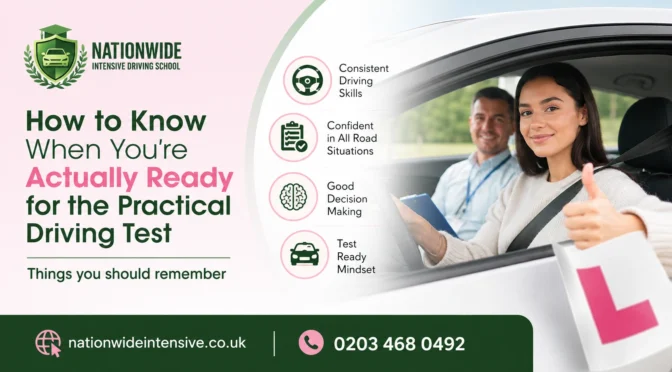
You’re usually ready for your practical driving test when you can drive safely and consistently without relying on prompts from your instructor, handle different road situations independently, complete mock tests to a good standard, and manage your nerves. As an experienced driving instructor, I don’t recommend booking a test simply because you’ve completed a certain number of lessons. Readiness is about your driving ability, not your lesson count.
One question I hear almost every week is:
“Do you think I’m ready for my driving test?”
Sometimes the learner is ready.
Sometimes they need a little more practice.
And occasionally, they’re somewhere in between.
The difficult part is that learners often judge themselves based on how they feel rather than how they actually drive.
You might feel nervous but drive very well.
Or you might feel confident while still making mistakes that could cause a test failure.
After teaching learners for years, I’ve found that the best way to judge readiness is to look at your consistency, independence and safety.
Here’s how to tell where you really stand.
Is There a Set Number of Lessons Before Your Test?
No.
There’s no magic number of driving lessons that automatically makes you ready for the practical driving test.
Some learners need fewer lessons, while others need considerably more.
Your progress can depend on:
- Previous driving experience
- Private practice
- Confidence
- Vehicle control
- Hazard awareness
- How regularly you practise
- How quickly you develop independent decision-making
That’s why booking a test simply because you’ve reached a certain number of hours isn’t a good strategy.
1. You Can Drive Without Constant Instructor Prompts
This is one of the clearest signs that you’re getting close.
Ask yourself:
Does my instructor still have to tell me what to do at every junction?
If the answer is yes, you probably need more practice.
You should increasingly be able to:
- Spot hazards yourself.
- Check mirrors without reminders.
- Choose appropriate speed.
- Position the car correctly.
- Read road signs.
- Select lanes independently.
- Make safe decisions at junctions.
Current DVSA “Ready to Pass?” guidance specifically recommends taking the test when you no longer need prompts from your instructor.
2. You Can Handle Different Road Situations
Being good at one familiar route doesn’t necessarily mean you’re test-ready.
Your driving should remain safe when you’re dealing with different environments, such as:
- Quiet residential roads
- Busy town centres
- Roundabouts
- Dual carriageways
- Traffic lights
- Complex junctions
- Different speed limits
- Unfamiliar roads
A practical driving test isn’t about memorising a particular route.
It’s about demonstrating that you can drive safely in situations you can’t completely predict.
3. Your Driving Is Consistent
This is something I pay close attention to when assessing learners.
Anyone can have one brilliant lesson.
The real question is:
Can you repeat that standard consistently?
For example, you might handle five roundabouts perfectly during one lesson and then struggle with three of them the following week.
That suggests the skill isn’t fully established yet.
Before your test, you want safe driving to feel like your normal driving, not something you occasionally manage when everything goes perfectly.
4. You Can Make Independent Decisions
During the practical test, you’ll have a section of independent driving. The current car test lasts around 35 minutes and includes independent driving, reversing and general driving ability.
You therefore need to be comfortable making your own decisions.
That includes:
- Following road signs.
- Following sat-nav instructions.
- Choosing appropriate lanes.
- Planning ahead.
- Responding to unexpected situations.
- Recovering safely if you make a wrong turn.
You don’t need to know every road.
You need to know how to deal with the road you’re on.
5. You Don’t Regularly Make Serious or Dangerous Mistakes
This is a major consideration.
The current pass standard allows up to 15 driving faults, but you must have no serious or dangerous faults.
However, don’t use the 15-fault limit as a target.
If you’re regularly making several driving faults during lessons, particularly in the same areas, you may still have work to do.
Current DVSA guidance highlights common test-failure areas including junction observations, mirror use, moving off safely, positioning, steering control, traffic lights and road signs.
The aim should be safe and consistent driving, not trying to stay below a numerical limit.
6. You Can Complete Mock Tests Successfully
This is one of the best ways to judge readiness.
Ask your instructor to conduct a realistic mock test.
That means:
- Minimal prompting.
- Independent driving.
- Test-style manoeuvres.
- Different road conditions.
- Normal test instructions.
- No unnecessary help.
If you can repeatedly complete mock tests to a good standard, that’s a strong indication that you’re getting close.
The DVSA’s current guidance specifically recommends being able to pass mock driving tests before taking the real test.
7. You Can Manage Your Nerves
You don’t need to feel completely calm before your test.
Almost everyone feels nervous.
The important question is:
Can you still drive safely when you’re nervous?
If your nerves cause you to forget observations, rush decisions or lose control of the vehicle, you may need more preparation.
Try practising under test-like conditions so the experience doesn’t feel completely unfamiliar on the day.
8. You Know How to Recover From Mistakes
Here’s something I regularly tell learners:
Making a mistake doesn’t automatically mean you’ve failed.
You might take the wrong turn or stall the car.
The important thing is what you do next.
Can you stay calm?
Can you correct the situation safely?
Can you continue without letting one mistake affect the rest of your drive?
Good drivers aren’t perfect drivers.
They’re drivers who can respond safely when something doesn’t go exactly as planned.
9. Your Instructor Agrees You’re Ready
Your instructor’s opinion matters.
They’ve watched your driving develop over many lessons and can compare your current performance with your previous ability.
If they say:
“You’re ready.”
that’s encouraging.
If they say:
“You’re close, but we need to work on your observations first.”
listen to them.
It’s much better to spend a few more lessons fixing a weakness than book a test simply because you’re impatient to finish.
The current DVSA guidance also recommends that your instructor agrees you’re ready before taking the test.
What If You’re Nearly Ready But Still Struggling?
This is where targeted training can help.
Instead of taking lessons without a clear goal, identify your weakest areas.
For example:
Week 1: Roundabouts and junction observations.
Week 2: Independent driving and lane discipline.
Week 3: Mock tests and manoeuvres.
This gives every lesson a purpose.
If you prefer concentrated training, an Intensive Driving Course South Wimbledon can provide focused practice over consecutive days and help you work on specific weaknesses without long gaps between sessions.
For some learners, this concentrated approach can also help maintain motivation.
What If You Don’t Feel Confident Enough Yet?
Don’t panic.
Confidence often comes after competence, not before it.
You might think:
“I’ll never feel ready.”
Then, after several successful mock tests, suddenly you realise you’re handling situations without thinking about them.
If you’re looking for structured Driving Lessons South Wimbledon, work with an instructor who gives you honest feedback rather than simply telling you what you want to hear.
A good instructor should be able to explain:
- What you’re doing well.
- What still needs work.
- Why it matters.
- What you should practise next.
- Whether you’re genuinely ready for the test.
How to Stay Motivated While Preparing for Your Test
The final stage can sometimes feel frustrating because you’re close but not quite there.
Try these habits:
Set Small Goals
Instead of “I need to pass”, aim for:
“Today I want to improve my roundabout observations.”
Track Your Progress
Write down improvements after each lesson.
Don’t Compare Yourself
Someone else’s lesson count has nothing to do with your readiness.
Treat Mock Tests as Practice
A mock test isn’t a judgement. It’s a way to identify what needs improving.
Don’t Rush
Taking a few extra lessons is far better than taking a test before you’re ready and losing confidence after a failed attempt.
Frequently Asked Questions
How do I know if I’m ready for my practical driving test?
You should be able to drive safely and consistently without regular instructor prompts, handle different road situations independently, manage your nerves and perform well in mock tests. Your instructor should also agree that you’re ready.
Should I book my test as soon as I feel confident?
Not necessarily. Confidence is useful, but consistent safe driving is more important. Your instructor should assess whether you’re genuinely test-ready.
How many driving lessons do I need before taking my test?
There is no fixed number. Different learners need different amounts of training depending on their experience, practice and individual progress.
Can I pass if I make a minor driving fault?
Yes. The current pass standard allows up to 15 driving faults, provided you have no serious or dangerous faults.
What happens if I’m not ready for my driving test?
You can move your test to a later date if you meet the appointment-change rules. DVSA recommends moving the test back if you aren’t fully prepared so you have more time to practise and build confidence.
Can an intensive driving course help me prepare for my test?
It can. An intensive course provides concentrated practice and can be particularly useful when you already have a reasonable level of driving ability but need focused work on specific weaknesses.
Final Thoughts
Knowing when you’re ready for your practical driving test isn’t about reaching a certain number of lessons or simply feeling confident.
From my experience as a driving instructor, you’re ready when safe driving has become consistent. You can make your own decisions, deal with different road situations, complete mock tests without regular prompts and remain reasonably calm when something unexpected happens.
If you’re looking for professional Driving Lessons South Wimbledon, choose an instructor at Nationwide Intensive LTD. who will give you an honest assessment rather than rushing you towards a test. And if you’re close to test standard but need concentrated preparation, an Intensive Driving Course South Wimbledon can help you focus on the areas that still need work.
You can also consider whether automatic driving lessons or manual driving lessons are the right fit for your long-term driving plans.
Most importantly, don’t measure your readiness by how quickly someone else passed. Your goal isn’t simply to get through the test. It’s to become a safe, confident driver who can handle real-world roads independently. When you’re consistently doing that, you’ll know you’re getting genuinely ready to pass.
