

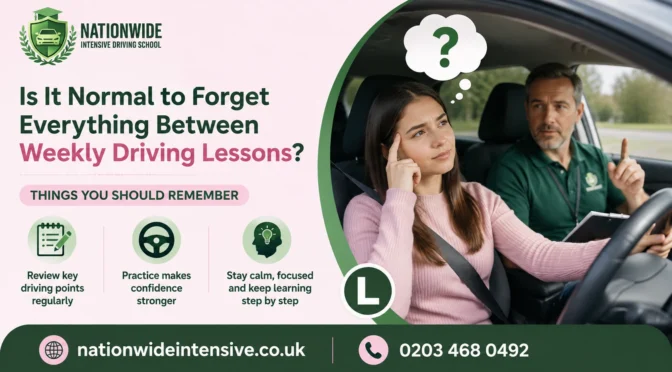
Yes, it’s completely normal to feel like you’ve forgotten everything between weekly driving lessons,especially if you’re only driving once a week and not practising in between. As a driving instructor, I’ve seen this happen with many learner drivers. The good news is that you’re probably forgetting less than you think. With regular practice, a few simple habits, and the right learning approach, you’ll retain your driving skills much more easily and build confidence faster.
One of the most common things I hear from learner drivers at the start of a lesson is:
“I feel like I’ve forgotten everything since last week.”
If you’ve ever said that yourself, don’t worry,you’re definitely not alone.
In fact, I’ve worked with plenty of learners who felt exactly the same. They’d spend the first ten minutes of every lesson trying to remember clutch control, mirror checks or how to approach a roundabout. Then, by the end of the lesson, they were driving confidently again.
That’s because learning to drive isn’t just about remembering information,it’s about building muscle memory and confidence through repetition.
So, if you feel like you’re starting from scratch every week, let’s look at why it happens and what you can do to stop it.
Why Do You Forget Driving Skills Between Lessons?
Learning to drive is different from studying for an exam.
You’re training your brain and body to work together at the same time.
During every lesson, you’re thinking about:
- Steering
- Clutch control
- Gear changes
- Mirror checks
- Road signs
- Hazard perception
- Speed control
- The Mirror-Signal-Manoeuvre (MSM) routine
That’s a huge amount of information to process.
If there’s a long gap before your next lesson, it’s perfectly natural to feel a little rusty when you get back behind the wheel.
The important thing to remember is that your skills haven’t disappeared, they simply need a few minutes to come back.
1. Weekly Lessons Can Slow Down Muscle Memory
In my experience, the biggest challenge with weekly driving lessons isn’t learning new skills, it’s maintaining them.
When learners only drive once every seven days, they often spend the beginning of each lesson refreshing what they learned previously.
That’s completely normal.
After 15–20 minutes, most learners settle back into their routine and begin driving confidently again.
This is why consistency matters more than perfection.
2. You’re Probably Remembering More Than You Think
Many learners judge themselves too harshly.
You might think you’ve forgotten everything because you stalled once or hesitated at a junction.
But then, a few minutes later, you’re:
- Changing gears smoothly.
- Completing roundabouts.
- Parking confidently.
- Reading traffic well.
- Making safe decisions.
That’s proof your learning is still there.
You’re simply warming up.
I often tell learners not to judge their progress by the first five minutes of a lesson.
Judge it by the last twenty.
3. Confidence and Memory Go Hand in Hand
Something I’ve noticed over the years is that learners often confuse nervousness with forgetting.
If you’re feeling anxious, your brain focuses on what might go wrong instead of what you already know.
That’s why simple tasks can suddenly feel difficult.
Once you relax, those same skills usually return naturally.
Confidence isn’t about never making mistakes, it’s about trusting yourself to deal with them calmly.
4. Practise Between Lessons If You Can
If you have access to a supervising driver, even one extra hour of practice each week can make a huge difference.
Focus on simple skills like:
- Moving off smoothly.
- Junction observations.
- Parking manoeuvres.
- Mirror checks.
- Speed awareness.
- Hill starts.
Regular practice helps strengthen muscle memory and reduces that “starting again” feeling.
During Driving Lessons Waddon, learners who combine professional instruction with supervised practice often build confidence much faster than those who only drive once a week.
5. Keep a Simple Driving Journal
This is one tip I recommend to many learners, and it’s surprisingly effective.
After each lesson, write down:
- Three things you did well.
- Two things to practise.
- One question to ask next time.
Reading those notes before your next lesson helps refresh your memory and keeps your progress clear in your mind.
It’s a simple habit that many learners overlook.
6. An Intensive Driving Course Can Help You Retain Skills
If you feel like you’re constantly relearning the same things, it may not be your ability that’s the problem, it could be the gap between lessons.
An Intensive Driving Course Waddon allows you to drive over consecutive days instead of once a week.
This consistent practice helps:
- Build muscle memory.
- Improve clutch control.
- Strengthen observation routines.
- Increase confidence.
- Prepare more effectively for the practical driving test.
Many learners tell me they finally feel like everything “clicks” because they aren’t forgetting skills between sessions.
7. Don’t Rush Your Progress
It’s easy to compare yourself with friends who seem to be progressing faster.
But every learner develops differently.
Some people need more repetition before new skills become automatic.
Others gain confidence quickly.
Neither approach is right or wrong.
The goal isn’t to learn the fastest.
The goal is to become a safe, confident driver for life.
Simple Ways to Remember More Between Lessons
If you want to make steady progress, try these practical tips:
- Book lessons consistently where possible.
- Practise with a supervising driver if you can.
- Review your lesson notes before each session.
- Watch educational driving videos to reinforce key techniques.
- Focus on one improvement at a time.
- Don’t panic if you feel rusty at the start of a lesson.
- Trust that repetition builds confidence.
Remember, every lesson builds on the last, even if it doesn’t always feel that way.
Frequently Asked Questions
Is it normal to forget things between weekly driving lessons?
Yes. Many learner drivers feel rusty after a week without driving. Once you spend a few minutes back behind the wheel, most of your skills return naturally.
Will practising between lessons help?
Absolutely. Even a small amount of supervised driving practice can improve confidence, strengthen muscle memory and help you retain what you’ve learned.
Would an intensive driving course help me learn faster?
For many learners, yes. Intensive courses reduce long gaps between lessons, allowing skills to develop through consistent daily practice.
Should I choose automatic or manual driving lessons?
If you’re finding clutch control stressful, automatic driving lessons may help simplify the learning process. If you want the flexibility of driving both manual and automatic cars, manual driving lessons remain an excellent choice.
How do I know if I’m ready for my practical driving test?
Your instructor should be able to assess whether you’re consistently driving safely, making good decisions and handling different road conditions confidently before recommending your practical driving test.
Final Thoughts
If you feel like you’ve forgotten everything between weekly driving lessons, don’t be too hard on yourself.
From my experience teaching learner drivers, this is one of the most common concerns I hear, and it’s rarely as serious as learners think. Most of the time, you’re simply shaking off the rust before your confidence returns. With regular practice, patience and the right guidance, those driving skills become second nature.
If you’re looking for supportive Driving Lessons Waddon, learning with experienced instructors at Nationwide Intensive LTD. who understand how people learn can help you make steady, long-term progress. And if you’d like to reduce the gap between lessons and build confidence more quickly, an Intensive Driving Course Waddon could be the ideal way to strengthen your skills and prepare for your practical driving test.
Whether you’re continuing with weekly lessons, exploring an intensive course, or deciding between automatic driving lessons and manual driving lessons, remember that learning to drive is a journey. Every lesson, every mile and every small improvement brings you one step closer to becoming a safe and confident driver.
