
Tag Archives: Driving

What Happens If You Need to Change Driving Instructors Midway?

Yes, you can change driving instructors midway through learning, and there’s nothing wrong with doing so. As a driving instructor, I’ve seen learners make better progress after changing instructors because the new instructor offered a teaching style, pace or approach that suited them better. You don’t lose everything you’ve learned. A good new instructor will assess your current ability, identify any gaps and continue from there.

Changing driving instructors can feel like you’re admitting you’ve failed.

It isn’t.

I’ve spoken to plenty of learners who stayed with an instructor for months because they felt awkward about leaving, even though they weren’t enjoying the lessons or making the progress they expected.

One thing I always tell learners is simple:

Your driving lessons should help you learn, not make you dread getting behind the wheel.

Sometimes the problem isn’t your ability. The teaching style simply isn’t the right fit.

If you’re thinking about changing instructors halfway through your training, here’s what you should know.

Why Do Learners Change Driving Instructors?

There are plenty of perfectly reasonable reasons to change instructors.

You might feel that:

  • Lessons aren’t structured properly.
  • You’re not getting useful feedback.
  • The instructor is too impatient.
  • You’re not progressing at the right pace.
  • You don’t feel comfortable asking questions.
  • Your instructor’s teaching style doesn’t suit you.
  • Your availability no longer matches their schedule.
  • You’re preparing for your practical driving test but don’t feel ready.

A learner should feel comfortable making mistakes and asking questions. That’s part of learning.

Will You Lose Everything You’ve Already Learned?

No.

This is one of the biggest worries learners have.

If you’ve already completed 20 or 30 driving lessons, changing instructors doesn’t take you back to lesson one.

A new instructor will usually assess your current driving ability and identify what you can already do confidently.

They may revisit some basics, but that’s not wasted time.

In fact, a fresh assessment can reveal small weaknesses that your previous instructor may not have focused on.

Your New Instructor May Teach Things Differently

Every instructor has their own teaching style.

One might give you detailed verbal instructions.

Another may encourage you to work things out independently.

One instructor might spend more time on technical car control, while another focuses heavily on road awareness and decision-making.

Neither approach is necessarily wrong.

The important question is:

Which approach helps you learn best?

During Driving Lessons Sanderstead, finding an instructor who matches your learning style can make a noticeable difference to your confidence and progress.

What Happens During Your First Lesson With a New Instructor?

Don’t be surprised if the first lesson feels slightly different.

Your new instructor will probably want to understand:

  • How many lessons you’ve completed.
  • What areas you’re comfortable with.
  • Which skills you struggle with.
  • Whether you’ve attempted the driving test.
  • How much private practice you’ve had.
  • What your goals are.

They may then take you on different roads or ask you to demonstrate certain skills.

This isn’t a test you need to worry about.

It’s simply an assessment to understand where you are.

Be Honest About Your Previous Lessons

There’s no need to criticise your previous instructor.

Instead, explain what you found difficult.

For example:

“I understand roundabouts, but I still hesitate when entering busy ones.”

Or:

“I’m comfortable with parking, but my observations aren’t always consistent.”

Specific information helps your new instructor build a useful lesson plan.

How Do You Know If You Really Should Change?

Before making the decision, ask yourself:

Am I actually progressing?

If the answer is yes, and you’re happy with your instructor, there may be no reason to change.

But if you’re repeatedly making the same mistakes, feel uncomfortable during lessons, or don’t feel your concerns are being addressed, changing instructors may be worth considering.

You don’t need to wait until you’ve failed your practical driving test.

Don’t Change Just Because Another Learner Passed Faster

This is important.

Your friend might have passed after 25 hours with one instructor.

You might need 45 hours with another.

That doesn’t automatically mean your instructor is doing a poor job.

Learners have different experience levels, confidence and learning speeds.

Judge your instructor based on your own progress, communication and learning experience.

What If You’re Close to Your Driving Test?

Changing instructors shortly before your practical driving test needs a little more thought.

If you’re already genuinely test-ready, switching instructors could temporarily disrupt your routine.

However, if you don’t feel ready or you’re repeatedly making the same mistakes, staying with an unsuitable instructor simply because your test is approaching may not help.

A new instructor can provide an independent assessment and tell you honestly whether you’re ready.

Could an Intensive Course Help After Changing Instructors?

Sometimes, yes.

If you’ve changed instructors and want to rebuild momentum, an Intensive Driving Course Sanderstead can provide a more concentrated learning schedule.

Instead of waiting a full week between lessons, you’ll have opportunities to practise the same skills over consecutive days.

This can be particularly useful if you need to:

  • Rebuild confidence.
  • Correct recurring mistakes.
  • Prepare for a retest.
  • Improve road awareness.
  • Refresh your driving after a long break.

The important thing is choosing the course based on your current ability rather than simply booking the largest package.

What Should You Look for in a New Driving Instructor?

When choosing your next instructor, look for someone who:

  • Explains mistakes clearly.
  • Gives constructive feedback.
  • Adjusts lessons to your ability.
  • Allows you to ask questions.
  • Helps you understand why something is wrong.
  • Tracks your progress.
  • Doesn’t make you feel uncomfortable when you make mistakes.

A good instructor shouldn’t simply tell you what to do. They should help you understand how to make safe decisions independently.

Frequently Asked Questions

Can I change driving instructors halfway through learning?

Yes. You can change instructors at any point during your learning journey. Your new instructor can assess your current ability and continue your training from there.

Will changing instructors delay my driving test?

It can take a little time to adjust to a new teaching style, but it doesn’t necessarily delay your test. If the new instructor identifies areas that need improvement, addressing them could actually improve your chances of passing.

Should I tell my current instructor I’m leaving?

You can, but you don’t need to provide a detailed explanation. A polite message letting them know you’ve decided to continue your lessons elsewhere is generally enough.

Is it worth changing instructors before a driving test?

It depends on your situation. If you’re genuinely test-ready and happy with your instructor, changing may not be necessary. If you’re not progressing or don’t feel prepared, a fresh assessment could be valuable.

Can I switch from manual to automatic lessons?

Yes, you can change your learning approach if you decide an automatic car suits you better. Automatic driving lessons remove clutch and manual gear changes, while manual driving lessons can provide greater flexibility after passing your test.

Final Thoughts

Changing driving instructors isn’t something you should feel guilty about.

After working with learner drivers, I’ve seen how much difference the right instructor can make. Sometimes a learner doesn’t need more hours—they need a different explanation, a different pace or simply an instructor they feel comfortable learning with.

If you’re looking for professional Driving Lessons Sanderstead, take the time to find an instructor at Nationwide Intensive LTD. who understands your current ability and learning style. And if you’ve already completed lessons but want a more focused approach to your training, an Intensive Driving Course Sanderstead could help you build consistency and prepare for your practical driving test.

Whether you continue with your current instructor, switch to someone new, choose an intensive course, or decide between automatic driving lessons and manual driving lessons, the goal remains the same: becoming a safe, confident driver who can make good decisions independently.
Getting Anxiety While Driving? Simple Techniques That Can Help

If you’re feeling anxious about learning to drive, you’re far from alone. As a driving instructor who’s worked with nervous learners for years, I can confidently say that anxiety is one of the most common challenges new drivers face. The good news is that it doesn’t have to stop you from passing your practical driving test. With the right instructor, consistent practice, and a few simple techniques, you can gradually replace fear with confidence and enjoy driving.

If there’s one thing I’ve learned from teaching learner drivers over the years, it’s this:

The people who worry the most about making mistakes often become some of the safest drivers.

I’ve had learners who were so nervous before their first lesson that they couldn’t sleep the night before. Others apologised every time they stalled the car or hesitated at a roundabout.

A few months later, those same learners were confidently driving through busy roads, completing independent driving routes, and passing their practical driving test.

That’s why I always remind nervous learners that feeling anxious doesn’t mean you’re a bad driver, it simply means you’re learning something new.

Let’s look at why driving anxiety happens and the simple techniques that can help you overcome it.

Why Does Learning to Drive Feel So Overwhelming?

Learning to drive isn’t just about steering a car.

At the same time, you’re expected to:

  • Watch other road users.
  • Read road signs.
  • Judge speed and distance.
  • Follow the Mirror-Signal-Manoeuvre (MSM) routine.
  • Make safe decisions at junctions.
  • Control the clutch and gears (if learning in a manual car).
  • Stay calm under pressure.

It’s completely normal for your brain to feel overloaded during the early lessons.

The important thing to remember is that confidence grows with experience, not overnight.

1. Accept That Anxiety Is Part of the Learning Process

One of the biggest misconceptions I hear is:

“I shouldn’t still be nervous after ten lessons.”

In reality, every learner develops at a different pace.

Some people feel confident after a few lessons.

Others take longer to trust themselves behind the wheel.

Neither is right or wrong.

As an instructor, I’ve found that learners improve much faster once they stop expecting perfection and start focusing on steady progress instead.

2. Be Honest With Your Driving Instructor

You don’t need to hide your nerves.

In fact, telling your instructor how you’re feeling allows them to adapt the lesson to suit your confidence.

For example, they might begin with:

  • Quiet residential roads.
  • Simple junctions.
  • Lower-speed areas.
  • Easier parking exercises.

As your confidence improves, they’ll gradually introduce more challenging situations.

During Driving Lessons Selhurst, learning with an instructor who understands nervous drivers can make a huge difference to how quickly your confidence grows.

3. Focus on One Driving Skill at a Time

Many anxious learners try to think about everything at once.

Instead, simplify the lesson.

Concentrate on improving one specific skill, such as:

  • Clutch control.
  • Mirror checks.
  • Roundabouts.
  • Bay parking.
  • Parallel parking.
  • Road positioning.

Breaking driving into smaller, manageable steps makes learning feel much less overwhelming.

Those small wins soon turn into bigger improvements.

4. Stop Comparing Yourself to Other Learners

This is something I talk about in almost every lesson.

One learner might pass after 30 hours.

Another might need 50.

Both receive exactly the same UK driving licence.

You never know someone else’s experience, confidence level or amount of private practice.

The only comparison that matters is whether you’re driving better today than you were last week.

That’s real progress.

5. Replace Negative Thoughts With Realistic Ones

Your mindset has a huge impact on your driving.

Instead of thinking:

“I’m definitely going to stall.”

Try saying:

“If I stall, I’ll restart the car safely because I know what to do.”

Notice the difference?

You’re not pretending mistakes won’t happen, you’re reminding yourself that you know how to deal with them.

That’s exactly how confident drivers think.

6. Build Confidence Through Consistent Practice

Confidence doesn’t suddenly appear one morning.

It’s built every time you successfully:

  • Move off smoothly.
  • Complete a roundabout.
  • Park correctly.
  • Drive through busy traffic.
  • Handle a new road safely.

Eventually, these actions become automatic.

Instead of thinking about every movement, you’ll naturally focus on reading the road ahead and anticipating hazards.

That’s when driving starts to feel enjoyable rather than stressful.

7. Would an Intensive Driving Course Help?

Some learners lose confidence because they leave too much time between lessons.

By the next session, they’re trying to remember what they learned the previous week.

An Intensive Driving Course Selhurst helps many learners overcome this by providing consistent daily practice.

Driving over consecutive days allows you to reinforce new skills immediately, helping build confidence and muscle memory much faster.

For learners preparing for their practical driving test, this can be an excellent way to stay focused and make steady progress.

8. Choose the Right Type of Driving Lessons

Another factor that can affect confidence is the type of car you’re learning in.

If clutch control and gear changes are increasing your anxiety, it’s worth discussing automatic driving lessons with your instructor.

Automatic cars remove the need to manage gears, allowing many learners to focus more on observations, hazard perception and road awareness.

If you prefer the flexibility that comes with a manual licence, manual driving lessons remain a great choice, it simply comes down to your personal goals and confidence.

Simple Techniques to Stay Calm Before Every Lesson

If you often feel nervous before driving, try these practical tips:

  • Arrive early so you’re not rushing.
  • Take slow, deep breaths before starting the engine.
  • Focus on today’s lesson instead of worrying about the driving test.
  • Accept that making mistakes is part of learning.
  • Celebrate one improvement after every lesson.
  • Trust your instructor’s guidance.
  • Remember that every experienced driver was once a beginner.

Progress happens one lesson at a time.

Frequently Asked Questions

Is it normal to feel anxious during driving lessons?

Yes. Driving anxiety is extremely common, especially during the early stages of learning. Most learners become more confident with regular practice and experience.

Can anxiety affect my practical driving test?

Yes. Nervousness can sometimes affect concentration and decision-making. However, mock driving tests, consistent lessons and good preparation usually help reduce test-day anxiety.

Should I tell my driving instructor that I’m nervous?

Absolutely. A professional instructor can adjust your lessons, introduce challenges gradually and help you build confidence at a pace that suits you.

Can an intensive driving course help nervous learners?

Yes. Many learners find that daily driving during an intensive course helps them build confidence more quickly because they practise consistently instead of waiting a week between lessons.

Should I choose automatic or manual lessons if I’m anxious?

If clutch control and gear changes are causing most of your stress, automatic lessons may be a good option. If you’re comfortable learning in a manual car and want greater flexibility after passing, manual lessons are still an excellent choice.

Final Thoughts

Learning to drive with anxiety can feel challenging, but it doesn’t have to hold you back.

After teaching nervous learners for many years, I’ve seen first-hand that confidence isn’t something people either have or don’t have, it’s something they build through patience, practice and the right support. Every lesson is another opportunity to improve your skills, trust your judgement and become a safer driver.

If you’re looking for supportive Driving Lessons Selhurst, working with experienced instructors at Nationwide Intensive LTD. who understand nervous learners can make your learning experience far more enjoyable. And if you’d like to gain confidence through regular, focused practice, an Intensive Driving Course Selhurst could help you build momentum and prepare for your practical driving test sooner.

Whether you’re considering regular lessons, an intensive course, or deciding between automatic driving lessons and manual driving lessons, remember that every confident driver on UK roads started exactly where you are today. Keep practising, trust the process, and you’ll be amazed at how far your confidence can grow.

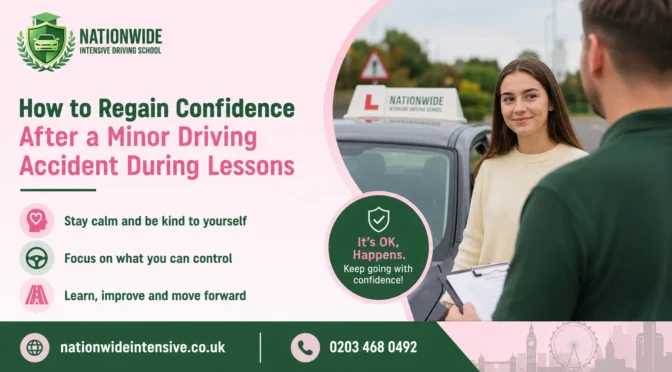
How to Regain Confidence After a Minor Driving Accident During Lessons

If you’ve had a minor accident during a driving lesson, it’s completely normal to feel nervous about getting back behind the wheel. In my experience as a driving instructor, most learner drivers lose confidence after even a small bump or near miss. The important thing to remember is that one mistake doesn’t define your ability. With the right guidance, regular practice, and a step-by-step approach, you can rebuild your confidence and continue progressing towards your practical driving test.

A few years ago, one of my learners clipped a kerb while trying to avoid a parked van on a narrow road.

The damage was minor, nobody was hurt, and we dealt with the situation safely. But what stayed with that learner wasn’t the kerb,it was the fear.

At the start of the next lesson, they admitted,

“I don’t know if I trust myself to drive anymore.”

A few months later, that same learner passed their practical driving test on the first attempt after the accident.

Why?

Because we didn’t ignore what had happened,we learned from it.

If you’ve experienced a minor accident during your driving lessons Pollards Hill, you’re not alone. More importantly, it doesn’t mean you’re not capable of becoming a safe and confident driver.

Let’s look at how you can rebuild your confidence.

First, Remember That Mistakes Are Part of Learning

Every experienced driver has made mistakes.

Some have stalled in traffic.

Some have misjudged a junction.

Others have clipped a curb or bumped another vehicle while parking.

The difference is that experienced drivers learn from those moments instead of letting them define their confidence.

As a learner driver, you’re still developing skills like:

  • Hazard perception
  • Road positioning
  • Speed judgement
  • Observation routines
  • Decision-making

It’s unrealistic to expect perfection while you’re still learning.

Understand What Actually Happened

One of the biggest mistakes learners make after a minor accident is blaming themselves without understanding the real cause.

Instead, ask your instructor questions like:

  • What caused the incident?
  • Could I have recognised the hazard earlier?
  • What should I do differently next time?
  • Was it caused by nerves, observations or judgement?

A good instructor won’t criticise you.

They’ll help you turn the experience into a valuable learning opportunity.

That’s how confident drivers are built.

Don’t Avoid Driving Afterwards

It’s natural to feel nervous.

However, taking a long break often makes those fears feel even bigger.

In my experience, learners who return to driving within a reasonable time usually rebuild confidence much faster than those who avoid getting behind the wheel for weeks.

Your first lesson back doesn’t have to involve busy roundabouts or heavy traffic.

Start with quieter roads and gradually increase the difficulty as your confidence grows.

Small successes create lasting confidence.

Focus on One Skill at a Time

After an accident, many learners try to overthink everything.

Instead, simplify your approach.

Concentrate on improving one area at a time.

For example:

  • Better mirror checks
  • Earlier observations
  • Smoother steering
  • Safer road positioning
  • More controlled speed

When you improve individual skills, your overall confidence naturally improves too.

Trust Your Instructor

One thing I always remind my learners is this:

If I wasn’t confident in your ability to continue learning, I wouldn’t ask you to drive.

Driving instructors are trained to manage risk and recognise when learners are ready for new challenges.

If your instructor encourages you to continue, it’s because they believe you’re capable.

That reassurance often helps learners regain confidence much sooner than they expected.

Practise Different Driving Situations

Sometimes confidence disappears because learners associate one type of road or manoeuvre with the accident.

The solution isn’t avoiding those situations.

It’s practising them safely.

Gradually work through:

  • Residential roads
  • Roundabouts
  • Junctions
  • Bay parking
  • Parallel parking
  • Dual carriageways
  • Independent driving

Each successful experience helps replace fear with confidence.

Consider an Intensive Driving Course

If you’ve lost confidence after a long break, an Intensive Driving Course Pollards Hill can help you regain momentum.

One advantage of intensive training is consistency.

Instead of waiting a week between lessons, you’re reinforcing new habits every day.

Many learners tell me this helps them stop dwelling on previous mistakes because they’re focused on making progress.

Whether you’re preparing for your practical driving test or simply rebuilding confidence, intensive learning can be an effective option.

Don’t Compare Yourself to Other Learners

After an accident, it’s easy to think everyone else is progressing faster.

The reality is very different.

Some learners recover their confidence within one lesson.

Others need a little longer.

Both outcomes are completely normal.

Learning to drive isn’t a race.

The goal isn’t to be the fastest learner, it’s to become a safe one.

How to Rebuild Your Confidence Faster

If you’re feeling nervous after a minor accident, try these practical steps:

  • Talk honestly with your instructor about your concerns.
  • Return to driving as soon as you’re comfortable.
  • Focus on one driving skill at a time.
  • Practise in quieter areas before tackling busy roads.
  • Learn from the incident instead of dwelling on it.
  • Celebrate small improvements after every lesson.
  • Remember that mistakes are part of becoming an experienced driver.

Confidence isn’t something you suddenly find, it grows every time you successfully handle another driving situation.

Frequently Asked Questions

Is it normal to lose confidence after a minor driving accident?

Yes. Many learner drivers feel anxious after even a small accident or near miss. With regular practice and support from a qualified instructor, confidence usually returns over time.

Should I stop taking driving lessons after an accident?

In most cases, no. Taking a long break can make anxiety worse. Returning to lessons gradually often helps rebuild confidence more quickly.

Can I still pass my driving test after an accident during lessons?

Absolutely. A minor accident while learning doesn’t affect your ability to pass your practical driving test. Many successful drivers have experienced setbacks during training.

Would an intensive driving course help rebuild confidence?

Yes. An intensive course allows you to practise consistently over consecutive days, helping replace uncertainty with confidence through regular repetition.

Should I choose automatic or manual driving lessons after losing confidence?

It depends on your circumstances. If clutch control or gear changes are increasing your anxiety, discussing automatic driving lessons with your instructor may be worthwhile. If you’re comfortable with manual driving, continuing your manual driving lessons can help rebuild confidence naturally.

Final Thoughts

A minor accident during your driving lessons can shake your confidence, but it doesn’t define your future as a driver.

In my experience, the learners who become the safest drivers aren’t the ones who never make mistakes,they’re the ones who learn from them, stay positive and keep moving forward. Every lesson after a setback is another opportunity to improve your judgement, strengthen your road awareness and become a more confident driver.

If you’re looking for supportive Driving Lessons Pollards Hill, learning with experienced instructors who understand how to rebuild confidence can make all the difference. And if you’re ready to get back behind the wheel with focused daily practice, an Intensive Driving Course Pollards Hill can help you regain momentum and prepare for your practical driving test with confidence.

Whether you’re continuing with regular lessons, considering an intensive course, or deciding between automatic driving lessons and manual driving lessons, remember that every experienced driver has faced challenges along the way. What matters isn’t the mistake itself,it’s the confidence you build by getting back on the road.

Learning to Drive with Anxiety? Simple Techniques That Can Help

Feeling anxious during driving lessons is far more common than you might think. In my experience as a driving instructor, many learner drivers worry about making mistakes, stalling the car, or failing their practical driving test. The good news is that driving anxiety can be managed. With the right instructor, consistent practice, and a few simple techniques, most learners gradually replace fear with confidence and become safe, capable drivers.

If you’ve ever felt nervous before a driving lesson, you’re definitely not alone.

I’ve taught learners who were so anxious before their first lesson that they considered cancelling altogether. Some worried about holding up traffic, while others were convinced they’d never be able to drive on busy roads.

A few months later, those same learners were confidently navigating roundabouts, parking independently, and passing their practical driving test.

That’s why I always tell nervous learners one thing:

Being anxious doesn’t mean you can’t become a good driver.

It simply means you’re stepping outside your comfort zone, and that’s exactly where learning happens.

Let’s look at why driving anxiety happens and what you can do to manage it.

Why Do So Many Learners Feel Anxious?

Learning to drive is one of the biggest new skills most people take on.

You’re expected to:

  • Control the vehicle.
  • Watch other road users.
  • Read road signs.
  • Make safe decisions.
  • Use observation routines.
  • Follow the Mirror-Signal-Manoeuvre (MSM) routine.
  • Stay calm under pressure.

That’s a lot for anyone, especially during the early stages of learning.

Feeling nervous doesn’t mean you’re doing something wrong,it means your brain is processing a lot of new information at once.

1. Accept That Anxiety Is Normal

One mistake many learners make is believing they should feel confident straight away.

The reality is very different.

Over the years, I’ve worked with hundreds of learner drivers, and many of the people who were most anxious at the beginning eventually became some of the safest drivers.

Confidence doesn’t come before experience.

It comes because of experience.

Every successful lesson gives your brain more evidence that you can handle the next one.

2. Tell Your Instructor How You’re Feeling

This is one of the simplest but most effective things you can do.

If your instructor knows you’re feeling anxious, they can adapt the lesson to suit your confidence level.

That might mean starting with:

  • Quiet residential roads.
  • Simpler junctions.
  • Lower speed limits.
  • Shorter driving sessions.

As your confidence grows, your instructor can gradually introduce more challenging situations.

During Driving Lessons Broad Green, a patient instructor should help you progress at a pace that feels challenging but not overwhelming.

3. Focus on One Skill at a Time

When learners feel anxious, they often try to think about everything at once.

Instead, narrow your focus.

For example, spend one lesson concentrating on:

  • Smooth clutch control.
  • Mirror checks.
  • Roundabouts.
  • Parking manoeuvres.
  • Lane positioning.

Breaking driving into smaller skills makes it feel much more manageable.

Small improvements soon add up to big progress.

4. Stop Comparing Yourself to Other Learners

One learner passes after 25 hours.

Another needs 50.

Both receive the same full UK driving licence.

I’ve seen learners become discouraged because their friend passed first time.

What they don’t see is the amount of private practice, confidence, or previous experience that person may have had.

Your driving journey is unique.

Measure your progress against where you were last month, not against someone else.

5. Practise Positive Self-Talk

This may sound simple, but it makes a real difference.

Instead of saying:

“I’m going to stall again.”

Try saying:

“I’ve practised this before, and I know what to do.”

Your mindset affects your confidence more than many people realise.

I’ve watched learners completely change their driving simply by replacing negative assumptions with realistic expectations.

6. Build Confidence Through Repetition

Driving confidence isn’t built overnight.

It’s built through repeated success.

The more often you:

  • Move off smoothly.
  • Complete roundabouts.
  • Park successfully.
  • Handle busy roads.
  • Drive independently.

…the more automatic those skills become.

Eventually, you’ll stop thinking about every individual action and start focusing on the road ahead.

That’s when driving begins to feel much easier.

7. Consider an Intensive Driving Course

Some learners find that weekly lessons leave too much time between sessions.

By the next lesson, they’ve forgotten some of what they learned previously.

An Intensive Driving Course Broad Green allows you to practise on consecutive days, helping you build confidence much more quickly through consistent repetition.

Many nervous learners tell me they feel more relaxed because they’re staying in a regular learning routine instead of starting from scratch each week.

8. Choose the Learning Style That Suits You

If you’re finding manual driving stressful because of clutch control and gear changes, it’s worth discussing your options with your instructor.

For some learners, automatic driving lessons reduce anxiety because they remove one part of the driving process, allowing them to focus more on road awareness and hazard perception.

Others prefer manual driving lessons because they enjoy the extra control and flexibility after passing.

The best choice is the one that helps you become a safe and confident driver.

Simple Techniques to Stay Calm Before a Lesson

If you feel anxious before driving, try these practical tips:

  • Arrive a few minutes early instead of rushing.
  • Take slow, steady breaths before getting into the car.
  • Focus on today’s lesson rather than your driving test.
  • Accept that making mistakes is part of learning.
  • Celebrate one improvement after every lesson, no matter how small.
  • Trust your instructor’s guidance.
  • Remember that confidence grows with practice, not perfection.

Even experienced drivers continue learning throughout their lives.

Frequently Asked Questions

Is it normal to feel anxious during driving lessons?

Yes. Driving anxiety is very common, especially for beginner drivers. Most learners become more confident as they gain experience and spend more time behind the wheel.

Can anxiety affect my driving test?

Yes, but good preparation, mock driving tests and regular practice can help reduce nerves and improve your confidence on the day of your practical driving test.

Should I tell my driving instructor I’m nervous?

Absolutely. A professional instructor can adapt your lessons, build confidence gradually and help you learn at a pace that’s comfortable for you.

Would an intensive driving course help with anxiety?

For many learners, yes. Intensive courses provide regular practice over consecutive days, helping build confidence and reduce uncertainty through repetition.

Should I learn in an automatic or manual car?

If gears and clutch control are increasing your anxiety, automatic lessons may feel easier. If you’re comfortable with manual driving and want greater flexibility after passing, manual lessons may still be the best option.

Final Thoughts

Learning to drive with anxiety can feel challenging, but it doesn’t have to stop you from becoming a confident driver.

In my experience, many of the learners who started out feeling the most nervous eventually became calm, capable drivers because they stayed patient, trusted the process and kept practising. Confidence isn’t something you’re born with, it’s something you build one lesson at a time.

If you’re looking for supportive Driving Lessons Broad Green,  choosing experienced instructors from Nationwide Intensive LTD., who understand nervous learners can make a huge difference to your progress. And if you’d like to build confidence through regular, focused practice, an Intensive Driving Course Broad Green could help you gain momentum and prepare for your practical driving test more quickly.

Whether you’re considering regular lessons, an intensive course, or deciding between automatic driving lessons and manual driving lessons, remember that every confident driver on UK roads was once a nervous beginner. Keep showing up, keep learning, and trust that your confidence will grow with every mile you drive.

Failed Your Driving Test More Than Once? Here’s How to Break the Cycle

Failing your driving test more than once doesn’t mean you’re a bad driver. In my experience as a driving instructor, most learners who fail repeatedly aren’t lacking driving skills,they’re repeating the same mistakes, struggling with nerves, or going into the test before they’re truly ready. The good news is that once you identify the reason behind your previous test failures, you can make targeted improvements and significantly increase your chances of passing next time.

Learning to drive is a journey, and for some people, that journey includes more than one practical driving test.

Over the years, I’ve worked with many learner drivers who walked back to the car feeling disappointed after another failed test. Some had failed twice, others three or four times. Almost every one of them asked the same question:

“Maybe I’m just not good enough to drive?”

The answer was almost always no.

In reality, most learners don’t fail because they can’t drive. They fail because they’re making the same small mistakes under test pressure. Once we identified those patterns and worked on them, many of those same learners passed with confidence.

If you’ve failed your driving test more than once, here’s how you can finally break the cycle.

Why Do People Keep Failing Their Driving Test?

A failed driving test is rarely caused by one major mistake.

More often, it’s a combination of small issues such as:

  • Test-day nerves
  • Poor observations
  • Rushing decisions
  • Lack of confidence
  • Weak planning skills
  • Not enough experience in different traffic conditions

The important thing to remember is that these are all skills that can be improved.

Failing a test doesn’t define your ability,it simply highlights the areas that need a little more work.

1. Read Your Driving Test Report Carefully

One mistake I often see is learners booking another test without reviewing their previous result.

After every practical driving test, the examiner explains why you didn’t pass.

Pay attention to recurring faults.

For example, if you’ve received faults for:

  • Mirror checks
  • Junction observations
  • Roundabouts
  • Speed awareness
  • Positioning

across multiple tests, those should become the main focus of your next lessons.

Don’t practise everything equally, practise what actually caused you to fail.

2. Stop Chasing the Pass Certificate

It’s understandable to want your full UK driving licence as soon as possible.

But when learners become obsessed with passing, they often put themselves under unnecessary pressure.

Instead, focus on becoming a calm, safe and confident driver.

The pass certificate usually follows naturally.

As instructors, we often say:

“Drive as if there isn’t an examiner in the car.”

That mindset alone can reduce unnecessary nerves.

3. Test Nerves Can Undo Good Driving

One of the biggest differences between a driving lesson and the practical test is pressure.

I’ve taught learners who drove confidently every week but suddenly forgot simple routines like Mirror-Signal-Manoeuvre (MSM) during the test.

If this sounds familiar, you’re not alone.

Building confidence comes from:

  • Regular practice
  • Mock driving tests
  • Driving unfamiliar routes
  • Learning breathing techniques before the test

The more familiar the experience feels, the less intimidating test day becomes.

4. You’re Booking the Next Test Too Soon

After failing, it’s tempting to book the next available test immediately.

Sometimes that’s the right decision.

Sometimes it isn’t.

If you haven’t corrected the faults that caused the previous failure, another test may simply produce the same outcome.

Take time to improve before sitting another practical test.

Quality preparation is far more valuable than rushing back into the examiner’s car.

5. Get Honest Feedback From Your Instructor

One of the most valuable conversations you can have is asking:

“If you were the examiner today, would you pass me?”

A good instructor will give you an honest answer.

Sometimes learners are surprised to hear they’re not quite test-ready yet.

Although it may feel disappointing, it’s much better than paying for another unsuccessful driving test.

If you’re taking Driving Lessons Hackbridge, your instructor should help you build a lesson plan around the exact skills that need improvement rather than repeating things you’ve already mastered.

6. Practise Different Roads and Traffic Conditions

Confidence grows through experience.

If you’ve only driven on familiar roads, the practical test can feel overwhelming when you’re faced with unfamiliar situations.

Try practising:

  • Busy roundabouts
  • Dual carriageways
  • Residential streets
  • Multi-lane junctions
  • Different speed limits
  • Independent driving routes using sat nav

The more situations you’ve experienced before your test, the fewer surprises you’ll face on the day.

7. Consider an Intensive Driving Course

Some learners lose momentum between weekly lessons.

If you’ve failed more than once, an Intensive Driving Course Hackbridge could help you rebuild confidence more quickly.

Learning over consecutive days allows you to reinforce new habits immediately instead of waiting another week before practising again.

Many learners also find intensive courses particularly helpful before a retest because everything stays fresh in their mind.

8. Stop Comparing Yourself to Other Learners

  • One learner passes for the first time.
  • Another passes on the fourth attempt.
  • Both receive exactly the same full UK driving licence.
  • Your journey is your own.

The DVSA practical test measures whether you’re a safe driver,not how quickly you learned.

Some of the safest drivers I’ve taught were the ones who took a little longer to pass because they developed strong habits along the way.

How to Improve Your Chances of Passing Next Time

If you’re preparing for another practical driving test, here’s what I recommend:

  • Review your previous test report carefully.
  • Focus on repeated faults first.
  • Take mock driving tests with your instructor.
  • Practise on unfamiliar roads.
  • Improve your observation routines.
  • Don’t book another test until both you and your instructor feel you’re genuinely ready.
  • Stay consistent with your lessons and private practice.

Remember, confidence is built through preparation, not luck.

Frequently Asked Questions

Is it common to fail a driving test more than once?

Yes. Many UK learner drivers need more than one attempt to pass their practical driving test. Failing doesn’t mean you won’t become a safe and confident driver.

Should I change my driving instructor after failing?

Not always. If your instructor provides constructive feedback and adapts lessons to your weaknesses, staying with them may be the best option. If you don’t feel you’re progressing, it’s worth discussing your concerns before considering a change.

How long should I wait before booking another driving test?

There’s no fixed answer. It’s usually better to book your next test once you’ve addressed the faults from your previous attempt rather than rushing into another test.

Can an intensive driving course help after failing?

Yes. Many learners find that an intensive course helps them rebuild confidence, improve consistency and prepare more effectively for a retest through focused daily practice.

Should I choose automatic or manual driving lessons?

It depends on your goals and confidence. If you’re unsure which option suits you, comparing automatic driving lessons and manual driving lessons can help you choose the learning style that matches your needs.

Final Thoughts

Failing your driving test more than once can feel discouraging, but it doesn’t mean you’re not capable of passing.

In my experience, learners who take the time to understand why they failed often come back stronger, more confident and better prepared than before. Every test provides valuable feedback, and every lesson is another opportunity to improve.

If you’re looking for professional Driving Lessons Hackbridge, contact Nationwide Intensive LTD. as we are working with experienced instructors who tailor lessons to your individual weaknesses can make a real difference. And if you want to rebuild confidence quickly before your next test, an Intensive Driving Course Hackbridge could help you develop the consistency and road awareness needed to pass.

Whether you’re exploring regular lessons, an intensive course, or deciding between automatic driving lessons and manual driving lessons, remember that success isn’t about passing for the first time,it’s about becoming a safe, confident driver for life.